What is ISO Certification? Benefits, Process & Why It Matters for Business
In today’s competitive and compliance-driven business environment, organizations must demonstrate quality, reliability, safety, and operational excellence to gain customer trust and access global markets. Businesses are increasingly expected to follow internationally recognized standards to ensure consistent performance and continuous improvement.
This is where ISO certification becomes essential.
ISO certification verifies that a company’s processes, management systems, and operations meet internationally accepted standards developed by the International Organization for Standardization (ISO). Achieving certification signals credibility, efficiency, and commitment to quality helping businesses build trust and compete globally.
This guide explains what ISO certification is, why it matters, its benefits, the certification process, and how it can strengthen your business performance.
What is ISO Certification?
ISO stands for the International Organization for Standardization an independent international body headquartered in Geneva that develops and publishes global standards across industries. ISO standards are created by experts from different countries to ensure consistency, reliability, and best practice alignment worldwide.
ISO certification is formal recognition that an organization’s management systems, processes, or services meet the requirements of a specific ISO standard. Certification is awarded after an independent audit by an accredited certification body.
In simple terms:
ISO certification proves that your business operates according to internationally trusted standards.
It is not a one-time achievement but an ongoing commitment to continual improvement, compliance, and performance excellence.
What ISO Certification Demonstrates
Achieving certification shows that an organization:
- follows internationally recognized best practices
- maintains consistent quality and operational control
- complies with regulatory and industry requirements
- prioritizes customer satisfaction and continuous improvement
- manages risks effectively
This recognition enhances trust among customers, partners, regulators, and stakeholders.
Why ISO Certification Matters for Businesses Today?
Modern markets demand transparency, accountability, and consistency. Customers, regulators, investors, and supply chain partners increasingly require proof that businesses operate responsibly and reliably.
In many sectors, ISO certification is:
- A contractual requirement to bid for projects
- A regulatory expectation for compliance
- A key factor in supplier approval
- A strong differentiator in competitive markets
ISO certification is more than a certificate — it is a strategic business tool that strengthens performance, credibility, and market competitiveness.
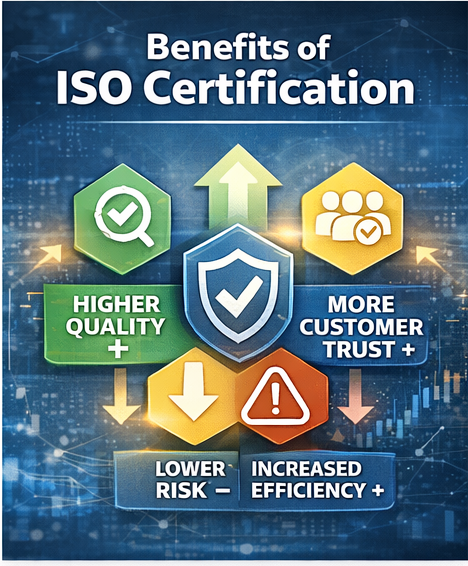
✔ Builds Customer Trust & Credibility
Certification assures clients that your organization follows globally recognized standards, increasing confidence in your products and services.
✔ Improves Operational Efficiency
ISO standards streamline processes, reduce waste, and improve productivity through structured management systems.
✔ Enhances Market Access & Global Trade
Many government contracts, multinational projects, and export markets require ISO certification as a prerequisite.
✔ Strengthens Regulatory Compliance
ISO frameworks help businesses align with legal, safety, and environmental requirements.
✔ Supports Continuous Improvement
Organizations implement ongoing monitoring and improvement processes to maintain certification and enhance performance.
The Business Value of ISO Certification
- ISO certification is not just about documentation. When implemented correctly, it transforms how an organization operates.
1. Improved Process Efficiency
ISO standards require organizations to define, monitor, and improve their processes. This reduces inefficiencies, rework, and operational errors. As a result, businesses save time, reduce costs, and deliver consistent results.
2. Stronger Customer Confidence
Clients prefer ISO-certified suppliers because certification reduces uncertainty. It signals professionalism, accountability, and commitment to quality. This builds long-term customer loyalty.
3. Risk Reduction
ISO management systems identify potential risks before they become serious problems. Whether it is safety hazards, environmental risks, or data security threats, ISO frameworks help mitigate them effectively.
4. Compliance Assurance
ISO standards align closely with regulatory requirements. Certification ensures your organization stays compliant with local and international laws, avoiding penalties and reputational damage.
5. Global Market Recognition
ISO certificates are recognized worldwide. This allows businesses to expand internationally without needing separate quality frameworks for each country.
6. Stronger Brand Reputation
ISO-certified companies are perceived as trustworthy, professional, and reliable — essential attributes for winning high-value contracts.
Key Benefits of ISO Certification
Here’s a quick summary of what ISO certification delivers:
✔ Consistent product and service quality
✔ Increased customer satisfaction
✔ Improved internal communication
✔ Better documentation and traceability
✔ Enhanced workplace safety
✔ Environmental responsibility
✔ Stronger supply chain credibility
✔ Continuous improvement culture
These benefits translate directly into better profitability and long-term sustainability.
Common Types of ISO Standards for Businesses
Different industries require different standards. Some of the most widely adopted ISO certifications include:
ISO 9001 – Quality Management System
- The world’s most widely adopted quality management standard. ISO 9001 helps organizations improve product and service quality, enhance customer satisfaction, and implement continual improvement practices.
- Ideal for:Manufacturing, services, construction, engineering, logistics, government contractors.
ISO 14001 – Environmental Management System
- ISO 14001 enables organizations to manage environmental responsibilities effectively, reduce waste, control emissions, and comply with environmental regulations.
- Ideal for:Manufacturing plants, oil & gas, construction, energy, chemical and industrial sectors.
ISO 45001 – Occupational Health & Safety Management
- This standard focuses on protecting employees, reducing workplace hazards, preventing accidents, and improving occupational health and safety performance.
- Ideal for:Construction, engineering, industrial facilities, oil & gas, logistics operations.
ISO 37001 – Anti-Bribery Management System
- ISO 37001 helps organizations establish controls to prevent bribery, promote ethical business practices, and ensure compliance with anti-corruption laws.
- Ideal for:Corporate organizations, government contractors, financial institutions, multinational companies.
ISO 22000 – Food Safety Management System
- ISO 22000 ensures food safety across the entire supply chain, from production to consumption, helping organizations meet global food safety requirements.
- Ideal for:Food processing, catering, restaurants, agriculture, food logistics.
ISO 27001 – Information Security Management System
- ISO 27001 protects sensitive data, IT systems, and digital infrastructure by implementing strong information security controls and risk management.
- Ideal for:IT companies, telecom, healthcare, finance, data centers, software services.
ISO 22301 – Business Continuity Management System
- This standard ensures organizations can continue operations during disruptions, emergencies, or disasters by establishing robust continuity planning.
- Ideal for:Financial services, telecom, IT, healthcare, government and critical infrastructure sectors.
ISO 50001 – Energy Management System
- ISO 50001 helps organizations improve energy efficiency, reduce energy costs, and support sustainable environmental performance.
- Ideal for:Manufacturing, industrial plants, energy sector, large facilities.
ISO 21001 – Educational Organization Management System
- ISO 21001 is designed for educational institutions to improve learning quality, management processes, and stakeholder satisfaction.
- Ideal for:Schools, colleges, universities, training institutes, educational service providers.
Choosing the right ISO standard depends on your business activities, regulatory obligations, and strategic objectives.
Who Needs ISO Certification?
ISO certification benefits almost every sector. Typical industries include:
- Manufacturing companies
- Construction and engineering firms
- Oil & gas operations
- Healthcare providers
- Logistics and transport companies
- Educational institutions
- Financial and IT service providers
- Government and corporate contractors
If your organization wants to increase efficiency, credibility, and compliance — ISO certification is a smart investment.
The ISO Certification Process — Step by Step
Understanding the certification journey helps businesses plan effectively.
Step 1: Gap Analysis
Current processes are reviewed against ISO requirements to identify missing elements.
Step 2: System Development
Policies, procedures, and documentation are created to meet standard requirements.
Step 3: Staff Training
Employees are trained to understand and implement the management system.
Step 4: Internal Audit
An internal review verifies system readiness before external audit.
Step 5: Certification Audit
An accredited certification body conducts the official audit.
Step 6: Certification Issued
Upon successful audit, ISO certificate is awarded.
Step 7: Continuous Improvement
Regular surveillance audits ensure ongoing compliance and improvement.
The following flowchart explains the complete ISO certification process from initial gap analysis to continuous improvement
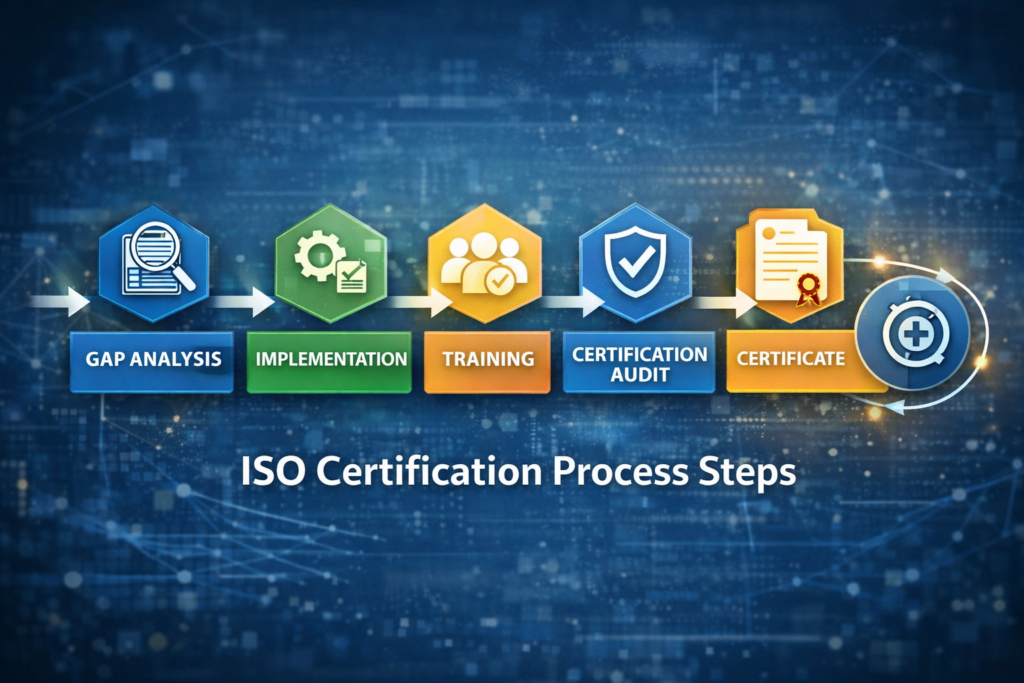
This structured process ensures sustainable long-term results — not just a one-time certificate.
Challenges Businesses Face Without ISO Certification
Companies that ignore ISO implementation often experience:
- Inconsistent quality
- Customer complaints
- Safety incidents
- Compliance failures
- Limited access to tenders
- Weak operational control
ISO certification eliminates these challenges by creating disciplined, transparent management systems.
ISO Certification vs ISO Compliance: What’s the Difference?
Many organizations use the terms ISO compliance and ISO certification interchangeably, but they represent two different levels of alignment with international standards. Understanding the distinction is important for businesses deciding how to demonstrate quality, safety, security, or environmental responsibility to customers, regulators, and partners.
ISO Compliance: Following the Standard Internally
ISO compliance means that an organization has implemented processes and practices that align with the requirements of a specific ISO standard. The company may use the standard as a framework to improve quality, efficiency, safety, or information security, but it has not undergone an external certification audit.
With ISO compliance:
- the organization adopts ISO guidelines and best practices internally
- systems and procedures are aligned with the standard’s requirements
- internal audits may be conducted to monitor performance
- improvements are made to enhance efficiency and risk control
- there is no independent verification by an accredited certification body
ISO compliance can improve operations and demonstrate internal commitment to quality and continuous improvement. However, because compliance is self-declared, external stakeholders must rely on the organization’s own assurance.
ISO Certification: Independent Verification of Compliance
ISO certification goes a step further. It confirms that an organization not only follows ISO standards but has been independently audited and verified by an accredited certification body.
The certification process includes:
- formal implementation of ISO management systems
- documented procedures and operational controls
- internal audits and corrective actions
- external audit by an accredited certification body
- ongoing surveillance audits to maintain certification
Once certified, the organization receives an official certificate confirming conformity with the chosen ISO standard.
This independent verification provides objective proof that systems meet international requirements.
Key Differences at a Glance
ISO Compliance
- self-implemented alignment with ISO guidelines
- internal monitoring and improvement
- no external audit or certification
- demonstrates internal commitment to best practices
ISO Certification
- independently audited and verified
- formal recognition by accredited certification body
- ongoing compliance monitoring through surveillance audits
- internationally recognized proof of conformity
Why Certification Offers Greater Credibility
While ISO compliance improves internal performance, certification provides external trust and market credibility. Certification demonstrates to customers, regulators, and business partners that your systems have been objectively evaluated and meet globally accepted standards.
ISO certification is often required or strongly preferred for:
- government and public sector contracts
- multinational supply chains
- export and international trade
- regulated industries
- high-risk sectors such as construction, oil & gas, and manufacturing
Choosing Between Compliance and Certification
Organizations may begin with ISO compliance to improve internal systems and prepare for certification. However, businesses seeking competitive advantage, market access, and stakeholder confidence typically pursue full certification.
In summary, ISO compliance reflects internal alignment with best practices, while ISO certification provides independent validation and global recognition — making it a powerful tool for credibility, growth, and business success.
ISO Certification and Competitive Advantage
In competitive markets, differentiation matters. When two companies offer similar services, the ISO-certified organization almost always wins customer trust.
Certification acts as:
- A marketing advantage
- A proof of credibility
- A trust-building tool
- A contract requirement
This makes ISO a direct contributor to revenue growth.
Which Businesses Need ISO Certification?
ISO certification benefits organizations of all sizes and sectors, including:
- manufacturing & industrial companies
- construction & engineering firms
- oil & gas contractors
- IT & data security companies
- healthcare providers
- food & beverage businesses
- exporters & logistics providers
- government contractors
Small and medium enterprises can also benefit by improving efficiency and gaining competitive advantage.
Cost & Timeframe for ISO Certification
Costs vary depending on:
- company size and complexity
- number of employees
- processes and locations
- selected ISO standard
- certification body fees
Typical timeframe:
- small organizations: 2–4 months
- medium businesses: 3–6 months
- large organizations: 6–12 months
Investment in certification often delivers long-term financial and operational benefits.
How ATTICS International Supports ISO Certification
At ATTICS International, we help organizations achieve ISO certification efficiently, professionally, and successfully.
Our services include:
- ISO consulting and implementation support
- Management system development
- Internal and external auditing
- Compliance and awareness training
- Inspection and technical assurance
- Ongoing certification maintenance support
Our experienced auditors and consultants ensure your organization meets international standards

Why Choose Professional ISO Support?
Implementing ISO without expert guidance often leads to:
- Incomplete documentation
- Failed audits
- Wasted time and resources
Partnering with experienced professionals ensures:
✔ Faster certification
✔ Proper system implementation
✔ Successful audit outcomes
✔ Long-term compliance maintenance
This is where ATTICS International adds real value.
Future of ISO Standards in Business
With increasing emphasis on sustainability, safety, cybersecurity, and ethical operations, ISO standards continue evolving. Businesses that adopt ISO early stay ahead of regulatory changes and market expectations.
ISO certification is no longer just about quality — it is about resilience, reputation, and readiness for the future.
In global markets, ISO certification is often viewed as a minimum requirement for trust and compliance.
It helps businesses:
- enter international markets
- qualify for government and multinational contracts
- meet regulatory requirements
- enhance brand reputation
- build long-term customer relationships
Certification positions businesses as reliable partners in global supply chains.
Final Thoughts
ISO certification is far more than a framed certificate on the wall. It is a strategic management tool that strengthens operations, builds credibility, and opens global business opportunities.
Organizations that invest in ISO systems experience:
- Better quality
- Safer workplaces
- Happier customers
- Stronger brand trust
- Sustainable growth
If your business is ready to begin its ISO certification journey, professional guidance makes all the difference.
ATTICS International is ready to support you at every step — from planning to certification and beyond.
ISO Certifications We Offer
Globally Recognized Standards for Sustainable Business Excellence
ATTICS International offers a comprehensive range of ISO management system certifications designed to support organizational compliance, performance improvement, and international recognition. All certifications are delivered in alignment with international ISO standards and under approved certification frameworks, ensuring credibility and global acceptance.