ISO Certification Benefits: Why Companies Choose to Get Certified
Top Benefits of ISO Certification for Business Growth
In today’s highly competitive and compliance-driven global marketplace, business success is no longer determined by price alone. Customers, regulators, investors, and corporate buyers now demand proof of quality, safety, reliability, and compliance before engaging with any organization. This is exactly why ISO certification has become a strategic business investment rather than a simple certificate on the wall.
From manufacturing and construction to IT, healthcare, logistics, and energy, companies across every sector are adopting ISO standards to improve performance, strengthen credibility, and unlock new growth opportunities.
What is ISO Certification?
ISO certification is formal recognition that an organization’s systems, processes, and operations meet internationally accepted standards developed by the International Organization for Standardization (ISO).
ISO standards provide structured frameworks for managing:
- Quality
- Environmental responsibility
- Occupational health & safety
- Information security
- Energy efficiency
- Business continuity
- Anti-bribery compliance
Certification is issued by accredited third-party bodies after independent audits, giving external validation that a company operates according to global best practices.
Why Do Companies Need ISO Certification?
In today’s globalized and highly regulated business environment, organizations are under constant pressure to prove that their operations meet recognized standards of quality, safety, security, and compliance. Customers, government bodies, investors, and corporate buyers increasingly demand verified assurance that a company can deliver consistent, reliable, and compliant products or services. This is where ISO certification plays a decisive role.
Across modern supply chains, government tenders, multinational contracts, and corporate procurement frameworks, working with ISO-certified partners has become a fundamental requirement. In many sectors, certification is no longer a competitive advantage it is a commercial entry condition for doing business.
ISO certification provides independent third-party validation that an organization’s management systems follow internationally accepted best practices. This external verification reduces risk for clients and regulators while enhancing the company’s professional standing in the marketplace.
Key Reasons Companies Pursue ISO Certification
Organizations seek ISO certification to:
- Demonstrate operational credibility by proving that their systems and processes meet international standards
- Meet legal and regulatory obligations and remain prepared for inspections and audits
- Qualify for government tenders and corporate contracts that require certified suppliers
- Reduce operational, compliance, and reputational risks
- Strengthen customer, investor, and stakeholder confidence
- Improve internal efficiency and process control through structured management systems
A Universal Business Language
ISO certification has effectively become a global business language. It allows organizations from different countries, industries, and cultures to align under the same performance and compliance expectations. For international clients and partners, an ISO certificate serves as instant assurance of professionalism, accountability, and reliability.
Why This Matters
For growing businesses, ISO certification opens doors to larger markets and high-value contracts.
For established enterprises, it protects reputation, strengthens governance, and ensures long-term sustainability.
In both cases, ISO certification is not just about compliance it is a strategic investment in credibility, efficiency, and competitive strength.
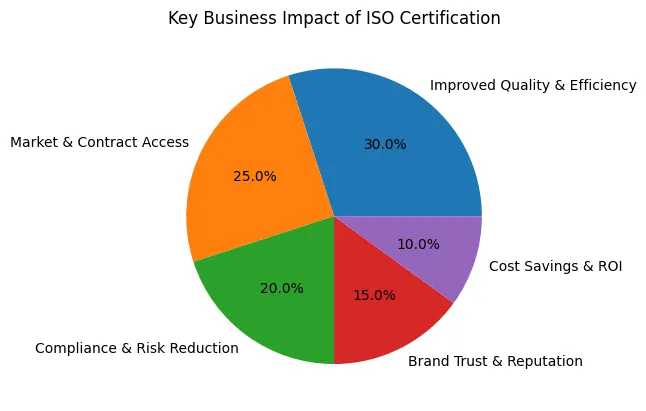
Top Business Benefits of ISO Certification
1. Improved Quality and Process Consistency
ISO standards introduce structured management systems that:
- Standardize workflows
- Reduce errors and rework
- Improve product and service consistency
- Increase customer satisfaction
This leads to fewer complaints, stronger brand loyalty, and long-term customer retention.
2. Operational Efficiency and Cost Savings
Implementing ISO systems helps organizations:
- Eliminate process waste
- Reduce downtime
- Improve resource utilization
- Optimize documentation control
Many companies experience positive return on investment within 12–18 months after certification due to reduced operational losses and improved efficiency.
3. Stronger Compliance and Risk Management
ISO-certified organizations are better prepared to:
- Meet legal and regulatory requirements
- Pass government inspections
- Handle client and supplier audits
- Reduce accident and liability risks
This protects businesses from fines, legal disputes, and reputational damage.
4. Increased Customer Trust and Brand Reputation
ISO certification provides third-party verification that your business meets recognized global standards. This:
- Builds instant credibility
- Shortens sales cycles
- Reduces client due-diligence checks
- Increases win rates in competitive bids
Certified companies are consistently preferred over non-certified competitors.
5. Access to Global Markets and Large Contracts
Many multinational corporations and government projects require suppliers to hold ISO certification. Achieving certification:
- Unlocks international market access
- Qualifies companies for large tenders
- Strengthens supply-chain partnerships
- Enables cross-border business expansion
6. Continuous Improvement Culture
ISO standards embed ongoing improvement into daily operations by requiring:
- Performance monitoring
- Internal audits
- Management reviews
- Corrective action systems
This ensures organizations stay resilient, competitive, and future-ready.
7. Employee Engagement and Accountability
ISO systems clarify roles, responsibilities, and procedures. This:
- Improves internal communication
- Enhances accountability
- Reduces workplace confusion
- Builds stronger safety and quality culture
Engaged employees deliver better business performance.
Financial ROI and Business Impact
Unlike many business investments that deliver only long-term or indirect benefits, ISO certification provides measurable and sustainable financial returns. By introducing structured management systems, defined procedures, and continuous performance monitoring, ISO standards directly improve how an organization operates leading to tangible cost savings and revenue growth.
ISO-certified organizations commonly experience:
- Reduced waste and rework costs through controlled and standardized processes
- Lower incident, accident, and downtime expenses due to stronger safety and risk management systems
- Fewer regulatory and compliance penalties by maintaining audit-ready operations
- Improved contract acquisition and tender success rates where certification is a qualification requirement
- Higher customer retention and repeat business driven by increased trust and service consistency
A Strategic Return on Investment
For many companies, ISO certification evolves into a profit-protecting and revenue-generating strategy. Reduced operational losses, improved efficiency, stronger client confidence, and access to larger contracts often result in a positive return on investment within a relatively short period.
Beyond Cost Savings
In addition to direct financial gains, ISO certification strengthens:
- Investor and lender confidence
- Insurance risk ratings
- Supply-chain partnership opportunities
- Brand market value
Industry-Specific Benefits of ISO Certification
Different industries face unique operational risks, regulatory pressures, and customer expectations. ISO certification provides tailored management frameworks that help organizations meet industry-specific challenges while improving efficiency, compliance, and market credibility. Below is how ISO certification delivers targeted value across major sectors.
Manufacturing Industry
Manufacturers operate in highly process-driven environments where consistency and quality control are critical. ISO certification helps manufacturing organizations implement standardized production systems that ensure reliability and minimize costly errors.
Key Benefits:
- Improved product quality and consistency
- Reduced defects, rework, and product recalls
- Stronger supplier and procurement control
- Better traceability across production cycles
- Increased customer satisfaction and brand trust


Construction & Engineering
Construction and engineering projects involve high safety risks, tight deadlines, and strict contractual compliance. ISO-certified management systems help organizations maintain safety performance, meet tender requirements, and deliver projects on time.
Key Benefits:
- Enhanced workplace health and safety performance
- Qualification for government and corporate tenders
- Reduced project delays and non-compliance penalties
- Stronger contractor and subcontractor control
- Improved project documentation and audit readiness
Oil, Gas & Energy Sector
The energy sector operates under strict regulatory oversight and high-risk operational environments. ISO certification ensures compliance with international safety, environmental, and risk-management requirements.
Key Benefits:
- Strict compliance with international regulations
- Reduced environmental and operational risks
- Increased acceptance by multinational contractors
- Improved emergency preparedness systems
- Enhanced corporate reputation in high-risk markets


IT & Data Services
With rising cyber threats and global data regulations, IT and data-driven organizations require strong information security and process control systems. ISO certification provides trusted assurance of data protection and service reliability.
Key Benefits:
- Strong data security and information protection
- Reduced cyber-security risks
- Increased client and investor confidence
- Eligibility for global outsourcing contracts
- Compliance with international data regulations
Healthcare & Education
Healthcare and education institutions must deliver consistent service quality while meeting strict regulatory requirements. ISO certification strengthens operational excellence and stakeholder trust.
Key Benefits:
- Consistent service quality and process control
- Improved patient and student satisfaction
- Higher trust from families and communities
- Stronger compliance with regulatory authorities
- Better risk and incident management systems

ISO Certification as a Competitive Advantage
In saturated markets, ISO certification differentiates your company by proving:
- Professional management systems
- Reliable service delivery
- Risk-controlled operations
- International business readiness
This advantage directly impacts brand positioning and long-term growth.
Comparison Across ISO Standards
| Standard | Primary Focus | Business Benefit |
|---|---|---|
| ISO 9001 | Quality Management | Consistent product & service quality |
| ISO 14001 | Environmental Management | Legal compliance & sustainability |
| ISO 45001 | Occupational Health & Safety | Reduced accidents & liability |
| ISO 27001 | Information Security | Data protection & client trust |
| ISO 22000 | Food Safety | Supply-chain food safety assurance |
| ISO 21001 | Educational Management | Training service excellence |
Organizations often integrate multiple standards into a single Integrated Management System (IMS) for maximum efficiency.
Global Trust and Supply-Chain Recognition
ISO certification creates universal trust across international markets. Certified companies are:
- Preferred by multinational buyers
- Trusted by regulators
- Accepted in global supply chains
- Viewed as lower-risk partners
This universal recognition accelerates international growth.
ISO certification is no longer just a quality badge it is a strategic business tool that drives operational excellence, builds market credibility, and ensures sustainable growth.
Organizations that invest in ISO standards position themselves as trusted, compliant, and globally competitive partners in today’s demanding business environment.
Whether your goal is improving internal efficiency, expanding into new markets, or strengthening corporate reputation ISO certification delivers measurable and lasting value.
ATTICS International is ready to guide your certification journey from planning to successful accreditation.