
ISO Certification for Construction Companies: Benefits, Standards & Business Impact
ISO Certification for Construction Companies
The construction industry is one of the most high-risk and quality-sensitive sectors in the world. From worker safety and environmental protection to project quality and regulatory compliance, construction companies must operate under strict standards to remain competitive and trustworthy.
ISO certification has become a powerful benchmark that demonstrates a company’s commitment to quality, safety, efficiency, and international best practices. In Pakistan and the GCC region, certified construction firms enjoy greater credibility, improved operational control, and enhanced eligibility for government and mega infrastructure projects.
This guide explains why ISO certification matters for construction companies and how it can transform business performance and growth.
What is ISO Certification in Construction?
ISO certification in the construction industry is a formal recognition that a company operates in accordance with internationally accepted management system standards developed by the International Organization for Standardization (ISO). These standards provide a structured framework for managing quality, safety, environmental responsibilities, and operational processes across all phases of construction projects — from planning and procurement to execution and final delivery.
In an industry where projects involve complex coordination, strict regulatory requirements, and high safety risks, ISO certification ensures that construction companies follow proven systems designed to improve performance, accountability, and consistency.
Rather than focusing on a single aspect of operations, ISO standards promote an integrated management approach that strengthens organizational control and continuous improvement. For construction firms, this means establishing clear procedures, documenting processes, monitoring performance, and implementing corrective actions to maintain high standards across every project.
ISO certification helps construction companies:
- Deliver consistent project quality
Standardized procedures ensure materials, workmanship, and project execution meet defined quality benchmarks, reducing defects, rework, and client complaints. - Protect worker health and safety
Structured safety management systems identify hazards, implement preventive controls, and promote a strong safety culture to reduce workplace injuries and incidents. - Manage environmental impact responsibly
Environmental management practices support waste reduction, pollution control, responsible resource usage, and compliance with environmental regulations. - Reduce operational and project risks
Risk-based planning helps identify potential project delays, cost overruns, safety hazards, and compliance issues before they escalate. - Improve efficiency and operational performance
Clearly defined workflows and performance monitoring eliminate inefficiencies, improve coordination, and enhance project delivery timelines. - Ensure legal and regulatory compliance
ISO systems help companies meet national construction regulations, labor laws, and environmental requirements, reducing the risk of penalties or project shutdowns. - Strengthen documentation and accountability
Standardized documentation improves traceability, communication, and audit readiness, which is critical for large-scale and government projects.
ISO certification also demonstrates a company’s commitment to continuous improvement. Certified organizations regularly review performance, address non-conformities, and enhance their systems to maintain compliance and operational excellence.
For clients, regulators, investors, and project partners, ISO certification is a powerful trust signal. It confirms that the construction company adheres to globally recognized best practices, manages risks effectively, and is capable of delivering safe, high-quality, and compliant projects.
In highly competitive markets such as Pakistan and the GCC region, ISO-certified construction firms are often preferred for major infrastructure projects, government tenders, and international collaborations, making certification not only a quality benchmark but also a strategic business advantage.
Key ISO Standards for Construction Companies
ISO 9001 — Quality Management System (QMS)
ISO 9001 is the world’s most recognized quality management standard and plays a vital role in ensuring consistent quality across construction projects. It establishes a structured framework that enables construction companies to plan, control, and continuously improve their processes — from procurement and material handling to project execution and final handover.
In construction, where multiple stakeholders, tight deadlines, and complex workflows are involved, ISO 9001 ensures that every phase of a project follows defined procedures and measurable quality benchmarks. This reduces variability in workmanship, ensures compliance with technical specifications, and strengthens client confidence.
By implementing ISO 9001, construction firms can minimize rework, prevent costly defects, improve supplier quality control, and enhance overall project efficiency. The standard also promotes customer-focused practices, helping companies meet contractual requirements and deliver projects that align with client expectations.
ISO 45001 — Occupational Health & Safety Management
ISO 45001 is a critical standard for construction companies due to the high-risk nature of construction sites. It provides a proactive framework for identifying hazards, assessing risks, and implementing preventive measures to protect workers, contractors, and site visitors.
Construction environments involve heavy machinery, working at heights, electrical hazards, confined spaces, and hazardous materials. ISO 45001 helps organizations establish structured safety protocols, emergency preparedness procedures, and incident reporting systems that reduce workplace injuries and fatalities.
Beyond protecting workers, the standard strengthens legal compliance with occupational health and safety regulations and reduces liability risks. It also improves workforce morale and productivity by fostering a strong safety culture where employees feel protected and valued.
For contractors working on government or international projects, ISO 45001 certification is often a prerequisite, demonstrating commitment to global safety standards and responsible project management.
ISO 14001 — Environmental Management System
ISO 14001 provides a systematic approach for managing environmental responsibilities in construction operations. Construction activities can significantly impact the environment through waste generation, emissions, noise pollution, water contamination, and excessive resource consumption.
This standard helps construction companies identify environmental risks, implement pollution prevention measures, manage construction waste responsibly, and ensure compliance with environmental regulations. It promotes sustainable practices such as efficient resource utilization, energy conservation, and responsible material usage.
As sustainability and green building practices become increasingly important in Pakistan and GCC markets, ISO 14001 certification supports regulatory approvals, environmental permits, and eligibility for eco-friendly infrastructure projects.
Additionally, the standard aligns organizations with Environmental, Social, and Governance (ESG) expectations, strengthening corporate reputation and demonstrating commitment to sustainable development.
ISO 27001 — Information Security Management (Optional but Growing)
As the construction industry adopts digital technologies, Building Information Modeling (BIM), smart infrastructure systems, and cloud-based project management tools, protecting sensitive data has become essential. ISO 27001 provides a comprehensive framework for managing information security risks and safeguarding critical project data.
Construction firms handle confidential architectural designs, engineering plans, financial records, contracts, and client information. ISO 27001 helps protect these assets from cyber threats, unauthorized access, data breaches, and digital disruptions.
The standard establishes security controls, access management protocols, data protection policies, and incident response procedures to ensure information integrity, confidentiality, and availability.
With the rise of smart construction and digital collaboration across global teams, ISO 27001 certification enhances trust among clients, investors, and international partners while reducing cybersecurity risks and operational disruptions.
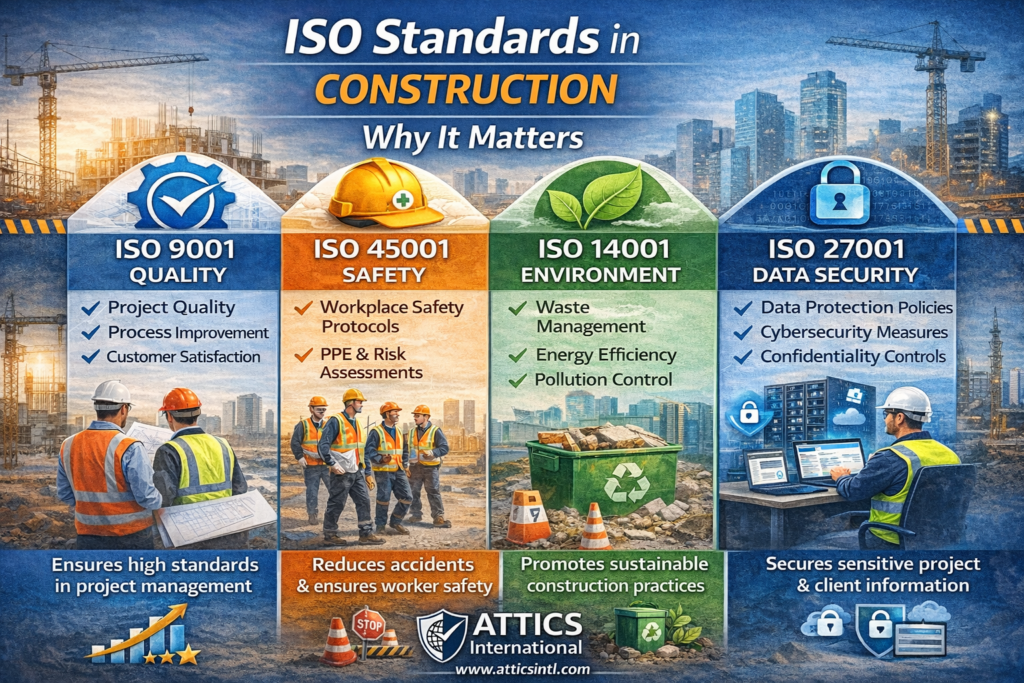
Why ISO Certification Matters in the Construction Industry
1. Improves Project Quality & Consistency
Standardized procedures ensure every project meets defined quality benchmarks, reducing errors and costly rework.
2. Enhances Worker Safety & Reduces Accidents
Construction sites carry significant risk. ISO 45001 establishes structured safety protocols that reduce injuries, downtime, and liability.
3. Ensures Legal & Regulatory Compliance
ISO standards help companies meet national regulations and international compliance requirements, avoiding penalties and project shutdowns.
4. Builds Client Trust & Market Credibility
Certified companies are viewed as reliable, professional, and capable of delivering high-quality projects.
5. Helps Win Government & Mega Contracts
In Pakistan and GCC countries, ISO certification is often required for:
- government tenders
- oil & gas infrastructure projects
- large commercial developments
- international partnerships
6. Reduces Delays, Errors & Cost Overruns
Process control and risk management reduce material waste, scheduling issues, and budget overruns.
7. Supports Sustainability & Environmental Responsibility
ISO 14001 helps firms align with green building requirements and sustainability initiatives.
ISO Standards & Their Benefits
| ISO Standard | Focus Area | Key Benefit | Why It Matters |
|---|---|---|---|
| ISO 9001 | Quality Management | Consistent project quality | Reduces defects & rework |
| ISO 45001 | Occupational Safety | Worker protection | Reduces accidents & legal risk |
| ISO 14001 | Environmental Management | Environmental compliance | Supports sustainability |
| ISO 27001 | Information Security | Data protection | Secures digital project data |
Risks of Operating Without ISO Certification
Operating without ISO certification can place construction companies at a significant competitive and operational disadvantage. In an industry where safety, quality, compliance, and reliability are critical, the absence of internationally recognized management systems increases exposure to risks that can affect project success, legal standing, and business growth.
Construction firms that do not implement ISO standards often struggle to maintain consistent procedures, manage risks effectively, and meet the expectations of clients, regulators, and project stakeholders.
Companies without ISO certification commonly face:
- Reduced eligibility for major tenders and contracts
Many government projects, multinational developments, and infrastructure initiatives require ISO certification as a prequalification criterion. Without it, companies may be excluded from bidding opportunities. - Higher accident risks and legal liability
Without structured safety management systems, construction sites are more vulnerable to workplace incidents, injuries, and fatalities — leading to legal claims, penalties, and project shutdowns. - Inconsistent quality and costly rework
Lack of standardized quality controls can result in defects, material wastage, project delays, and expensive rework that affects profitability and reputation. - Weak client trust and reduced credibility
Clients and developers prefer certified contractors because certification demonstrates professionalism, reliability, and adherence to international best practices. - Regulatory compliance challenges
Failure to implement structured compliance systems increases the risk of violating safety, environmental, and labor regulations, which can lead to fines and operational disruptions. - Limited access to international markets
ISO certification is globally recognized. Without it, companies may struggle to partner with international firms or participate in cross-border projects. - Poor subcontractor and supplier control
Without standardized procedures, managing subcontractors and suppliers becomes inconsistent, increasing the likelihood of disputes, delays, and quality issues.
In highly competitive construction markets such as the UAE, Saudi Arabia, and Qatar, ISO certification is often viewed as a minimum requirement rather than an advantage. Companies lacking certification may find it difficult to secure high-value projects, form international partnerships, or compete with certified firms that demonstrate proven systems for quality, safety, and compliance.
Adopting ISO standards is not only about meeting requirements it is about protecting your business, strengthening operational control, and positioning your company for sustainable growth.
With vs Without ISO Certification
| Area | With ISO Certification | Without ISO |
|---|---|---|
| Safety | Structured safety controls | Higher accident risk |
| Quality | Standardized processes | Inconsistent results |
| Tender Eligibility | Eligible for major projects | Limited opportunities |
| Compliance | Meets regulations | Risk of penalties |
| Client Trust | High credibility | Lower trust |
How ISO Certification Improves Contractor & Subcontractor Management
Construction projects depend heavily on subcontractors, suppliers, and multiple specialist teams. Without clear systems in place, inconsistencies in safety practices, workmanship, and communication can quickly lead to delays, disputes, and quality issues. Implementing ISO management systems creates a structured framework that ensures all parties operate according to the same standards and expectations.
ISO systems help construction companies:
- Standardize supplier and subcontractor evaluation by establishing clear selection criteria, performance monitoring, and compliance requirements.
- Enforce safety compliance across all teams through unified health and safety procedures, risk assessments, and site safety protocols.
- Maintain consistent quality standards by ensuring subcontractors follow approved specifications, inspection procedures, and quality controls.
- Improve communication and documentation through standardized reporting, record keeping, and clear documentation of responsibilities and procedures.
- Reduce disputes, errors, and project delays by defining roles, responsibilities, and workflows that minimize misunderstandings and coordination failures.
- Strengthen accountability and traceability so performance issues can be identified and corrected quickly.
By aligning subcontractors and suppliers under a unified management system, construction companies achieve smoother coordination, improved project control, and more reliable project outcomes.
ROI: How ISO Certification Saves Money Long Term
While certification requires initial investment, the long-term financial benefits include:
- reduced rework and material waste
- fewer workplace incidents and compensation claims
- improved project efficiency
- lower insurance premiums
- increased project approvals and contract wins
ISO certification strengthens operational efficiency while improving profitability.
ISO Certification Process for Construction Companies
Achieving ISO certification is a structured process that helps construction companies align their operations with internationally recognized standards for quality, safety, environmental management, and compliance. While the process may seem complex, a systematic approach ensures smooth implementation with minimal disruption to ongoing projects.
The typical ISO certification journey includes the following stages:
- Gap Analysis
An initial assessment is conducted to compare your current practices with ISO requirements. This step identifies weaknesses, compliance gaps, and improvement areas that must be addressed before certification. - Documentation & System Development
Policies, procedures, risk assessments, and operational controls are developed to meet the requirements of the selected ISO standards. This includes defining workflows, responsibilities, safety protocols, and quality control measures. - Implementation & Staff Training
The documented systems are integrated into daily operations. Employees, supervisors, and site teams receive training to ensure they understand new procedures, safety requirements, and compliance responsibilities. - Internal Audit
An internal audit is carried out to evaluate whether the implemented systems comply with ISO standards and are functioning effectively. Any non-conformities are identified and corrective actions are taken. - Management Review & Readiness Check
Senior management reviews system performance, audit findings, and improvement actions to ensure the organization is prepared for certification. - Certification Audit
An accredited certification body conducts an external audit to verify compliance. If the organization meets all requirements, ISO certification is awarded. - Continuous Improvement & Surveillance Audits
ISO certification is not a one-time achievement. Regular surveillance audits and ongoing monitoring ensure continued compliance and encourage continuous improvement in processes and performance.
With expert guidance and proper planning, construction companies can achieve ISO certification efficiently while strengthening operational control, improving safety and quality standards, and enhancing their competitiveness in local and international markets.
ISO Certification in Pakistan & GCC Construction Markets
ISO certification plays an increasingly important role in strengthening the credibility, compliance readiness, and global competitiveness of construction companies operating in Pakistan and the Gulf Cooperation Council (GCC) region. As infrastructure development accelerates and regulatory oversight becomes more stringent, certification is no longer viewed as an optional advantage — it is a strategic requirement for sustainable growth.
In Pakistan, ISO certification enhances a company’s professional reputation and improves eligibility for large-scale infrastructure and development initiatives. Certified construction firms are better positioned to participate in:
Certification demonstrates adherence to global best practices, which increases trust among investors, regulators, and multinational partners.
In GCC countries — including the UAE, Saudi Arabia, Qatar, and Oman — ISO certification is frequently mandatory or strongly preferred for contractors working on major developments. This is especially true for projects involving:
Regulatory authorities and project owners in the GCC prioritize contractors that meet international quality, safety, and environmental standards. ISO-certified firms are considered lower risk, more reliable, and better equipped to meet strict compliance requirements.
As a result, certified construction companies gain a competitive advantage when forming joint ventures, securing international contracts, and collaborating with multinational developers. ISO certification not only opens doors to high-value opportunities but also positions firms as trusted partners in a rapidly evolving regional construction landscape.
Future Trends: Compliance & Smart Construction
The construction sector is evolving rapidly with increasing focus on:
- sustainability & ESG compliance
- digital construction management
- smart infrastructure projects
- stricter safety regulations
- international project collaborations
ISO certification positions companies to adapt to these changes and remain globally competitive.
Why Choose ATTICS International for ISO Certification Support?
ATTICS International provides expert guidance to construction companies seeking ISO certification across Pakistan and the GCC region.
What sets us apart:
- internationally recognized training & compliance expertise
- ISO 9001:2015 certified organization
- ISO/IEC 17024 compliant certification processes
- industry-focused implementation support
- practical, audit-ready documentation guidance
- support for tender compliance & regulatory requirements
Our structured approach ensures smooth certification and long-term compliance success.
Conclusion
ISO certification is more than a compliance requirement — it is a strategic investment in quality, safety, credibility, and long-term growth.
For construction companies operating in Pakistan and the GCC, certification enhances competitiveness, improves project outcomes, and opens doors to high-value contracts and international partnerships.
Organizations that adopt ISO standards position themselves as trusted leaders in an increasingly regulated and quality-driven construction landscape.