
What Is a Level 7 Diploma? Equivalent & Career Benefits (Guide 2026)
Table of Contents
What Is a Level 7 Diploma? Equivalent, Benefits & Career Scope
If you’re planning to advance your career or pursue postgraduate-level education, you may have come across the term Level 7 Diploma. But what exactly is it, and how does it compare to a Master’s degree?
A Level 7 diploma is an advanced postgraduate qualification designed to develop strategic leadership, management, and specialist expertise. Recognized internationally, it is widely considered equivalent to master’s-level study and is ideal for professionals seeking career progression without committing immediately to a full Master’s degree.
In this guide, we’ll explain the level 7 diploma meaning, equivalency, benefits, entry requirements, and career opportunities.
What Is a Level 7 Diploma?
Definition and Overview
A Level 7 diploma is an advanced postgraduate-level qualification designed to provide learners with in-depth knowledge, strategic insight, and high-level professional competencies. Positioned above undergraduate study, this qualification focuses on developing critical thinking, leadership ability, and decision-making skills required for senior management and specialist roles.
Unlike entry-level certifications, a Level 7 qualification emphasizes strategic planning, organizational leadership, risk management, and problem-solving in complex professional environments. It is particularly suited for experienced professionals, managers, and graduates who want to enhance their expertise, gain leadership credibility, or progress into executive-level positions.
Postgraduate-Level Qualification Explained
Academically, a Level 7 diploma sits at the same level as a Master’s degree within the UK Regulated Qualifications Framework (RQF). This means the learning outcomes reflect postgraduate study standards and advanced professional competence.
However, while a traditional master’s degree often emphasizes academic research and dissertation work, Level 7 diplomas focus more on practical application, workplace leadership, and industry-relevant skills. Programs typically include coursework, case studies, assignments, and strategic projects that mirror real-world professional challenges.
Most Level 7 diplomas carry approximately 120 credits, representing the taught component of a master’s program. Graduates can often progress to a Master’s or MBA top-up by completing a dissertation to achieve the full 180 credits required for a master’s degree.
Who Awards Level 7 Diplomas?
Level 7 diplomas are awarded by reputable UK awarding organizations that are regulated by Ofqual (Office of Qualifications and Examinations Regulation). Ofqual regulation ensures the qualification meets rigorous academic standards, quality assurance processes, and international recognition requirements.
Some of the most widely recognized awarding bodies include:
- OTHM Qualifications
- Qualifi
- ProQual
- NCC Education
These awarding organizations design qualifications aligned with industry needs and global professional standards. Approved training centers and institutes deliver the programs, ensuring learners receive structured learning, assessment support, and quality-assured certification.
Because of strict regulatory oversight and standardized frameworks, Level 7 diplomas are trusted by employers, universities, and professional bodies worldwide.
Where Does Level 7 Sit in the Qualification Framework?
Understanding where a Level 7 diploma sits within international education frameworks helps learners and employers recognize its academic value and professional credibility. This qualification is positioned at the postgraduate level and is aligned with globally recognized standards, making it widely accepted across universities, professional bodies, and employers worldwide.
UK Regulated Qualifications Framework (RQF)
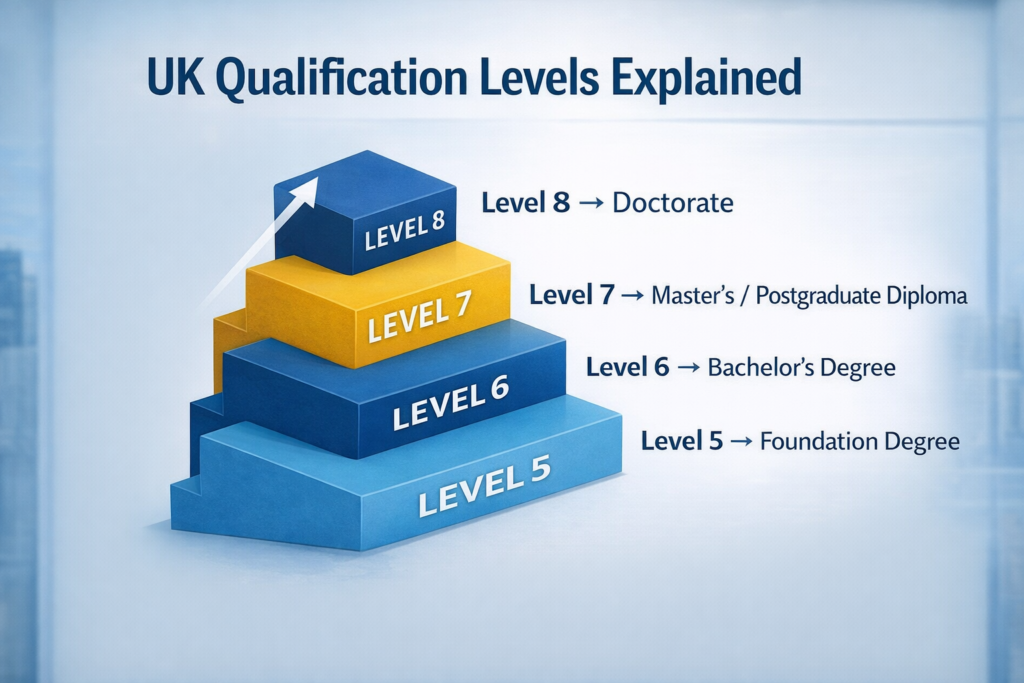
The Regulated Qualifications Framework (RQF) is the official system used in the United Kingdom to classify qualifications based on their complexity, depth of learning, and academic level.
Within the RQF structure:
- Level 6 = Bachelor’s Degree or Graduate Certificate
- Level 7 = Master’s Degree level / Postgraduate Diploma
- Level 8 = Doctorate (PhD or equivalent)
A RQF Level 7 diploma therefore represents postgraduate-level learning that requires advanced analytical thinking, strategic decision-making, and professional expertise. It confirms that learners have achieved a level of knowledge and competence comparable to master’s-level study.
RQF-regulated qualifications are overseen by Ofqual, ensuring consistent academic standards, quality assurance, and international credibility.
European Qualifications Framework (EQF)
The European Qualifications Framework (EQF) provides a common reference system that enables qualifications from different countries to be compared and recognized across Europe.
Level 7 of the UK RQF aligns directly with EQF Level 7, which corresponds to master’s-level education across European nations. This alignment supports academic progression, professional recognition, and employment mobility throughout Europe and in regions that reference the EQF for qualification equivalency.
As a result, holders of a Level 7 diploma benefit from increased international acceptance and cross-border career opportunities.
Recognition in Pakistan & International Markets
A UK Level 7 diploma is widely recognized and respected across global job markets due to its alignment with internationally accepted qualification frameworks and its focus on advanced professional competencies.
Employers and institutions value Level 7 qualifications in regions including:
- Pakistan
Professionals use Level 7 diplomas to enhance career prospects, qualify for senior management roles, and meet international employer standards. - Middle East (UAE, Saudi Arabia, Qatar)
These qualifications are highly regarded in sectors such as construction, oil & gas, healthcare, education, and corporate management. - United Kingdom & Europe
Recognized for both employment and progression to master’s degree top-up programs. - Asia & Africa
Widely accepted by multinational organizations and international employers seeking qualified leadership professionals.
Because of its global recognition and professional relevance, a Level 7 diploma is an excellent choice for individuals seeking international career mobility, postgraduate progression, and enhanced professional credibility.
What Is a Level 7 Diploma Equivalent To?
One of the most common questions students and professionals ask is: what is a Level 7 diploma equivalent to? Understanding its academic standing helps clarify how it compares with postgraduate education and how it can support career advancement.
A Level 7 diploma is widely recognized as equivalent to master’s-level study within the UK Regulated Qualifications Framework (RQF). It represents advanced postgraduate learning and demonstrates a high level of professional competence, strategic thinking, and subject mastery.
Comparison with a Master’s Degree
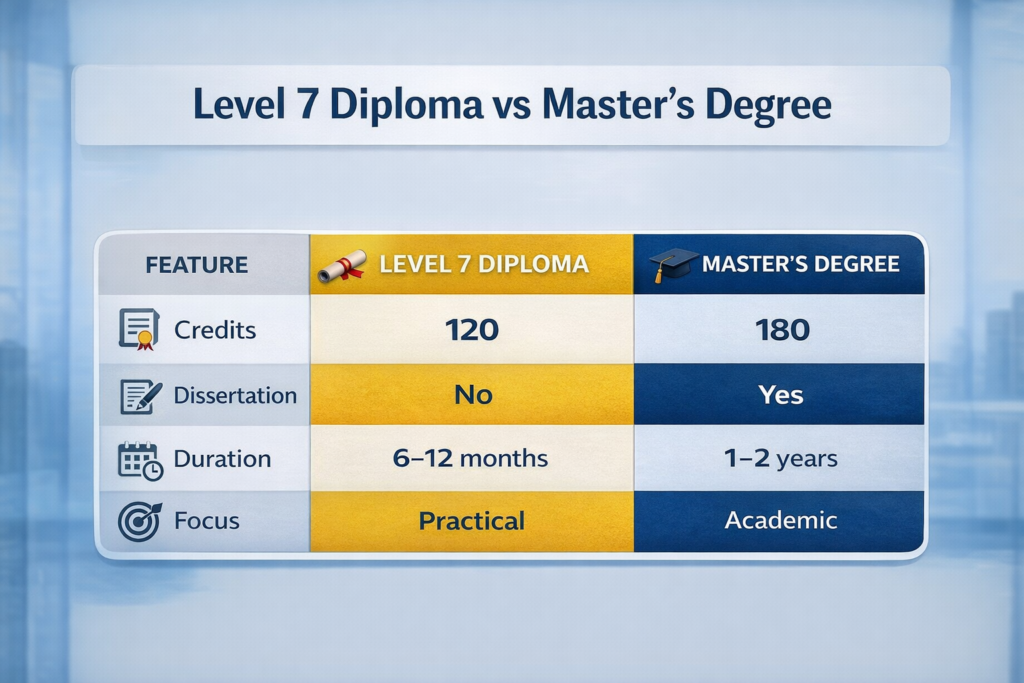
A Level 7 diploma is considered equivalent to the taught component of a master’s degree program. Both qualifications operate at the same academic level and require learners to engage in advanced study, critical analysis, and strategic decision-making.
Typical credit structure:
- Level 7 Diploma: approximately 120 credits
- Master’s Degree: typically 180 credits
To convert a Level 7 diploma into a full master’s qualification, students usually complete an additional 60-credit dissertation or research project, often referred to as a Master’s top-up. This pathway allows learners to achieve a full MSc, MA, or MBA in a shorter time and at a reduced cost.
This flexible progression route is one of the main reasons professionals choose Level 7 diplomas as an alternative pathway to postgraduate degrees.
Postgraduate Diploma vs Full Master’s
Although both qualifications are at the same academic level, their structure and focus differ.
Level 7 Diploma
✔ Emphasizes coursework and practical assignments
✔ Develops professional and workplace leadership skills
✔ Focuses on real-world application and strategic decision-making
✔ Flexible study options suitable for working professionals
✔ Faster completion time (often 6–12 months)
Master’s Degree
✔ Includes dissertation or original research project
✔ Strong academic and theoretical focus
✔ Required for research or academic career paths
✔ Longer duration (typically 1–2 years)
Because of its practical focus, a Level 7 diploma is often preferred by professionals seeking career progression rather than academic research roles.
Academic vs Professional Recognition
While universities award master’s degrees as academic qualifications, Level 7 diplomas are recognized as professional postgraduate credentials that demonstrate advanced expertise and leadership capability.
Academic Recognition
- Accepted for progression to Master’s top-up programs
- Recognized within postgraduate education frameworks
- Equivalent to master’s-level study standards
Professional Recognition
- Valued by employers worldwide
- Demonstrates strategic leadership and specialist expertise
- Supports promotion into senior management roles
- Enhances credibility in international job markets
Employers often value Level 7 diploma holders for their practical skills, strategic thinking, and ability to apply advanced knowledge in real-world business and organizational environments.
Types of Level 7 Diplomas
Popular specializations include:
Strategic Management & Leadership
- Level 7 Diploma in Strategic Management and Leadership
- Leadership and executive decision-making
Health & Safety
- NVQ Level 7 Diploma in Occupational Health & Safety
- Strategic safety leadership roles
Education & Teaching
- Education management & leadership
- Teaching & training development
IT & Project Management
- Level 7 Diploma in IT
- Project and technology leadership
These qualifications focus on real-world leadership and strategic skills.
Entry Requirements for a Level 7 Diploma
Academic Requirements
Most programs require:
✔ Bachelor’s degree or Level 6 qualification
✔ Equivalent professional qualification
Work Experience Pathway
Some institutions accept experienced professionals without a degree.
English Language Requirements
International students may need proof of English proficiency.
Benefits & Career Value of a Level 7 Diploma
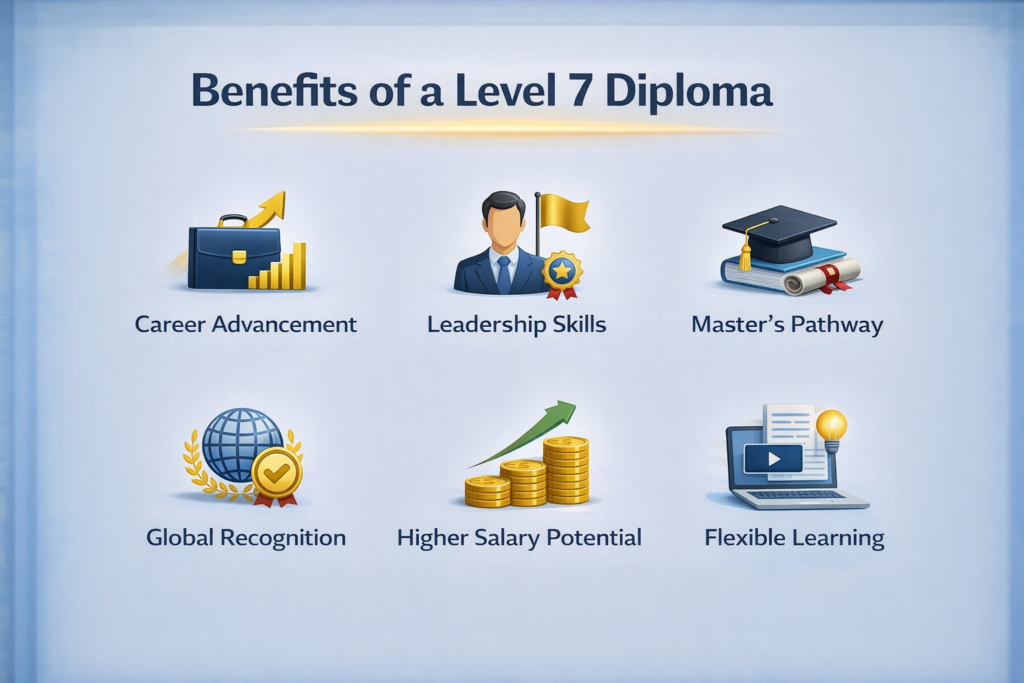
A Level 7 diploma offers more than academic progression — it delivers practical leadership capabilities, professional credibility, and access to senior career opportunities. Because it is aligned with master’s-level study, employers view this qualification as evidence of advanced expertise and strategic decision-making ability.
Below are the key benefits and the real career value it provides.
Accelerated Career Advancement
One of the most significant advantages of earning a Level 7 qualification is its ability to fast-track career progression. The diploma develops high-level competencies such as strategic planning, risk assessment, organizational leadership, and performance management — skills required for senior and executive roles.
Professionals often use Level 7 diplomas to transition into positions such as:
- Senior Manager
- Operations Director
- Health & Safety Director
- Project Manager
- Education Leader
- Business Consultant
Because employers recognize Level 7 as a master’s-level qualification, it strengthens promotion prospects and leadership credibility.
Enhanced Leadership & Strategic Skills
Unlike lower-level qualifications, Level 7 programs focus on leadership in complex environments. Learners develop the ability to:
✔ lead teams effectively
✔ make data-driven strategic decisions
✔ manage organizational change
✔ improve operational performance
✔ solve complex business challenges
These competencies are essential for leadership roles in modern organizations.
Pathway to a Full Master’s or MBA
A major benefit of a Level 7 diploma is its flexibility as a progression route to a master’s degree. After completing the diploma (typically 120 credits), learners can enroll in a Master’s or MBA top-up program and complete a dissertation to earn a full postgraduate degree.
This pathway allows students to:
- save time and tuition costs
- study while working
- gain professional qualifications before completing a full master’s
This makes it an ideal route for working professionals seeking postgraduate credentials.
Global Recognition & International Mobility
Because Level 7 diplomas are regulated within the UK qualification framework and aligned with international standards, they are recognized by employers worldwide.
Holders of Level 7 qualifications often find opportunities in:
- Pakistan’s corporate and industrial sectors
- Middle East industries (construction, oil & gas, healthcare, education)
- UK & European organizations
- multinational companies across Asia & Africa
This global recognition supports career mobility and overseas employment opportunities.
Flexible Learning for Working Professionals
Most Level 7 diploma programs are designed with professionals in mind. Study options often include:
✔ online or blended learning
✔ assignment-based assessment instead of exams
✔ flexible schedules
✔ self-paced learning
This flexibility allows learners to upgrade their qualifications without interrupting their careers.
Increased Earning Potential
Advanced qualifications are strongly linked to higher salary potential. Professionals with Level 7 credentials often qualify for senior positions with improved compensation and leadership responsibilities.
Employers value the diploma because it demonstrates:
- advanced professional competence
- strategic thinking ability
- leadership readiness
- commitment to professional development
Career Impact: Level 7 Diploma vs Bachelor’s vs Master’s
The table below highlights how a Level 7 diploma compares in terms of career value.
| Feature | Bachelor’s Degree (Level 6) | Level 7 Diploma | Master’s Degree |
|---|---|---|---|
| Academic Level | Undergraduate | Postgraduate | Postgraduate |
| Focus | Foundational knowledge | Strategic & professional expertise | Academic & research depth |
| Leadership Skills | Basic | Advanced & strategic | Advanced |
| Career Level | Entry to mid-level roles | Senior & management roles | Senior & specialist roles |
| Study Duration | 3–4 years | 6–12 months | 1–2 years |
| Dissertation Required | No | No | Yes |
| Workplace Relevance | Moderate | High | High |
| Flexibility for Professionals | Limited | Excellent | Moderate |
| Pathway to Master’s | Yes | Yes (Top-up) | Completed degree |
| Global Recognition | Yes | Yes | Yes |
Why Employers Value Level 7 Diploma Holders
Organizations increasingly seek professionals who can lead teams, manage change, and drive strategic growth. A Level 7 diploma signals that the holder possesses:
✅ leadership and decision-making expertise
✅ advanced problem-solving abilities
✅ strategic planning capability
✅ industry-relevant professional skills
✅ readiness for executive responsibilities
This makes Level 7 graduates highly competitive in today’s global job market.
Level 7 Diploma vs Master’s Degree
| Feature | Level 7 Diploma | Master’s Degree |
|---|---|---|
| Academic Level | Master’s Level | Master’s Level |
| Credits | 120 | 180 |
| Dissertation | Not included | Required |
| Duration | 6–12 months | 1–2 years |
| Cost | Lower | Higher |
| Flexibility | High | Moderate |
Which Option Is Better?
Choose a Level 7 diploma if you want flexible postgraduate learning and career advancement. Choose a full master’s if you require academic research credentials.
Who Should Study a Level 7 Diploma?
This qualification is ideal for:
Working Professionals
Seeking promotion or leadership roles.
Managers & Team Leaders
Looking to strengthen strategic decision-making skills.
Graduates Seeking Specialization
Adding professional expertise after a bachelor’s degree.
Entrepreneurs & Business Owners
Improving leadership and business growth strategies.
How to Enroll in a Level 7 Diploma Program
Enrolling in a Level 7 diploma is a straightforward process, but choosing the right provider and understanding the requirements are essential to ensure your qualification is recognized and valuable for career advancement.
Choosing an Accredited Provider
Selecting a reputable and accredited training provider is the most important step in your enrollment journey. A recognized institute ensures your qualification meets international academic standards and is accepted by employers, universities, and professional bodies worldwide.
When choosing a provider, consider the following:
✔ Accreditation & Recognition
Ensure the institute delivers qualifications awarded by recognized UK awarding bodies such as OTHM, Qualifi, ProQual, or NCC Education.
✔ Regulatory Compliance
Verify that the awarding organization is regulated by Ofqual or aligned with the UK Regulated Qualifications Framework (RQF).
✔ Institution Reputation
Look for training centers with positive student reviews, experienced tutors, and a strong track record of successful graduates.
✔ Progression Opportunities
Confirm whether the diploma allows progression to a Master’s or MBA top-up program at recognized universities.
✔ Learning Support & Resources
Choose providers offering tutor guidance, structured learning materials, and academic support.
Taking time to research providers ensures your investment leads to genuine academic and professional recognition.
Documents Required
Admission requirements are generally simple and designed to accommodate both graduates and experienced professionals. While requirements may vary slightly between institutions, applicants are typically asked to submit:
✔ Academic Certificates
Copies of your bachelor’s degree or Level 6 qualification. Equivalent qualifications may also be accepted.
✔ Curriculum Vitae (CV) or Experience Record
A professional CV highlighting relevant work experience, especially for mature applicants applying through the experience-based entry route.
✔ Valid Identification Document
A passport copy or national ID card for identity verification.
✔ English Language Proof (if applicable)
International students may need to provide evidence of English proficiency.
Some institutes may conduct an eligibility assessment to ensure the program aligns with your academic background and career goals.
Study Modes
Level 7 diploma programs are designed to accommodate working professionals and international learners, offering flexible study options.
Study Modes
✔ Online Learning – Study from anywhere with full digital access to materials and tutor support.
✔ Blended Learning – Combination of online coursework and instructor-led sessions.
✔ Classroom-Based Learning – Available at select training centers for face-to-face instruction.
How Long Does a Level 7 Diploma Take to Complete?
Explain the duration and flexibility of the qualification.
Include:
- typical duration 6–12 months
- full-time vs part-time study
- online learning options
- assignment-based assessments
Top Industries That Value Level 7 Qualifications
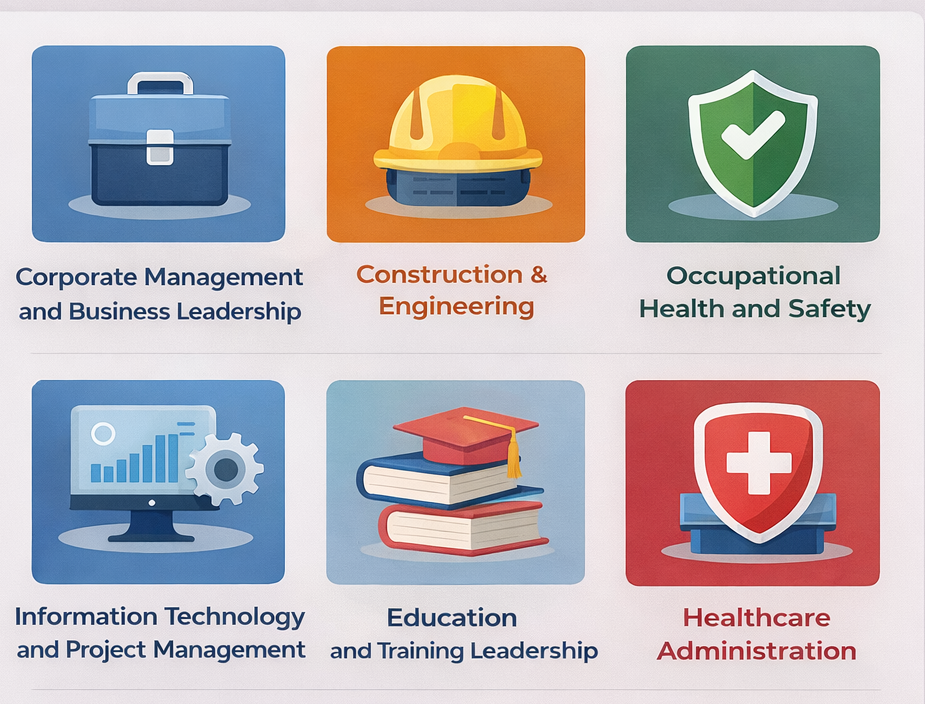
A Level 7 diploma equips professionals with advanced leadership, strategic management, and decision-making skills that are highly valued across a wide range of industries. Because this qualification is aligned with postgraduate-level study, many organizations consider it a strong indicator of professional competence and readiness for senior roles.
Below are some of the key industries where Level 7 qualifications are particularly valuable.
Corporate Management and Business Leadership
Many professionals pursue a Level 7 diploma in strategic management and leadership to advance within corporate environments. Organizations look for leaders who can develop long-term strategies, manage teams effectively, and drive organizational growth.
Common roles include:
- Operations Manager
- Business Development Manager
- Strategic Planning Manager
- Executive Director
These roles require professionals who can make informed decisions, manage resources efficiently, and guide organizations through complex challenges.
Construction and Engineering
The construction and engineering sectors value professionals who possess strong leadership and project management capabilities. Level 7 qualifications related to management, project leadership, or occupational health and safety help professionals move into senior supervisory and managerial roles.
Typical career opportunities include:
- Construction Project Manager
- Engineering Operations Manager
- Infrastructure Development Manager
- Senior Site Manager
In large infrastructure and engineering projects, professionals with advanced qualifications are often responsible for managing teams, ensuring compliance, and overseeing project execution.
Occupational Health and Safety
Health and safety is another field where Level 7 qualifications are highly respected. Diplomas in occupational health and safety prepare professionals to manage complex workplace risks, develop safety strategies, and lead safety teams.
Examples of roles include:
- Health and Safety Manager
- Safety Director
- Risk Management Consultant
- Compliance Manager
Organizations in sectors such as construction, manufacturing, and oil & gas rely on qualified safety leaders to maintain regulatory compliance and protect workplace wellbeing.
Information Technology and Project Management
Technology-driven industries require professionals who can combine technical knowledge with strategic leadership. Level 7 diplomas in IT management or project management help professionals develop skills in planning, innovation, and digital transformation.
Career paths may include:
- IT Project Manager
- Technology Operations Manager
- Digital Transformation Leader
- Systems Strategy Consultant
These roles focus on managing complex projects, implementing technology solutions, and aligning IT strategies with organizational goals.
Education and Training Leadership
Education institutions and training organizations also value Level 7 qualifications in education management and leadership. These programs prepare professionals to manage educational institutions, design training programs, and lead academic teams.
Common roles include:
- Academic Manager
- Training and Development Director
- Education Consultant
- Institutional Leader
Professionals in this field contribute to curriculum development, institutional strategy, and quality assurance in educational environments.
Healthcare Administration
Healthcare systems require leaders who can manage operations, oversee regulatory compliance, and improve service delivery. Level 7 qualifications in management or healthcare leadership help professionals advance into administrative and executive positions within hospitals and healthcare organizations.
Typical roles include:
- Healthcare Operations Manager
- Clinical Services Manager
- Hospital Administrator
- Healthcare Strategy Consultant
These positions involve coordinating healthcare services, managing staff, and ensuring efficient patient care systems.
Why Level 7 Qualifications Are Valuable Across Industries
Across these industries, a Level 7 diploma signals that the holder possesses:
- advanced strategic thinking skills
- leadership and management expertise
- ability to solve complex organizational challenges
- readiness for senior and executive roles
As industries become more competitive and globally connected, employers increasingly seek professionals who combine practical experience with advanced qualifications. A Level 7 diploma helps demonstrate that level of expertise and professional capability.
Is a Level 7 Diploma Worth It in 2026?
Industry Demand & Future Scope
In today’s rapidly evolving business environment, organizations are seeking professionals who can lead teams, manage change, and make strategic decisions in complex environments. As industries become more competitive and globally connected, the demand for individuals with advanced leadership, strategic management, and problem-solving skills continues to grow.
A Level 7 diploma equips professionals with these high-level competencies, making them valuable assets in sectors such as:
- Corporate management and business leadership
- Health & safety and compliance management
- Construction and engineering projects
- Education and training leadership
- Information technology and project management
- Healthcare administration and operations
Employers increasingly prioritize candidates who can demonstrate strategic thinking, operational efficiency, and leadership capability. A Level 7 qualification signals that the holder is prepared to manage organizational growth, lead teams effectively, and drive performance improvements.
With globalization, digital transformation, and evolving regulatory standards shaping industries, professionals with postgraduate-level expertise are expected to remain in high demand well into the future.
Common Misconceptions About Level 7 Diplomas
- Level 7 Diploma Is Lower Than a Master’s Degree
- Level 7 Diplomas Are Not Internationally Recognized
- Level 7 Qualifications Are Only Academic
- A Level 7 Diploma Cannot Lead to a Master’s Degree
Return on Investment (ROI)
One of the most compelling advantages of a Level 7 diploma is its strong return on investment. Compared to a traditional master’s degree, this qualification offers a cost-effective route to postgraduate-level credentials without compromising career benefits.
Financial Advantages
✔ Lower tuition fees compared to full master’s programs
✔ Ability to continue working while studying
✔ Reduced accommodation and relocation costs through online learning
Career Benefits
✔ Eligibility for senior and leadership roles
✔ Increased earning potential
✔ Enhanced promotion prospects
✔ Professional credibility and competitive advantage
Additionally, the option to progress to a Master’s or MBA top-up allows learners to spread costs over time while achieving the same academic level.
This combination of affordability, flexibility, and career advancement makes the Level 7 diploma an excellent investment for professionals seeking long-term growth.
Professional Recognition Worldwide
A Level 7 diploma offers international credibility because it is aligned with globally recognized qualification frameworks and regulated academic standards. Employers, universities, and professional bodies recognize these qualifications as evidence of advanced expertise and leadership competence.
This recognition supports career mobility across multiple regions, including:
- United Kingdom & Europe
Accepted for employment and progression to master’s degree top-up programs. - Middle East (UAE, Saudi Arabia, Qatar)
Highly valued in sectors such as construction, oil & gas, healthcare, education, and corporate management. - Pakistan & South Asia
Supports career advancement, professional recognition, and eligibility for senior roles in multinational and local organizations. - Asia & Africa
Recognized by international employers and global corporations seeking skilled leadership professionals.
Because of its global acceptance, a Level 7 diploma enables professionals to pursue international job opportunities, secure leadership roles, and build careers beyond their local job market.
A Level 7 diploma is a powerful postgraduate qualification that equips professionals with advanced leadership skills, global recognition, and a pathway to a Master’s degree. Whether you want career advancement, international opportunities, or specialized expertise, this qualification offers a flexible and cost-effective route to professional success.
If you are aiming to move into senior roles or strengthen your leadership credentials, a Level 7 qualification can be a strategic investment in your future.