
NVQ Level 6 Portfolio Requirements: Complete Guide for Health and Safety Professionals
NVQ Level 6 Portfolio Requirements
The NVQ Level 6 Diploma in Occupational Health and Safety Practice is a work-based qualification designed for professionals responsible for managing workplace health and safety systems. Unlike traditional academic courses, the NVQ Level 6 qualification is assessed through a portfolio of workplace evidence rather than written examinations.
The portfolio plays a crucial role in demonstrating that a learner has the knowledge, skills, and practical competence required to manage occupational health and safety responsibilities in real workplace environments.
Understanding the NVQ Level 6 portfolio requirements is essential for learners who want to successfully complete the qualification and achieve professional recognition in the health and safety industry.
What is the NVQ Level 6 Portfolio?
The NVQ Level 6 portfolio is a collection of documents, reports, and workplace evidence that demonstrate a learner’s competence in managing health and safety practices.
This portfolio is developed during the course and reviewed by a qualified assessor who evaluates whether the learner meets the required competency standards.
The portfolio provides proof that the learner can apply health and safety management principles in real workplace situations.
Unlike traditional exams, this assessment method focuses on practical performance and professional experience.
Types of Evidence Required in the NVQ Level 6 Portfolio
Occupational Health and Safety (OHS) assignments, projects, and reports
To complete the ProQual Level 6 NVQ Diploma in Occupational Health and Safety Practice, learners must compile a professional portfolio of workplace evidence demonstrating competence in managing occupational health and safety systems.
Hazard Identification and Risk Assessment (HIRA):
Assignment: Conduct a HIRA for a newly established factory or a specific department within an organization.
Report: Detail the identified hazards, their potential impacts, the likelihood of occurrence, and proposed control measures.
Safety Audits:
Project: Plan and execute a safety audit for a construction site.
Report: Document observations, non-compliances, areas of concern, and recommendations for improvement.
Safety Training & Awareness Programs:
Assignment: Develop a training module on the safe handling of chemicals.
Report: Evaluation of the training program’s effectiveness, feedback from participants, and areas of improvement.
Incident Analysis:
Project: Investigate a recent accident/incident in the workplace.
Report: Detail the root causes, contributing factors, lessons learned, and preventive measures to avoid recurrence.
Ergonomic Assessments:
Assignment: Analyze the ergonomics of office workstations and recommend improvements.
Report: Identify potential ergonomic issues, their implications on employee health, and recommendations for ergonomic enhancements.
Safety Equipment Evaluation:
Project: Assess the effectiveness and suitability of personal protective equipment (PPE) provided to employees.
Report: Findings regarding the condition, suitability, and utilization of PPE and recommendations for upgrades or replacements.
Health Surveillance Programs:
Assignment: Design a health surveillance program for workers exposed to hazardous chemicals.
Report: Outline the program’s objectives, procedures, frequency, and expected outcomes.
Environmental Impact Assessments:
Project: Examine the environmental implications of a company’s waste disposal methods.
Report: Analyze the environmental and potential OHS impacts, compliance with regulations, and recommendations for waste management improvements.
Safety Culture and Behavior:
Assignment: Survey employees to gauge their perceptions of the organization’s safety culture.
Report: Present findings regarding employees’ attitudes, behaviors, and perceptions related to safety and recommendations to enhance the safety culture.
Emergency Response Plans:
Project: Develop an emergency response plan for potential hazards, such as fires, chemical spills, or natural disasters.
Report: Detail the procedures, roles, and responsibilities during emergencies, communication plans, and training needs.
To successfully complete the NVQ Level 6 Diploma in Occupational Health and Safety Practice, learners must provide different types of evidence demonstrating their competence in workplace safety management. These evidence types help assessors evaluate whether the learner meets the required occupational health and safety standards.
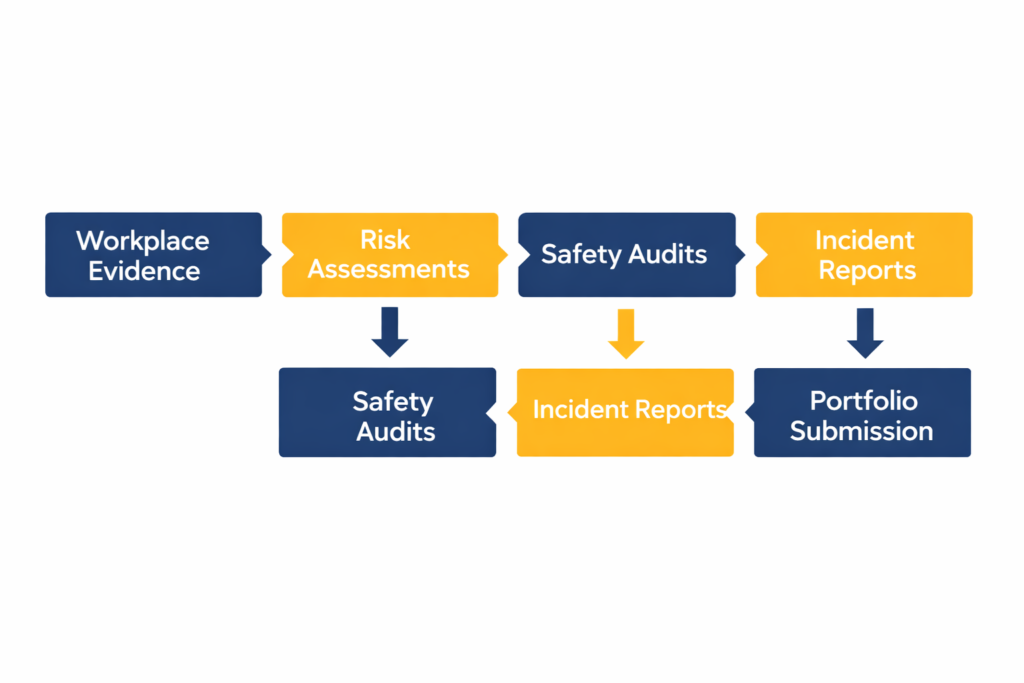
Below are some of the most commonly used forms of evidence in OHS assignments and assessments.
Professional Discussion
A professional discussion is a structured and planned conversation between the learner and an assessor or qualified professional. This discussion allows the learner to demonstrate their knowledge, practical experience, and understanding of occupational health and safety practices.
Professional discussions may involve:
- Explaining workplace safety procedures
- Describing how risk assessments are conducted
- Discussing real safety challenges experienced in the workplace
- Demonstrating knowledge of safety regulations and standards
This method helps assessors confirm that the learner understands the principles of occupational health and safety management and can apply them in real work environments.
Witness Testimony
A witness testimony is a statement provided by a third party who has directly observed the learner performing specific health and safety tasks in the workplace.
The witness is usually:
- A supervisor
- A manager
- A colleague
- A safety officer
The testimony confirms that the learner has demonstrated competence in real work situations related to occupational health and safety management.
Witness testimonies may verify activities such as:
- Conducting safety inspections
- Implementing safety procedures
- Managing workplace hazards
- Leading safety meetings
This evidence provides independent confirmation of the learner’s professional performance.
Candidate Product Evidence
A candidate product refers to tangible work produced by the learner that demonstrates their knowledge and practical skills in occupational health and safety.
These products are usually developed as part of assignments or workplace tasks.
Examples of candidate products include:
- Risk assessment reports
- Safety management plans
- Safety audit reports
- Health and safety procedures
- Training materials
Assessors review these documents to evaluate the learner’s competence against occupational safety standards.
OHS Worksheets
Worksheets are structured documents that guide learners through specific occupational health and safety tasks. They help learners capture data, analyze workplace hazards, and reflect on safety practices.
Worksheets provide a practical way for learners to apply theoretical knowledge in real workplace situations.
Common Types of OHS Worksheets
Hazard Identification Worksheet
This worksheet helps learners identify workplace hazards and assess their potential impact.
It may include columns for:
- Hazard identification
- Risk description
- Affected individuals
- Recommended control measures
Risk Assessment Matrix
A risk assessment matrix allows learners to evaluate risks based on two key factors:
- Likelihood of occurrence
- Severity of consequences
This tool helps prioritize safety actions and determine appropriate control measures.
Safety Inspection Checklist
A safety inspection checklist helps ensure that workplace safety standards are maintained.
Typical checklist items may include:
- Equipment safety
- Workplace housekeeping
- Emergency exits
- Personal protective equipment availability
The checklist may include options such as:
- Compliant
- Non-compliant
- Not applicable
Incident Report Form
An incident report form is used to document workplace accidents or safety incidents.
It typically includes:
- Date and time of incident
- People involved
- Description of the event
- Immediate corrective actions
- Recommendations to prevent recurrence
Safety Training Log
A safety training log records details about training sessions attended by employees.
Information recorded may include:
- Training date
- Training topic
- Trainer name
- Key learning points
This document helps track employee safety training and compliance.
Personal Protective Equipment (PPE) Checklist
This checklist ensures that employees use the correct personal protective equipment for specific tasks.
Typical items checked include:
- Safety helmets
- Gloves
- Safety glasses
- Protective footwear
- High-visibility clothing
Emergency Response Drill Evaluation
This worksheet documents the results of emergency response exercises.
It may include:
- Drill objectives
- Observed outcomes
- Identified weaknesses
- Recommendations for improvement
Safety Procedure Review Worksheet
This document helps learners analyze and review workplace safety procedures.
It may include sections for:
- Procedure steps
- Importance of the procedure
- Observations during implementation
- Questions or recommendations
Safety Legislation and Standards Summary
This worksheet helps learners understand relevant occupational health and safety regulations.
Learners summarize key aspects of:
- Health and safety legislation
- Industry safety standards
- Compliance requirements
Reflective Journaling
Reflective journaling encourages learners to analyze their workplace experiences.
Prompts may include:
- Lessons learned from safety activities
- Challenges faced during safety management tasks
- Improvements for future safety practices
This promotes deeper understanding of occupational health and safety responsibilities.
Ergonomic Assessment Tool
An ergonomic assessment worksheet evaluates workplace ergonomics to improve employee comfort and safety.
Typical factors examined include:
- Chair height and posture
- Screen position
- Lighting conditions
- Workspace layout
Safety Culture Survey
A safety culture survey measures employee perceptions of workplace safety practices.
It may include questions about:
- Management commitment to safety
- Communication of safety policies
- Employee involvement in safety programs
Record of Oral and Written Questioning
A record of oral and written questioning is used to assess a learner’s knowledge and understanding of occupational health and safety topics.
During this process:
- The assessor asks questions related to safety practices
- The learner provides detailed responses
- The responses are documented as evidence of competence
This assessment method ensures that learners have a clear understanding of safety principles.
Recognition of Prior Learning (RPL)
Recognition of Prior Learning (RPL) is a process used to evaluate and acknowledge a learner’s existing skills, knowledge, and experience that were gained outside formal education.
Through RPL, learners may receive credit toward a qualification based on:
- Previous work experience
- Professional training
- Informal learning activities
This process helps individuals avoid repeating learning they have already mastered.
Simulation in OHS Training
Simulation is a learning method where realistic workplace scenarios are created to help learners practice health and safety skills in a controlled environment.
Examples of simulation activities include:
- Emergency evacuation drills
- Fire response simulations
- Hazard identification exercises
These simulations allow learners to develop safety management skills without exposing them to real workplace risks.
Product Evidence
Product evidence refers to physical or documented outputs created by the learner to demonstrate competence in occupational health and safety.
Examples include:
- Safety policies
- Risk assessments
- Incident investigation reports
- Workplace safety plans
These documents provide proof that the learner can apply health and safety principles in real situations.
APA Referencing in OHS Assignments
The APA (American Psychological Association) referencing style is widely used for academic and professional writing.
Using APA referencing in OHS assignments ensures:
- Proper citation of sources
- Academic integrity
- Clear presentation of research information
APA formatting is commonly used when referencing safety regulations, research studies, and professional guidelines.
Accreditation of Prior Learning (APL)
Accreditation of Prior Learning (APL) is a process similar to Recognition of Prior Learning. It recognizes the knowledge and skills individuals have gained from previous education, training, or professional experience.
APL allows learners to:
- Receive credit for prior achievements
- Reduce duplication of learning
- Progress more quickly through qualifications
This process supports flexible learning pathways for professionals working in occupational health and safety.
ProQual NVQ Level 6 OHSP- Potential Evidences
UNIT 1
- Toolbox Talks
- Training Sessions
- Presentations
- Newsletters
- Safety Alerts
- Emails
- Management Review Meeting Minutes
- H&S Committee Meeting Minutes
- Safety bulletins
- Toolbox talks Emails
- Contractor Inductions
- Supplier Questionnaires
- Professional body membership/meetings
- Examples of performance monitoring
- Webinars/seminars CPD Activities
- Meeting appointments Plans/projects
- Webinars/seminars Future CPD Activities
- Future meeting appointments
- Future Plans/projects
UNIT 2
- H&S Policy Organogram/Responsibilities Roles and Responsibilities
- Toolbox Talks
- Inductions Meeting Minutes
- Emails
- Training Sessions
- Applicable Legislation Register / Legal Register
- H&S Policy (if it states applicable legislation)
- Risk Assessments (if showing external people/groups) RAMS
- H&S Policy (if identifying external people/groups)
- Interested parties document
- Current H&S Policy and new amended H&S Policy
- Committee Meeting Minutes Management Review Meeting Minutes
- Current H&S Policy and new amended H&S Policy
- Management Review Meetings
- Committee Meetings
- Inductions
- Document control procedure
- Controlled Document Register
- Evidence of document controls with H&S Policy
UNIT 3
- IOSH Membership IOSH Magazines/emails
- Legislation update subscriptions HSE Bulletins
- Coming in:
- IOSH/HSE bulletins or updates
- HSE Website information – Flowing through:
- Toolbox Talks
- Training Sessions
- Safety Standdowns
- Meeting Minutes
- Going Out:
- Pre-Qualification Questionnaires
- Third Party Accreditation
- Information passed to contractors
- Communicated action plans from results of monitoring.
- Delivered TBTs, Training sessions as a result of monitoring
- H&S promotion activities Committee Meeting minutes discussing monitoring results, performance/promotion activities
- Emails Safety Alerts Posters Newsletters
- Notice Boards
- Emails
- Safety Reports Safety Alerts Newsletters
- Online Portals, Server structures, Filing Systems etc. showing storage of information relating to records such as:
- Supplier/contractor information
- MSDS/COSHH Assessments
- LOLER Inspections
- Equipment inspections
Online Portals, Server structures, Filing Systems etc. showing storage of information relating to records such as:- Supplier/contractor information
- MSDS/COSHH Assessments
- LOLER Inspections
- Equipment inspections
- Training sessions Toolbox Talks Reports Presentation
- RIDDOR Reports
- Accident Reporting Procedure
- Visitor Inductions
- H&S Signage
- H&S relating to products, services waste communicated to stakeholders such as:
- Emails
- Meeting Minutes
- Training sessions etc.
- Contractor induction
- Contractor meeting minutes
UNIT 4
- Training Matrix Competency assessments
- Organisation/Delivery of training
- Induction training with proof of delivery
- Training Sessions with proof of delivery
- Toolbox Talks with proof of delivery
- Course Evaluation
- Statistics, figures which show improvement
- Tests Exams
UNIT 5
- Workplace Inspection form COMPLETE x2
- Workplace inspections Safety Sampling Safety Tour
- Decibel Meters Air Monitoring Light Meters(CAN INCLUDE THIRD PARTY CONSULTANT REPORTS)
- Company server structure Online or Cloud based storage Review process or procedure
- Quality Management Requirements – Risk Assessment which:
- Uses instruments/methods to determine exposure i.e. HAVS Calculator, Noise monitoring, air quality monitoring, COSHH exposure etc.
- Shows the calculation of risk
- Prioritises risks
- Risk Assessment/SSOW Review Audit Results
- Workplace inspections Emails
- Meeting Minutes
- Risk assessment/SSOW Safety Signage
- ACOP’s
- Risk assessment Emails
- Action plans Inspections
- Cost benefit analysis Emails
- Spreadsheet calculations
- Meeting minutes discussing benefits
- Cost benefit analysis Emails
- Spreadsheet calculations
- Meeting minutes discussing benefits
- Meeting minutes Emails
- Management Review
- Risk Assessments Emails
- Meeting Minutes
- Training sessions
- TBTs with proof of delivery External training courses
- Company server structure Online or Cloud based storage Review process or procedure
- Quality Management Requirements
UNIT 6
- Proactive monitoring procedure Workplace instructions
- Certificates Proactive monitoring procedures/instructions
- Training Matrices
- Training Sessions TBT’s
- Safety Committee Meeting Minutes
- Management Review Meetings Emails
- Noise Monitoring Results/ Air Monitoring Results/Light Monitoring Results
- HAV Monitoring
- Risk Assessment/SSOW review Policy Review
- Review of previous workplace inspections
- Previous workplace inspection results
- Review of previous actions
- Committee meeting minutes TBT’s
- Training Sessions Joint inspections
- Process Review Procedure Storage location
- Remedial action log
- Training Sessions Presentations (if they include proactive monitoring statistics) Online notification software
- Monitoring reports with remedial actions included
- Presentations (if they include proactive monitoring statistics)
- Workplace inspection reports
- Committee Meetings Presentations (if they include proactive monitoring statistics) Online notification software Monitoring reports with remedial actions included
- Emails
- Committee Meetings Presentations (if they include proactive monitoring statistics) Online notification software Monitoring reports with remedial actions included
- Monitoring reports with remedial actions included
- Enforcement notices
UNIT 7
- Accident Reporting Procedure if it includes types of loss event
- Accident Reporting Form NOT INVESTIGATION FORM
- Accident Reporting Procedure
- Training Sessions Meeting Minutes TBT’s
- Accident Record Book Online storage of documents
- Accident Reporting Procedure
- Accident Reporting Investigation Procedure
- Training Sessions Meeting Minutes TBT’s
- Strategy for implementation
- Accident Investigation completed by yourself
- Emails
- Meeting Minutes Presentations Safety Reports
- Action Trackers Action Plans
- Implementation of additional controls
- Online Storage directories
- LTI statistics
- Accident by injury information Accident by area/site information Accident by time-of-day information
- Online Server Locations Online Cloud based storage locations
- Emails Presentations Meeting Minutes Reports
- Reactive monitoring reports/results Action log/tracker
- RIDDOR Reports Accident Reporting Procedure/process
UNIT 8
- Emergency Response Procedures
- Training Matrices Competence Certificates
- Inspection of first aid equipment Inspection of firefighting equipment Inspection of sounding alarms
- Meeting Minutes Training Sessions Emails – Feedback on procedure
- Server storage locations Cloud based storage locations Notice Boards etc.
- Emergency Response Procedure showing review dates
- Media response procedures Emails to regulatory authorities
- Any policies relating to media statements
- Inductions Training Sessions TBT’s
- Meeting minutes
- Workplace inspections which include checks on emergency related equipment
- Emergency Response Procedures MUST INCLUDE COMPETENCIES
- Training Matrix
- Emails
- Training sessions Presentations
- Meeting Minutes Identification of hospitals etc.
- Emails to regulatory authorities Any policies relating to media statements
- Accident investigation policy/procedure
- Online storage systems Servers
UNIT 9
- Management system procedures
- Online folders showing management system
- Certifications
- Management system procedures.
- Online folders showing management system.
- Certifications.
- Policies
- Working Procedures
- Policies, procedures, statutory requirements, client/insurance requirements
- Management review meeting minutes
Emails / Presentations - Training presentations, Emails, Toolbox Talks communications with employee forums, trade unions etc.
- Online/cloud-based systems/remedial action logs
- Management review meeting minutes.
- Reports.
- Management review meeting minutes
- Reports Training Presentations
- Remedial Action plans
- Online storage systems
UNIT 10
- IOSH Membership IOSH Magazine
- HSE Bulletins/updates SHP Magazine – Legal updates
- Changes to operations Changes to policies/RA
- Consider COVID, Welding fume etc.
- Training Sessions TBT’s – Internal magazines/articles Emails
- Meeting Minutes
- IOSH Branch Meetings Internal meeting minutes Steering groups
- H&S Committee Meetings
- Evidence of CPD
- Certificates etc.
- IOSH CPD Summary
- CPD Template from resources
- section
- H&S Committee meetings Steering groups
- Project work – H&S Performance Reviews
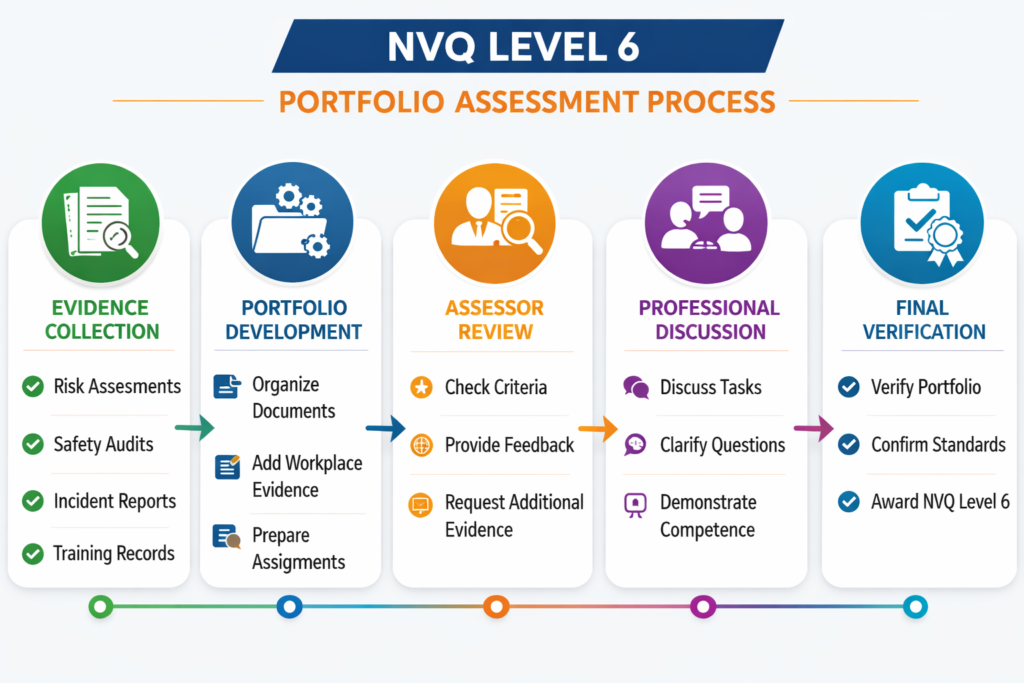
How the Portfolio is Assessed
The NVQ Level 6 portfolio is reviewed by a qualified assessor who evaluates the learner’s evidence against the required competency standards.
The assessment process typically involves:
- Portfolio review by the assessor
- Feedback and guidance from the assessor
- Professional discussions if required
- Final verification of the portfolio
Once all requirements are successfully met, the learner is awarded the NVQ Level 6 Diploma in Occupational Health and Safety Practice.
Tips for Building a Strong NVQ Level 6 Portfolio
To successfully complete the qualification, learners should focus on building a well-organized and comprehensive portfolio.
Some helpful tips include:
- Collect workplace evidence regularly
- Keep detailed records of safety activities
- Include real examples from your workplace
- Organize documents clearly within the portfolio
- Follow assessor guidance carefully
A well-prepared portfolio helps demonstrate professional competence and makes the assessment process smoother.
Learn More About NVQ Level 6 Health and Safety
If you are interested in enrolling in the qualification, you can learn more about the ProQual Level 6 NVQ Diploma in Occupational Health and Safety Practice and how it supports professional development in occupational safety management.
The NVQ Level 6 portfolio requirements are designed to ensure that learners demonstrate real workplace competence in managing health and safety systems. By compiling evidence such as risk assessments, safety audits, incident investigations, and training documentation, professionals can prove their ability to manage occupational health and safety responsibilities effectively.
Completing the portfolio successfully allows learners to achieve the NVQ Level 6 Diploma in Occupational Health and Safety Practice, a qualification that can significantly enhance career opportunities in the health and safety profession.