
How to Become a Safety Officer?
How to Become a Safety Officer?(Complete Career Guide 2026)
Workplace safety has become a critical priority for organizations across the globe as industries continue to expand and regulatory requirements become more stringent. Governments, international regulatory bodies, and corporate organizations now emphasize strict compliance with occupational health and safety standards to protect employees, reduce workplace accidents, and ensure sustainable business operations. As a result, companies operating in sectors such as construction, oil and gas, manufacturing, logistics, engineering, energy, and infrastructure development increasingly rely on trained safety professionals to manage workplace risks and maintain safe working environments.
A Safety Officer plays a vital role in this process by identifying potential hazards, implementing safety policies and procedures, and ensuring that all workplace activities comply with local and international health and safety regulations. Their responsibilities include conducting risk assessments, performing site inspections, delivering safety training to employees, investigating incidents, and promoting a strong safety culture within organizations. By proactively managing workplace risks, safety officers help prevent accidents, injuries, and operational disruptions while ensuring that companies meet legal and regulatory obligations.
In recent years, the demand for qualified safety professionals has grown significantly due to rapid industrial development, stricter safety regulations, and increased awareness of occupational health and safety practices. Large-scale construction projects, industrial plants, energy facilities, and multinational companies require dedicated safety officers to monitor workplace safety and ensure compliance with established standards. This growing demand has made occupational health and safety one of the most promising and stable career paths globally.
What Does a Safety Officer Do?
A Safety Officer is responsible for ensuring workplace safety and minimizing risks by implementing occupational health and safety policies.
Key Responsibilities
- Conduct workplace risk assessments
- Identify potential hazards
- Implement safety policies and procedures
- Monitor compliance with safety regulations
- Provide safety training to employees
- Investigate workplace accidents and incidents
- Prepare safety reports and documentation
- Ensure proper use of Personal Protective Equipment (PPE)
Safety officers play a critical role in protecting workers and preventing workplace injuries.

A key responsibility of a safety officer is identifying and controlling workplace risks. To understand this in detail, read our guide on common workplace hazards and how to prevent them.
Why Choose a Career as a Safety Officer?
A career in Occupational Health and Safety (OHS) is highly rewarding and increasingly important in today’s industrial world. As organizations place greater emphasis on employee wellbeing, regulatory compliance, and risk prevention, the role of safety professionals has become essential across almost every major industry. From large construction projects and oil & gas facilities to manufacturing plants and logistics operations, companies rely on qualified Safety Officers to ensure safe working environments and minimize operational risks.
Choosing a career as a Safety Officer not only offers strong job security but also provides opportunities for continuous professional development and international employment. With the right certifications and experience, safety professionals can build successful careers in both local and global markets while contributing to the protection of workers and the improvement of workplace standards.
Key Benefits of Becoming a Safety Officer
- High Global Demand
The demand for safety professionals continues to grow worldwide as governments enforce stricter safety regulations and organizations invest more in workplace safety management systems. - Competitive Salary Packages
Safety officers often receive attractive salary packages, especially in industries such as construction, oil and gas, energy, and large infrastructure projects. - International Career Opportunities
Qualified safety professionals are in demand across many countries, particularly in the Middle East, Europe, Australia, and North America, offering opportunities to work on international projects. - Strong Career Stability
Safety roles are essential in almost every industry, making this profession relatively stable even during economic fluctuations. - Opportunity to Protect Lives
One of the most meaningful aspects of this profession is the ability to protect workers, prevent accidents, and contribute to safer and healthier workplaces. - Clear Career Progression
The safety profession offers structured career advancement opportunities, allowing professionals to progress from Safety Officer to senior roles such as HSE Manager, Safety Consultant, or Safety Director.
Step-by-Step Guide to Become a Safety Officer
Step 1: Complete Basic Education
The minimum educational requirement to become a safety officer is:
- Intermediate (12th grade) or equivalent
However, many employers prefer candidates with:
- Diploma in Occupational Health and Safety
- Engineering degree
- Environmental science background
Step 2: Obtain Professional Safety Certifications
Professional certifications are essential for building a career in health and safety.
Most Popular Safety Certifications for Safety Officers
To build a successful career as a Safety Officer, obtaining internationally recognized safety certifications is extremely important. These certifications provide essential knowledge about workplace hazards, safety management systems, regulatory compliance, and risk prevention strategies. Employers in industries such as construction, oil and gas, manufacturing, and engineering often prefer candidates who hold professional safety certifications because they demonstrate practical competence and a strong understanding of occupational health and safety practices.
Below are some of the most widely recognized safety certifications that can help individuals start or advance their careers in the safety profession.
IOSH Managing Safely
IOSH Managing Safely is one of the most popular entry-level safety certifications designed for managers, supervisors, and professionals who are responsible for workplace safety. The course is developed by the Institution of Occupational Safety and Health (IOSH), UK, which is one of the world’s leading professional bodies for health and safety.
This certification provides learners with a solid foundation in occupational health and safety principles and helps them understand how to manage risks effectively in the workplace.
Key topics covered in the IOSH Managing Safely course include:
- Identifying workplace hazards
- Conducting risk assessments
- Understanding safety responsibilities
- Investigating accidents and incidents
- Measuring and improving safety performance
IOSH Managing Safely is widely accepted in many industries and is often considered a starting point for individuals who want to enter the safety profession.
OSHA Safety Certification (OSHA 30 / OSHA 48 Hours)
OSHA safety certifications are developed based on the standards of the Occupational Safety and Health Administration (OSHA), USA, which regulates workplace safety in the United States. OSHA training programs are widely recognized around the world, particularly in industries such as construction, manufacturing, and industrial operations.
Common OSHA safety courses include:
- OSHA 30 Hours General Industry
- OSHA 30 Hours Construction Safety
- OSHA 48 Hours Advanced Safety Training
These courses focus on practical safety knowledge and hazard prevention techniques used in real workplace environments.
Key learning areas include:
- Workplace hazard identification
- Fall protection and working at heights safety
- Electrical safety practices
- Personal protective equipment (PPE)
- Fire prevention and emergency response
- Occupational safety regulations and compliance
OSHA certifications are highly valued by employers, especially for professionals seeking job opportunities in construction projects, industrial facilities, and international workplaces.
Level 3 Certificate / Diploma in Health and Safety
The Level 3 Certificate or Diploma in Health and Safety is a foundational professional qualification designed for individuals who want to start or advance their careers in occupational health and safety management. This qualification provides learners with essential knowledge and practical skills required to identify workplace hazards, manage risks, and implement effective safety procedures in different industries.
Level 3 health and safety qualifications are widely recognized by employers in sectors such as construction, manufacturing, oil and gas, logistics, engineering, and industrial operations. These programs are ideal for aspiring safety officers, supervisors, team leaders, and professionals responsible for workplace safety.
The qualification focuses on building a strong understanding of occupational health and safety principles and preparing learners to contribute to safer working environments.
Key Topics Covered in Level 3 Health and Safety Programs
- Fundamentals of occupational health and safety management
- Risk assessment and hazard identification
- Workplace health and safety regulations and compliance
- Safe systems of work and accident prevention strategies
- Fire safety and emergency response planning
- Use of personal protective equipment (PPE)
- Incident reporting and basic accident investigation
Completing a Level 3 Certificate or Diploma in Health and Safety can significantly improve career opportunities and serves as an excellent stepping stone for higher-level qualifications such as advanced health and safety diplomas or professional safety certifications. It also helps individuals build the knowledge and confidence required to work effectively in roles such as Safety Assistant, Safety Officer, or Health and Safety Coordinator.
NVQ Level 6 Diploma in Occupational Health and Safety
The NVQ Level 6 Diploma in Occupational Health and Safety Practice is an advanced professional qualification designed for experienced safety professionals who want to move into leadership and management roles. This qualification is regulated within the UK Regulated Qualifications Framework (RQF) and is equivalent to a Bachelor’s degree level qualification.
Unlike traditional academic courses, NVQ Level 6 is a competency-based qualification, meaning it is assessed based on practical workplace experience rather than written exams.
This qualification focuses on advanced topics such as:
- Developing and implementing safety management systems
- Leading organizational safety culture
- Strategic risk management
- Compliance with international safety standards
- Managing workplace health and safety performance
Professionals who complete NVQ Level 6 often progress to senior roles such as HSE Manager, Safety Consultant, or Health and Safety Director.
Essential Skills for Safety Officers
Successful safety professionals possess a combination of technical knowledge and leadership abilities.
Key Skills
- Risk assessment and hazard identification
- Safety auditing and inspections
- Incident investigation
- Knowledge of safety regulations
- Communication and leadership
- Emergency response management
- Problem-solving and decision-making
These skills enable safety officers to create effective safety programs in organizations.
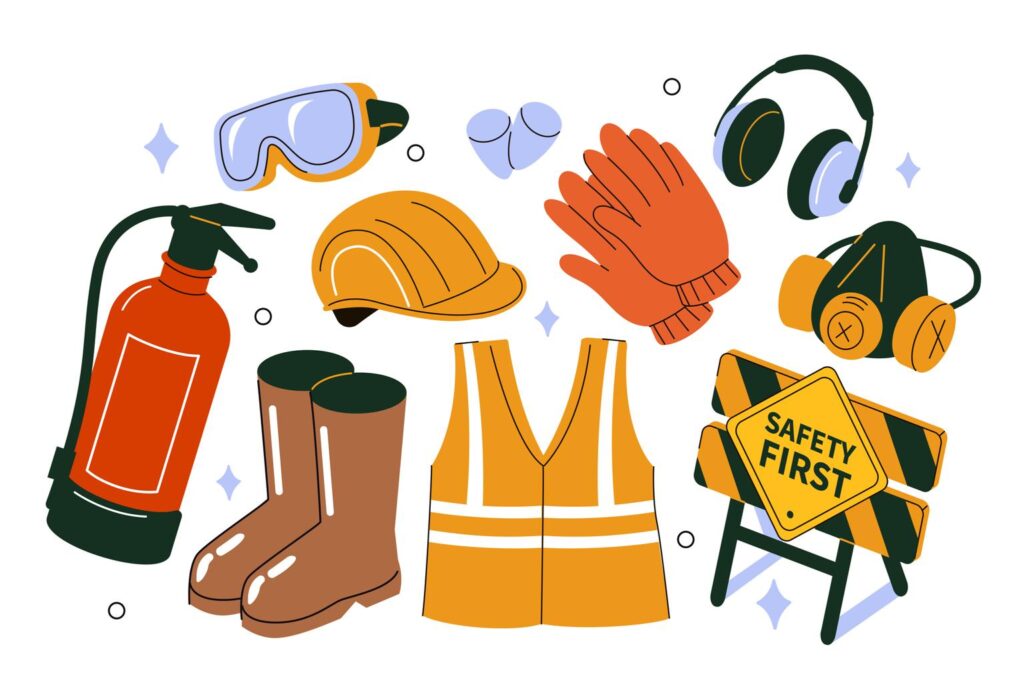
Industries Hiring Safety Officers
Safety professionals are required across many industries.
Major Industries
- Construction
- Oil & Gas
- Manufacturing
- Chemical plants
- Logistics and transportation
- Power generation
- Mining
- Engineering projects
Large construction and industrial projects require multiple safety professionals to ensure compliance with safety regulations.
Safety Officer Salary
Safety officer salaries vary based on experience, certifications, and industry.
Pakistan
Entry Level
PKR 60,000 – 120,000 per month
Experienced
PKR 150,000 – 300,000 per month
Gulf Countries
Entry Level
AED 3000 – 6000
Experienced
AED 8000 – 15000
Professionals with NVQ Level 6 certifications typically earn higher salaries.
Career Progression in Safety Profession
The field of Occupational Health and Safety (OHS) offers a well-defined and structured career path with strong opportunities for professional growth and leadership. As industries continue to strengthen workplace safety standards and regulatory compliance, experienced safety professionals are increasingly valued by organizations across sectors such as construction, oil & gas, manufacturing, energy, and infrastructure development.
A career in safety typically begins with entry-level roles where professionals gain practical field experience in hazard identification, safety inspections, and compliance monitoring. With time, additional certifications, and industry experience, safety professionals can progress into senior technical and managerial roles responsible for developing safety strategies, leading safety teams, and implementing organizational safety management systems.
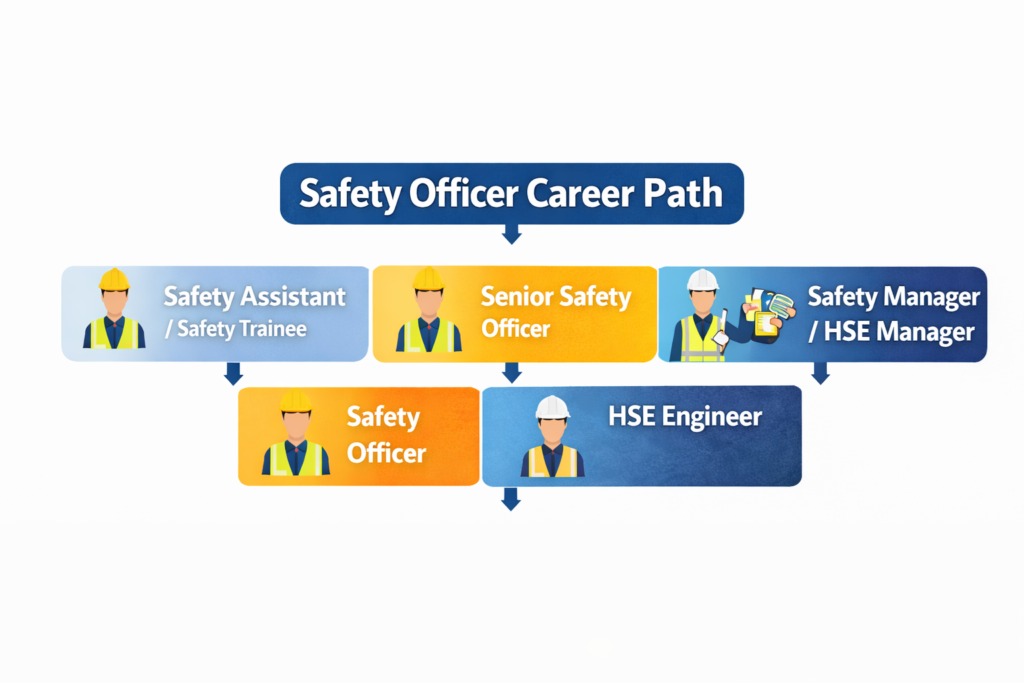
Below is the typical career progression path in the safety profession:
1. Safety Assistant / Safety Trainee
This is usually the entry-level position for individuals starting their careers in occupational health and safety. In this role, professionals assist senior safety staff in monitoring workplace safety and implementing safety procedures.
Key responsibilities include:
- Assisting with site safety inspections
- Monitoring the use of personal protective equipment (PPE)
- Reporting unsafe conditions and hazards
- Supporting safety training sessions
- Maintaining basic safety documentation
This stage helps professionals gain practical field exposure and foundational safety knowledge.
2. Safety Officer
After gaining initial experience and obtaining professional safety certifications such as IOSH or OSHA, individuals can progress to the role of Safety Officer.
Safety Officers are responsible for actively managing workplace safety systems and ensuring compliance with safety regulations.
Common responsibilities include:
- Conducting risk assessments and hazard analysis
- Implementing workplace safety policies and procedures
- Monitoring compliance with safety standards
- Investigating accidents and incidents
- Delivering safety training and awareness programs
This role is considered the core operational position in occupational health and safety management.
3. Senior Safety Officer
With several years of experience, safety professionals may be promoted to Senior Safety Officer, where they take on greater responsibility in supervising safety operations and mentoring junior safety staff.
Typical responsibilities include:
- Leading safety inspections and audits
- Supervising safety officers and assistants
- Managing incident investigations
- Ensuring compliance with company and regulatory safety standards
- Coordinating with project managers and engineering teams
Professionals at this level often work on large projects or complex industrial environments.
4. HSE Engineer
The role of Health, Safety, and Environment (HSE) Engineer combines technical engineering knowledge with advanced safety management practices. This position is commonly found in industries such as oil & gas, manufacturing, and large construction projects.
Responsibilities may include:
- Developing safety management systems
- Conducting advanced risk assessments
- Designing safety procedures for complex operations
- Evaluating environmental and occupational risks
- Ensuring compliance with international safety standards
Professionals in this role typically hold advanced safety qualifications and strong technical expertise.
5. Safety Manager / HSE Manager
At the management level, Safety Managers are responsible for overseeing the entire health and safety framework of an organization or project.
Their responsibilities include:
- Developing organizational safety policies and strategies
- Managing safety teams and safety programs
- Conducting high-level safety audits and compliance reviews
- Coordinating with regulatory authorities and stakeholders
- Promoting a strong workplace safety culture
This role requires significant experience along with professional qualifications such as NEBOSH or NVQ Level 6 Diploma in Occupational Health and Safety.
6. HSE Director / Head of Safety
The HSE Director or Head of Health and Safety represents the highest level of leadership in the safety profession. Individuals in this position are responsible for setting the strategic direction of workplace safety across large organizations or multinational companies.
Key responsibilities include:
- Developing long-term safety strategies and policies
- Leading corporate safety governance and compliance
- Managing large safety departments and teams
- Advising executive leadership on safety risks and regulatory matters
- Driving continuous improvement in safety performance
This role requires extensive experience, advanced qualifications, and strong leadership capabilities.
Long-Term Career Growth
With continuous professional development, internationally recognized certifications, and strong industry experience, safety professionals can advance into senior leadership roles, consultancy positions, or international safety management careers. The growing global emphasis on workplace safety ensures that qualified safety professionals will continue to have strong career opportunities and long-term professional stability.
How Long Does It Take to Become a Safety Officer?
The time required depends on the certifications and training you pursue.
Typical timeline:
- Basic safety certification: 1–3 months
- Advanced safety qualification: 6–12 months
- Professional experience: 1–3 years
Global Demand for Safety Officers
The demand for occupational health and safety professionals continues to increase due to strict workplace safety regulations and corporate compliance requirements.
Countries with high demand include:
- UAE
- Saudi Arabia
- Qatar
- United Kingdom
- Canada
- Australia
Industries such as construction, oil & gas, and infrastructure projects constantly require qualified safety professionals.
Tips to Build a Successful Safety Career
If you want to succeed in the safety profession, follow these tips:
- Obtain internationally recognized certifications
- Gain practical field experience
- Stay updated with safety regulations
- Develop leadership and communication skills
- Participate in professional safety training
Continuous learning is essential for long-term success in the safety industry.
Becoming a Safety Officer is an excellent career choice for individuals who want to work in a responsible and impactful profession. With the right training, certifications, and practical experience, you can build a successful career in occupational health and safety across various industries worldwide.
By earning internationally recognized safety certifications and continuously improving your skills, you can advance to senior safety and management roles in the future.