
ISO 21001 vs ISO 9001: Which Standard Is Better for Educational Organizations?
Educational institutions today operate in an increasingly competitive environment where learners, employers, regulators, accreditation bodies, and other stakeholders expect consistent quality, measurable outcomes, and continuous improvement. To meet these expectations, many organizations turn to internationally recognized management system standards.
Two of the most widely discussed standards are ISO 9001, the globally recognized Quality Management System (QMS) standard, and ISO 21001, the Educational Organizations Management System (EOMS) standard designed specifically for the education sector.
While both standards share a common management system structure and promote continual improvement, they serve different purposes. Educational organizations often ask:
- Is ISO 21001 better than ISO 9001?
- Should schools and universities implement ISO 21001 or ISO 9001?
- Can educational institutions benefit from both standards?
- Which certification delivers greater value for learners and stakeholders?
This guide provides a detailed comparison of ISO 21001 and ISO 9001 to help educational organizations make an informed decision.
| Feature | ISO 21001 | ISO 9001 |
|---|---|---|
| Purpose | Educational Management System | Quality Management System |
| Designed For | Educational Organizations | All Industries |
| Main Focus | Learners | Customers |
| Educational Outcomes | Yes | No |
| Teaching Processes | Yes | No |
| Global Recognition | Yes | Yes |
What Is ISO 9001?
ISO 9001 is the world’s most widely adopted Quality Management System (QMS) standard. It provides a framework for organizations to consistently deliver products and services that meet customer requirements while improving operational efficiency and customer satisfaction.
The standard can be applied to virtually any industry, including:
- Manufacturing
- Healthcare
- Construction
- Technology
- Government
- Education
- Professional services
ISO 9001 focuses on:
- Customer satisfaction
- Process management
- Risk-based thinking
- Leadership commitment
- Performance evaluation
- Continual improvement
Because it is a generic management system standard, ISO 9001 can be implemented by organizations of any size and sector.
What Is ISO 21001?
ISO 21001 is an Educational Organizations Management System (EOMS) standard developed specifically for organizations that provide education, training, assessment, or learning support services.
The standard was created to address the unique needs of educational institutions that are not fully covered by generic quality management standards.
ISO 21001 focuses on:
- Learner satisfaction
- Educational outcomes
- Accessibility and inclusivity
- Educational effectiveness
- Stakeholder engagement
- Teaching and learning processes
- Educational governance
It applies to:
- Schools
- Colleges
- Universities
- Vocational institutions
- Training centres
- E-learning providers
- Corporate training departments
Why Was ISO 21001 Developed?
Before ISO 21001 was introduced, many educational institutions implemented ISO 9001 to improve quality management.
Although ISO 9001 provided valuable process controls, it did not specifically address:
- Learner needs
- Educational outcomes
- Curriculum development
- Teaching effectiveness
- Learning support services
- Educational accessibility
- Academic performance measurement
ISO 21001 was developed to fill this gap by providing a management system framework specifically designed for educational organizations.
What Is ISO 21001:2025? Complete Guide to Educational Organizations Management System Certification
ISO 21001 vs ISO 9001: Key Differences
| Feature | ISO 21001 | ISO 9001 |
|---|---|---|
| Full Name | Educational Organizations Management System | Quality Management System |
| Primary Focus | Education and Learning | Products and Services |
| Target Sector | Educational Organizations | All Industries |
| Main Beneficiary | Learners | Customers |
| Educational Outcomes | Required | Not Specific |
| Curriculum Management | Included | Not Included |
| Accessibility and Inclusion | Strong Focus | Limited Focus |
| Learner Satisfaction | Core Requirement | Indirect Requirement |
| Teaching and Learning Processes | Covered | Generic Approach |
| Educational Stakeholders | Specifically Addressed | General Stakeholders |
| Education Sector Relevance | Very High | Moderate |
| Industry Applicability | Education Sector | All Sectors |
Similarities Between ISO 21001 and ISO 9001
Although ISO 21001 and ISO 9001 are designed for different sectors, they are built upon many of the same quality management principles. ISO 21001 was developed using the same management system framework as ISO 9001, which means both standards share a common structure, terminology, and approach to organizational management. Their primary objective is to help organizations improve performance, enhance stakeholder satisfaction, manage risks effectively, and create a culture of continual improvement.
Both standards encourage organizations to adopt systematic management practices that support consistency, accountability, and long-term success. While ISO 21001 is specifically tailored for educational organizations and ISO 9001 is applicable across all industries, their core management requirements are remarkably similar.
Leadership Commitment
Strong leadership is a fundamental requirement in both ISO 21001 and ISO 9001. Top management is expected to take responsibility for the effectiveness of the management system and ensure that quality objectives align with the organization’s strategic direction. Leaders must provide the necessary resources, establish policies, communicate organizational goals, and actively support continual improvement initiatives.
Key aspects of leadership commitment include:
• Establishing a clear vision and quality policy.
• Defining measurable organizational objectives.
• Allocating resources to achieve desired outcomes.
• Promoting a culture of quality and accountability.
• Supporting continual improvement across all functions.
• Ensuring compliance with relevant requirements and expectations.
Effective leadership creates a strong foundation for successful implementation and long-term sustainability of the management system.
Risk-Based Thinking
Both standards emphasise the importance of identifying risks and opportunities that may affect organizational performance. Risk-based thinking enables organizations to anticipate challenges, prevent potential problems, and take advantage of opportunities for improvement and growth.
Organizations are encouraged to:
• Identify internal and external risks.
• Assess the potential impact of identified risks.
• Implement controls to reduce negative consequences.
• Monitor emerging threats and opportunities.
• Improve resilience and business continuity.
• Support informed and proactive decision-making.
This approach helps organizations remain adaptable and responsive in a constantly changing environment.
Process Approach
A process-based approach is one of the key principles shared by ISO 21001 and ISO 9001. Organizations are encouraged to manage activities as interconnected processes that work together to achieve strategic objectives. Understanding these relationships helps improve efficiency, consistency, and overall performance.
Benefits of a process approach include:
• Better coordination between departments and functions.
• Clear definition of responsibilities and accountabilities.
• Improved operational efficiency and productivity.
• Consistent delivery of products, services, or educational programmes.
• Enhanced monitoring and performance measurement.
• Greater control over organizational activities.
Managing processes systematically enables organizations to achieve more predictable and reliable outcomes.
Continual Improvement
Continual improvement is a central principle of both standards. Organizations are expected to regularly evaluate their performance, identify opportunities for enhancement, and implement corrective and preventive actions where necessary. This ongoing commitment to improvement helps organizations remain competitive and responsive to stakeholder needs.
Common improvement activities include:
• Monitoring performance indicators and objectives.
• Analysing stakeholder feedback.
• Investigating non-conformities and root causes.
• Implementing corrective actions.
• Reviewing processes and procedures.
• Identifying opportunities for innovation and development.
A culture of continual improvement encourages long-term growth and operational excellence.
Evidence-Based Decision Making
Both ISO 21001 and ISO 9001 require organizations to make decisions based on objective evidence rather than assumptions. Reliable data and performance information help leaders and managers make informed choices that support organizational objectives and continuous improvement.
Organizations commonly use:
• Performance metrics and key performance indicators.
• Stakeholder satisfaction surveys.
• Audit findings and compliance reports.
• Operational and financial data.
• Risk assessment results.
• Performance reviews and trend analyses.
Using factual information improves decision quality, reduces uncertainty, and supports more effective management practices.
Internal Audits
Internal audits play a vital role in both standards by helping organizations evaluate whether their management systems are functioning effectively and complying with established requirements. Audits provide valuable insights into strengths, weaknesses, risks, and opportunities for improvement.
Internal audits help organizations:
• Verify compliance with standard requirements.
• Assess the effectiveness of processes and controls.
• Identify non-conformities and gaps.
• Improve operational performance.
• Prepare for external certification audits.
• Support continual improvement initiatives.
Regular auditing strengthens governance, accountability, and organizational effectiveness.
Stakeholder Focus
Both standards recognise that organizational success depends on understanding and meeting the needs of stakeholders. While ISO 9001 focuses primarily on customers and customer satisfaction, and ISO 21001 places greater emphasis on learners and educational stakeholders, both standards require organizations to actively engage with interested parties and respond to their expectations.
Important stakeholder-focused activities include:
• Identifying stakeholder needs and expectations.
• Gathering and analysing feedback.
• Addressing complaints and concerns promptly.
• Monitoring satisfaction levels.
• Improving services based on stakeholder input.
• Building trust and confidence through transparency.
A stakeholder-focused approach strengthens relationships and contributes to sustainable success.
Performance Evaluation and Monitoring
To ensure objectives are achieved, both standards require organizations to monitor, measure, analyse, and evaluate performance. Performance evaluation provides management with valuable information about organizational effectiveness and areas requiring improvement.
Performance evaluation activities include:
• Establishing measurable objectives and targets.
• Monitoring progress against key indicators.
• Conducting performance reviews.
• Analysing trends and results.
• Reporting findings to management.
• Implementing improvement actions where necessary.
Regular monitoring helps organizations maintain control over their operations and continuously improve performance.
Competence and Resource Management
Both standards recognise that competent personnel and adequate resources are essential for achieving organizational objectives. Organizations must ensure that employees have the appropriate knowledge, skills, training, and support required to perform their roles effectively.
Key requirements include:
• Identifying competency requirements.
• Providing training and professional development.
• Evaluating training effectiveness.
• Maintaining suitable facilities and infrastructure.
• Ensuring access to appropriate technology and equipment.
• Supporting personnel with adequate resources.
Investing in people and resources enhances efficiency, quality, and organizational performance.
Documented Information and Compliance
Effective documentation is another common requirement shared by ISO 21001 and ISO 9001. Organizations must maintain documented information necessary to support operations, demonstrate compliance, and provide evidence of effective management system implementation.
Examples of documented information include:
• Policies and procedures.
• Operational records.
• Audit reports.
• Risk assessments.
• Performance measurement data.
• Corrective action records.
• Management review documentation.
Proper documentation promotes consistency, accountability, transparency, and continual improvement.
Despite their different areas of application, ISO 21001 and ISO 9001 share many fundamental principles that contribute to organizational excellence. Both standards emphasise leadership commitment, risk-based thinking, process management, stakeholder satisfaction, evidence-based decision-making, internal auditing, performance evaluation, and continual improvement. These shared principles enable organizations to improve effectiveness, strengthen stakeholder confidence, and achieve sustainable success. However, ISO 21001 extends these principles further by incorporating specific requirements designed to address the unique needs of educational organizations and learners.
Which Standard Is Better for Educational Organizations?
For most educational institutions, ISO 21001 is generally the more relevant standard because it was specifically designed for the education sector.
ISO 21001 addresses issues that are critical to educational success, including:
- Learner engagement
- Educational quality
- Accessibility
- Academic performance
- Curriculum effectiveness
- Stakeholder satisfaction
Schools, colleges, universities, and training providers typically gain greater value from ISO 21001 than from ISO 9001 alone.
Benefits of ISO 21001 for Educational Organizations
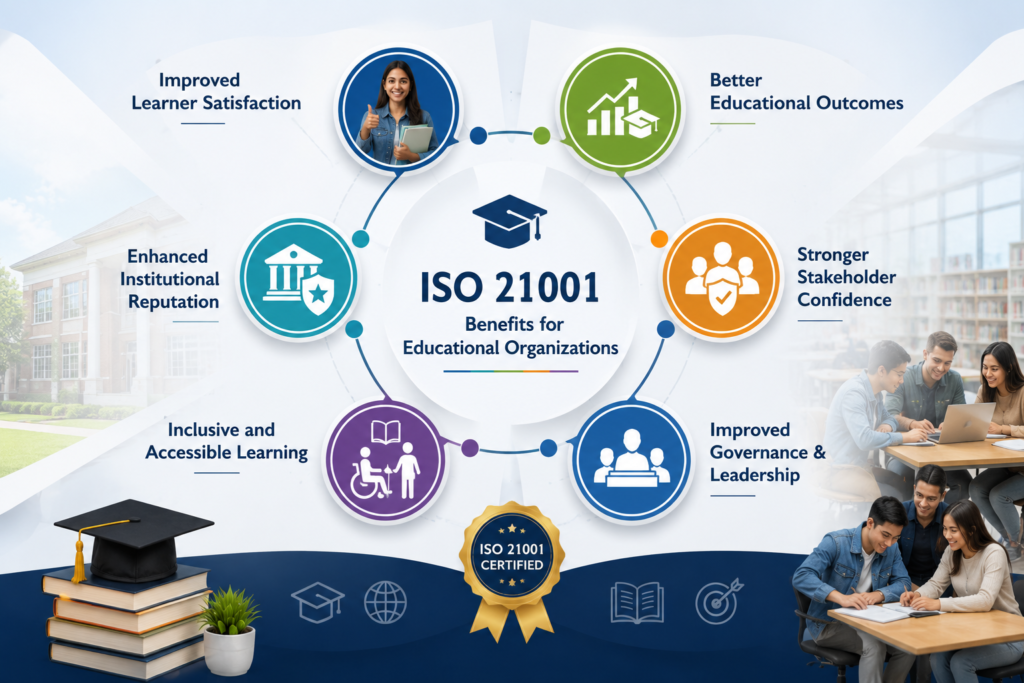
Improved Learner Satisfaction
One of the primary benefits of ISO 21001 is its strong focus on learners and their educational experience. The standard encourages educational organizations to identify learner needs, expectations, and objectives and align their services accordingly. By implementing learner-centred policies and processes, institutions can improve engagement, increase satisfaction levels, and create a more positive learning environment. This approach helps learners feel supported throughout their educational journey, resulting in higher retention and success rates.
Better Educational Outcomes
ISO 21001 is specifically designed to improve the quality of teaching, learning, and assessment processes. The standard helps institutions establish clear educational objectives, monitor learner performance, and evaluate the effectiveness of educational programmes. By continuously measuring outcomes and implementing improvements, organizations can enhance academic achievement, skill development, and overall learner success. This focus on educational excellence ensures that learners receive high-quality education that meets industry and societal needs.
Enhanced Institutional Reputation
Achieving ISO 21001 certification demonstrates an organization’s commitment to delivering high-quality education and maintaining internationally recognised management practices. Educational institutions that adopt the standard often gain a competitive advantage by showcasing their dedication to excellence, transparency, and continuous improvement. This can enhance their reputation among learners, parents, employers, accreditation bodies, and other stakeholders, helping to attract more learners and strengthen their market position.
Stronger Stakeholder Confidence
Educational organizations serve a wide range of stakeholders, including learners, parents, employers, regulatory authorities, accreditation agencies, and funding bodies. ISO 21001 provides a structured framework for managing educational quality and ensuring accountability. Certification reassures stakeholders that the institution follows consistent and effective management processes, resulting in greater trust and confidence in its educational services, qualifications, and outcomes.
Inclusive and Accessible Learning
A unique feature of ISO 21001 is its emphasis on accessibility, equity, and social responsibility. The standard encourages organizations to create inclusive learning environments that accommodate diverse learner needs, including individuals with disabilities, different cultural backgrounds, and varying learning abilities. By promoting equal access to educational opportunities, institutions can improve learner participation, reduce barriers to learning, and support educational inclusion.
Improved Governance and Leadership
ISO 21001 strengthens leadership involvement in educational management by requiring top management to establish clear objectives, policies, and responsibilities. Leaders are encouraged to actively support quality initiatives and ensure that educational goals align with the institution’s mission and vision. Strong leadership contributes to better decision-making, improved accountability, and more effective organizational performance.
Data-Driven Decision Making
The standard promotes the use of evidence-based decision-making processes. Educational institutions are encouraged to collect, analyse, and evaluate data related to learner performance, stakeholder feedback, operational effectiveness, and educational outcomes. This enables management to identify strengths, address weaknesses, and make informed decisions that support continuous improvement and educational excellence.
Continuous Improvement Culture
Continuous improvement is a core principle of ISO 21001. Educational organizations regularly assess their performance through monitoring, internal audits, management reviews, and stakeholder feedback. This systematic approach helps institutions identify opportunities for improvement, implement corrective actions, and enhance the effectiveness of their educational services over time. As a result, organizations develop a culture of innovation, quality enhancement, and lifelong learning.
Greater International Recognition
As an internationally recognised standard, ISO 21001 helps educational institutions demonstrate their commitment to global best practices. Certification can improve credibility in international markets, support partnerships with overseas institutions, and attract learners from different countries. This is particularly valuable for universities, training providers, and educational organizations seeking to expand their global presence.
Benefits of ISO 9001 for Educational Organizations
Although ISO 9001 was not specifically developed for the education sector, it can still provide substantial benefits for schools, colleges, universities, and training providers by improving overall organizational performance and service quality.
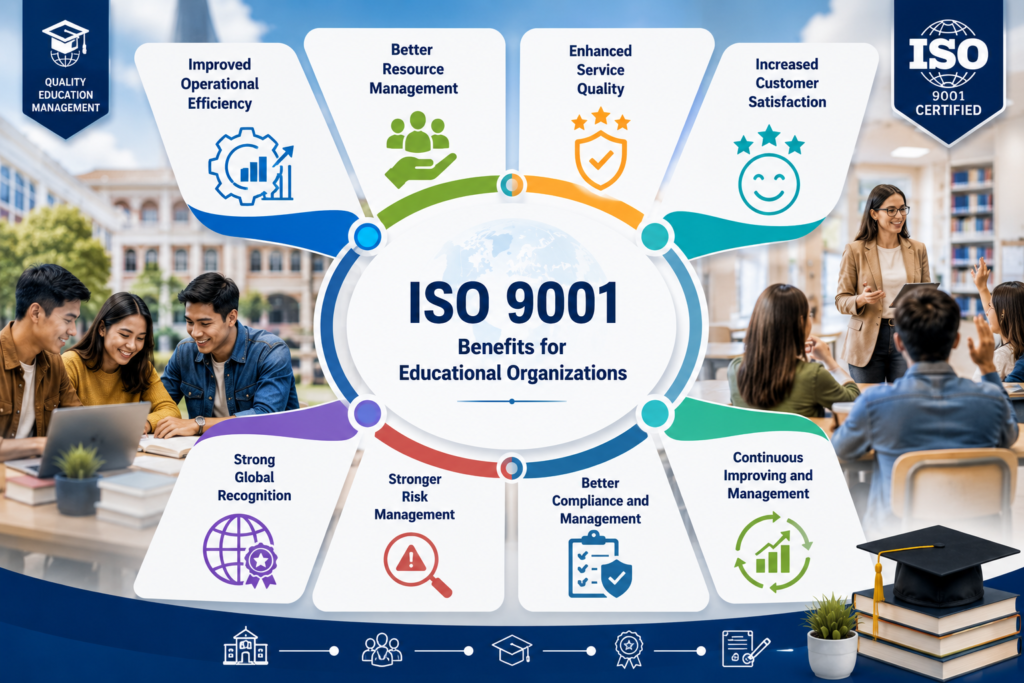
Improved Operational Efficiency
ISO 9001 helps educational organizations establish well-defined processes and procedures for managing their operations. Standardised workflows reduce inefficiencies, minimise duplication of effort, and ensure consistency across departments. By streamlining administrative and operational activities, institutions can improve productivity and focus more resources on supporting learners and educational delivery.
Better Resource Management
Educational institutions often manage a wide range of resources, including staff, facilities, equipment, technology, and learning materials. ISO 9001 encourages organizations to plan, allocate, and monitor resources effectively. This leads to better utilisation of available assets, reduced waste, improved budgeting, and enhanced operational performance.
Enhanced Service Quality
The standard promotes a process-based approach to quality management, enabling institutions to consistently deliver high-quality services. While ISO 9001 does not focus specifically on educational outcomes, it can significantly improve administrative, support, and operational functions such as admissions, student services, procurement, and facility management. Improved service quality contributes to a better overall experience for learners and stakeholders.
Increased Customer Satisfaction
ISO 9001 emphasises understanding customer needs and continuously improving service delivery. In an educational context, customers may include learners, parents, employers, sponsors, and other stakeholders. By systematically collecting feedback and addressing concerns, institutions can improve satisfaction levels and strengthen stakeholder relationships.
Strong Global Recognition
ISO 9001 is one of the most widely adopted management system standards in the world. Certification demonstrates that an organization operates according to internationally recognised quality management principles. This global recognition can enhance credibility, support international partnerships, and improve competitiveness in both educational and commercial sectors.
Stronger Risk Management
The standard incorporates risk-based thinking, encouraging organizations to identify potential challenges and implement preventive measures. Educational institutions can use this approach to manage operational risks, maintain service continuity, and improve resilience in a rapidly changing educational environment.
Better Compliance and Accountability
ISO 9001 helps organizations establish documented procedures, maintain records, and monitor performance against defined objectives. This structured approach supports compliance with regulatory requirements, accreditation criteria, and internal policies while improving transparency and accountability across the institution.
Continuous Improvement and Organizational Growth
Like ISO 21001, ISO 9001 promotes continual improvement through performance monitoring, audits, corrective actions, and management reviews. Educational organizations can use these mechanisms to enhance efficiency, strengthen quality management practices, and achieve long-term organizational growth and sustainability.
ISO 21001 for Schools
Schools benefit from ISO 21001 because it focuses on:
- Learner achievement
- Teaching quality
- Parent satisfaction
- Accessibility
- Educational effectiveness
For primary and secondary schools, ISO 21001 often provides a stronger framework than ISO 9001.
ISO 21001 for Colleges and Universities
Higher education institutions face complex challenges involving academic quality, research, governance, and stakeholder expectations.
ISO 21001 supports:
- Academic excellence
- Student engagement
- Programme effectiveness
- Institutional accountability
- Quality assurance
ISO 21001 for Training Providers
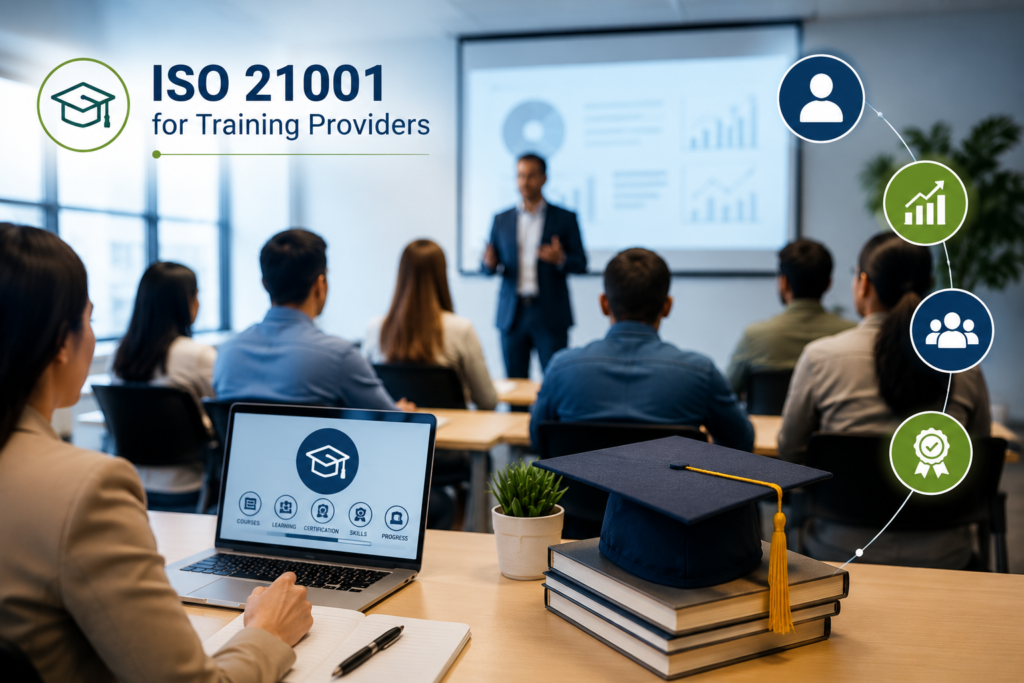
Professional training organizations can use ISO 21001 to improve:
- Course design
- Learner outcomes
- Trainer performance
- Assessment quality
- Client satisfaction
Training providers frequently find ISO 21001 particularly valuable because it aligns closely with learning and development objectives.
Can Organizations Implement Both ISO 21001 and ISO 9001?
Yes.
Many organizations choose to implement both standards through an integrated management system.
Benefits include:
- Broader quality management coverage
- Stronger governance
- Improved operational performance
- Enhanced educational effectiveness
- Greater stakeholder confidence
Because ISO 21001 shares many structural elements with ISO 9001, integration is often straightforward.
Which Standard Should You Choose?
Choose ISO 21001 If:
- You are primarily an educational organization.
- Learner satisfaction is a priority.
- You want to improve educational outcomes.
- You need an education-specific management system.
Choose ISO 9001 If:
- You operate outside the education sector.
- You require a generic quality management framework.
- Your focus is broader organizational quality management.
Implement Both If:
- You want the benefits of educational excellence and comprehensive quality management.
- Your organization operates across education and non-education functions.
- You seek maximum stakeholder confidence and international recognition.
Conclusion
Both ISO 21001 and ISO 9001 are valuable management system standards, but they serve different purposes. ISO 9001 provides a strong foundation for quality management across all industries, while ISO 21001 is specifically designed to address the unique requirements of educational organizations.
For schools, colleges, universities, training centres, and online learning providers, ISO 21001 is generally the better choice because it focuses directly on learner satisfaction, educational outcomes, accessibility, stakeholder engagement, and continuous improvement in education.
Organizations seeking the highest level of educational quality and international credibility may also consider implementing both standards through an integrated management system, creating a powerful framework for operational excellence and educational success.