
15 Essential Management Skills for the Modern Workplace
Management is more than assigning tasks and supervising employees. Modern managers need to lead teams, make decisions, manage priorities, solve problems, develop employees and respond to change.
Effective managers combine communication, business knowledge, strategic thinking and practical management skills. They need to delegate effectively, handle conflicts, understand performance, manage resources and make good decisions.
This guide explains the essential management skills, how they are used in the workplace and simple ways managers can develop them.
What Are Management Skills?
Management skills are the abilities managers use to plan work, coordinate resources, guide people, solve problems, make decisions and achieve organisational objectives.
They can broadly be divided into three interconnected areas:
Technical and operational skills
These relate to understanding processes, systems, budgets, projects, performance information and the technical requirements of a particular business or function.
Interpersonal skills
These include communication, listening, empathy, coaching, delegation, motivation, negotiation and conflict resolution.
Conceptual and strategic skills
These enable managers to understand the wider organisation, identify relationships between different business activities, evaluate complex situations and make decisions with longer-term consequences in mind.
A manager rarely uses one category in isolation. For example, improving an underperforming project may require technical knowledge to understand the problem, interpersonal skills to discuss it with employees and strategic thinking to determine how the issue affects wider business objectives.
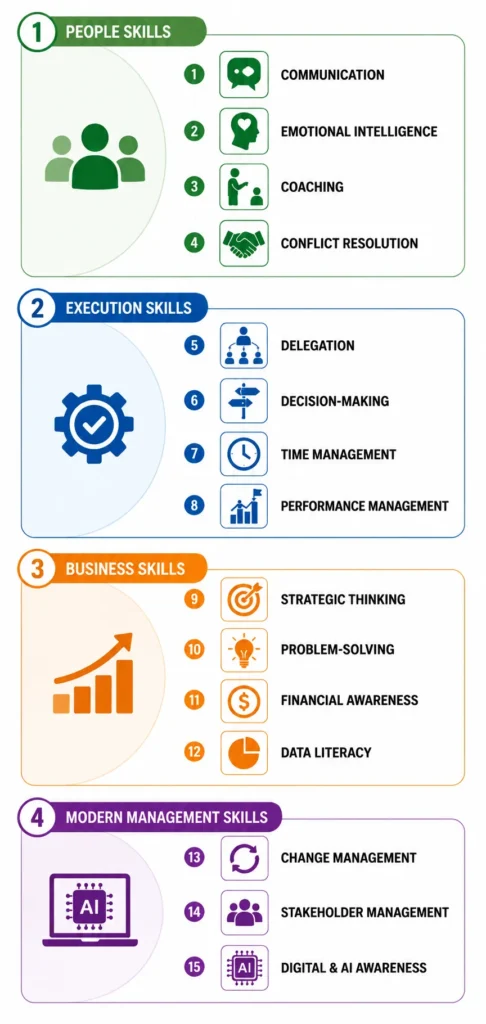
15 Essential Management Skills Every Manager Needs
1. Communication
Communication is one of the foundations of effective management. Managers communicate goals, responsibilities, priorities, feedback, decisions and changes to employees and stakeholders.
However, effective managerial communication is more than speaking clearly. It includes active listening, questioning, written communication, presentation skills and adapting a message to different audiences.
A manager may communicate differently with a new employee, senior executive, customer or technical specialist because each audience needs different information.
How to strengthen it:
- Practise active listening.
- Make expectations specific.
- Confirm important decisions in writing.
- Adapt communication to the audience.
- Ask employees whether instructions are clear.
- Encourage questions instead of assuming understanding.
2. Delegation and Empowerment
Delegation is not simply giving someone extra work. Effective delegation involves transferring responsibility while providing appropriate authority, resources and support.
Poor delegation creates two common problems: managers become overloaded while employees remain dependent on them, or employees receive responsibility without enough guidance.
Strong delegation matches the task with the person’s capability and development needs.
A manager should establish:
- What needs to be achieved
- Who owns the outcome
- What authority is available
- What resources are required
- What deadlines apply
- When progress should be reviewed
The goal is accountability without unnecessary micromanagement.
3. Decision-Making
Managers make decisions constantly, from staffing and budgets to operational priorities and customer issues.
Good decision-making requires more than confidence. Managers need to identify the problem, gather relevant information, compare alternatives, consider risks and consequences, and select an appropriate course of action.
In uncertain situations, waiting for perfect information can sometimes create more risk than making a timely decision.
A useful managerial decision process is:
Define → Analyse → Compare → Decide → Communicate → Review
This creates a more consistent approach and makes decisions easier to explain to employees and stakeholders.
4. Emotional Intelligence
Emotional intelligence helps managers recognise and manage their own emotions while understanding the emotions and perspectives of others.
This becomes particularly important during pressure, disagreement, organisational change and difficult conversations.
An emotionally intelligent manager does not simply avoid conflict. They remain composed enough to understand what is happening before responding.
Important elements include:
- Self-awareness
- Self-control
- Empathy
- Social awareness
- Relationship management
For example, an employee who appears disengaged may not simply have a motivation problem. The underlying issue could involve workload, unclear expectations, conflict, lack of recognition or uncertainty about their role.
5. Strategic Thinking
Strategic thinking enables managers to look beyond immediate tasks and understand how current decisions affect future performance.
A strategically capable manager asks questions such as:
- What are we trying to achieve?
- Why does this matter?
- What could prevent success?
- Which resources are most important?
- What changes in the market could affect us?
- What should we stop doing?
- What opportunities are emerging?
Strategic thinking is particularly important because managers often have to balance short-term performance with longer-term organisational priorities. University of Phoenix and Selby Jennings both identify strategic thinking and planning as important management capabilities.
6. Problem-Solving and Critical Thinking
Managers rarely receive problems in a perfectly structured form.
A customer complaint may actually be caused by a process failure. A missed deadline may be caused by poor resource allocation. Declining productivity may be related to unclear objectives rather than employee effort.
Critical thinking helps managers distinguish symptoms from underlying causes.
Instead of immediately asking, “Who is responsible?”, an effective manager asks:
What happened → Why did it happen → What evidence supports this → What alternatives exist → What solution addresses the root cause?
This approach reduces reactive decision-making.
7. Conflict Resolution and Negotiation
Workplace disagreement is inevitable. Differences may arise over resources, deadlines, responsibilities, working methods, priorities or interpersonal relationships.
Avoiding every disagreement is not effective management. Managers need to recognise when conflict requires intervention and address it fairly.
Negotiation is equally important because managers regularly balance competing interests between employees, departments, customers, suppliers and senior leaders.
Effective conflict management focuses on:
- Facts rather than assumptions
- Behaviour rather than personal attacks
- Interests rather than fixed positions
- Solutions rather than blame
- Fairness rather than favouritism
Selby Jennings specifically identifies conflict management and negotiation among its core management skills.
8. Coaching and Employee Development
A manager’s impact is not measured only by what they personally accomplish. It is also measured by the capability they develop within their team.
Coaching helps employees understand their strengths, identify improvement areas and take greater ownership of their performance.
Good managers regularly discuss:
- Current performance
- Development needs
- Career interests
- Challenges
- Strengths
- Future responsibilities
Coaching should not happen only when something goes wrong. Regular development conversations can make feedback more constructive and less threatening.
9. Performance Management and Accountability
Accountability means making responsibilities and expected outcomes clear and following up consistently.
A manager should be able to answer:
- What is expected?
- Who owns it?
- How will success be measured?
- When should it be completed?
- What support is available?
- What happens if performance falls below expectations?
Accountability should apply to managers as well as employees. If managers repeatedly change priorities, miss commitments or fail to provide resources, employees may reasonably struggle to meet expectations.
Effective accountability therefore combines clear standards, support, measurement and follow-through.
10. Time and Priority Management
Managers rarely have enough time to respond to every demand immediately.
The real skill is deciding what deserves attention first.
An effective manager distinguishes between:
Urgent work — requires immediate attention.
Important work — contributes significantly to organisational objectives.
Low-value work — consumes time without producing meaningful results.
Managers should protect time for planning, coaching, decision-making and strategic work instead of spending the entire day reacting to interruptions.
Time management also involves protecting the team’s capacity. A manager who continuously adds new priorities without removing existing ones can create overload and reduce performance.
11. Financial and Commercial Awareness
Financial literacy is an area that is sometimes underdeveloped in general management articles.
Managers do not necessarily need to be accountants, but they should understand how their decisions affect revenue, costs, budgets, profitability and resource utilisation.
Commercial awareness can help managers evaluate questions such as:
- What will this decision cost?
- What value will it create?
- Is the resource being used efficiently?
- What is the financial risk?
- Does the proposal support the organisation’s objectives?
University of Phoenix specifically includes financial literacy among its essential business management skills.
This makes financial awareness an important differentiator for managers who want to move beyond people supervision into broader business responsibility.
12. Data Literacy and KPI Management
Modern managers increasingly work with dashboards, reports, customer data, operational metrics and performance indicators.
Data literacy does not mean becoming a data scientist. It means being able to understand relevant information and use it responsibly when making decisions.
Managers should know:
- Which KPIs matter
- What the numbers actually measure
- Whether data is reliable
- What trends are emerging
- What may be causing a change
- Which action should follow
For example, a fall in sales may not automatically mean that a sales team is underperforming. The manager may need to examine pricing, customer demand, market conditions, product availability and conversion rates before deciding what action to take.
13. Change Management and Adaptability
Organisations regularly face changes in technology, customer expectations, market conditions, structures and working methods.
Adaptability allows managers to respond without losing sight of core objectives.
But adaptability does not mean changing direction every time a new idea appears. Effective change management requires managers to explain:
Why is the change necessary? What will change? Who will be affected? What support is available? How will success be measured?
Managers who communicate change clearly are more likely to maintain trust and reduce unnecessary uncertainty.
Adaptability is also identified as an important management skill by Selby Jennings.
14. Stakeholder Management
Managers rarely work only with their immediate team.
They may need to coordinate with senior leaders, customers, suppliers, finance teams, HR, technical departments and external partners.
Each stakeholder may have different priorities.
Stakeholder management involves understanding:
- Who has influence?
- Who is affected?
- What does each stakeholder need?
- What information should be shared?
- Where might interests conflict?
- Who needs to be involved in decisions?
This skill becomes increasingly important as managers take responsibility for larger projects and cross-functional initiatives.
15. Digital and AI Awareness
Technology is changing how managers organise work, analyse information, communicate and make decisions.
Managers do not need to become software engineers, but they increasingly need to understand how digital tools and artificial intelligence can support productivity and decision-making.
Useful areas include:
- Digital collaboration
- Data dashboards
- Workflow automation
- AI-assisted analysis
- Digital communication
- Cybersecurity awareness
- Responsible use of AI-generated information
The important management skill is not simply knowing which technology exists. It is knowing when technology adds value, where human judgement remains essential and what risks must be controlled.
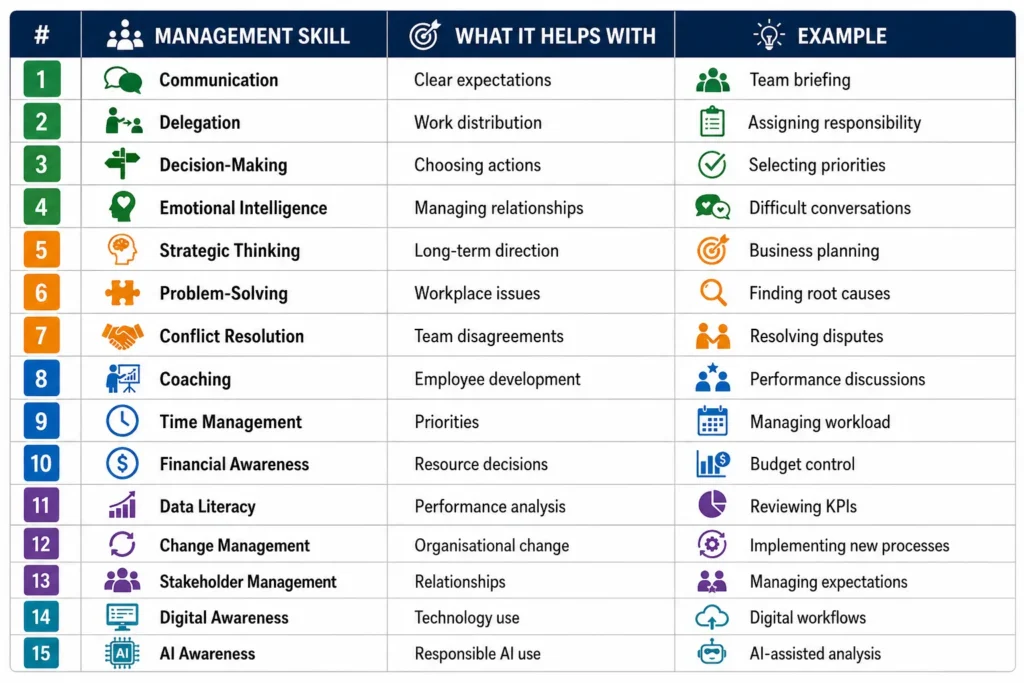
How Management Skills Work Together
One of the biggest weaknesses in many management-skills articles is treating each skill as completely separate.
In real management, skills overlap.
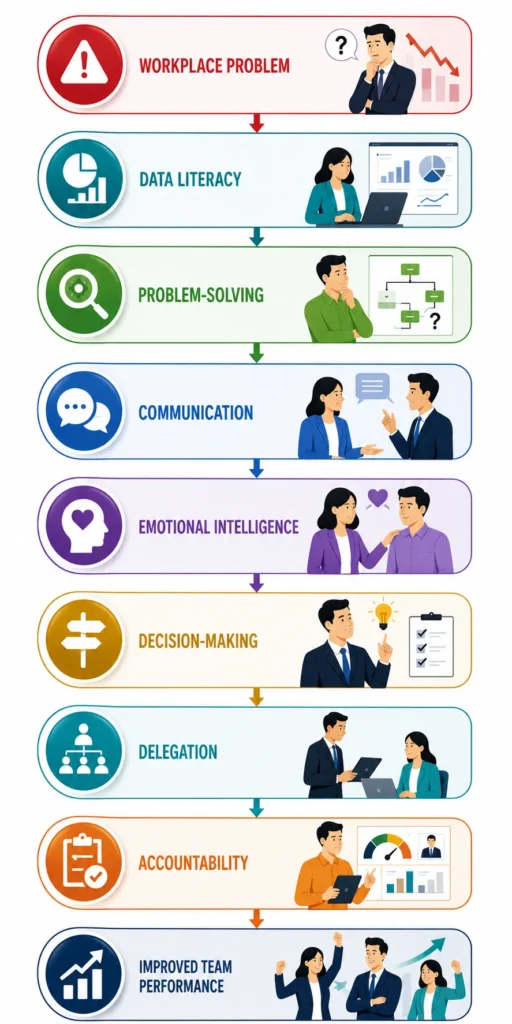
Imagine that an important project is falling behind schedule.
A manager may need:
Data literacy to identify the performance problem.
Problem-solving to find the underlying cause.
Communication to discuss the issue with the team.
Emotional intelligence to understand employee concerns.
Delegation to redistribute responsibilities.
Decision-making to choose the best corrective action.
Stakeholder management to update senior leaders.
Time management to protect critical priorities.
Accountability to ensure agreed actions are completed.
This is why effective management is better understood as a connected capability system rather than a simple list of soft skills.
What Is the Most Important Management Skill?
There is no single management skill that is always the most important.
The priority depends on the situation.
For a new manager, communication, delegation and emotional intelligence may be particularly important during the transition from individual contributor to people manager. StormWind Studios, for example, places strong emphasis on these transition skills.
For a project manager, planning, risk management, stakeholder communication and decision-making may become more important.
For a senior manager, strategic thinking, financial awareness, change management and organisational leadership may receive greater emphasis.
The strongest managers therefore understand which skill to apply, when to apply it and how different skills interact.
How to Improve Management Skills
Management skills develop through deliberate practice rather than simply reading about them.
1. Choose one capability at a time
Instead of attempting to improve everything simultaneously, select one skill and define a measurable behaviour.
For example:
“Improve communication” is vague.
“End every weekly team meeting with clear owners, deadlines and next actions” is measurable.
2. Request specific feedback
Ask colleagues questions such as:
- Was my message clear?
- Did I give enough context?
- Did I listen effectively?
- Did I involve the right people?
- What could I have handled differently?
Specific questions usually generate more useful feedback than simply asking whether you are a good manager.
3. Use real workplace situations
Apply management concepts to actual problems rather than learning them only theoretically.
After a difficult decision, ask:
What information did I use? What did I overlook? What assumptions did I make? What would I do differently next time?
4. Track management outcomes
Management improvement should eventually produce observable changes.
Potential indicators include:
- Employee engagement
- Staff turnover
- Project completion
- Customer satisfaction
- Productivity
- Quality
- Absence
- Budget performance
- Employee development
- Team delivery against objectives
Not every management outcome can be reduced to a number, but measurable indicators can help identify trends.
5. Develop both people and business skills
A manager who is excellent with people but cannot understand budgets, priorities or performance data may struggle with broader responsibilities.
Likewise, a manager who understands numbers but cannot communicate, coach or resolve conflict may struggle to lead people.
The strongest management development therefore combines human, operational, analytical and strategic capabilities.
Management Skills Checklist for Career Development
When evaluating your current capabilities, consider these questions:
| Management capability | Question to ask yourself |
|---|---|
| Communication | Do people understand my expectations? |
| Delegation | Do I delegate outcomes rather than tasks alone? |
| Decision-making | Can I make defensible decisions under uncertainty? |
| Emotional intelligence | Do I manage my reactions under pressure? |
| Strategic thinking | Can I connect daily work to wider objectives? |
| Problem-solving | Do I investigate root causes? |
| Conflict resolution | Can I address disagreements fairly? |
| Coaching | Am I developing people’s capabilities? |
| Accountability | Are responsibilities and measures clear? |
| Time management | Do I protect high-value priorities? |
| Financial awareness | Do I understand the commercial impact of decisions? |
| Data literacy | Can I interpret relevant performance information? |
| Adaptability | Can I lead effectively through change? |
| Stakeholder management | Can I balance different interests? |
| Digital and AI awareness | Can I use technology responsibly and effectively? |
Related Business Management Courses
1. Qualifi Level 3 Diploma in Business Management
The Qualifi Level 3 Diploma in Business Management introduces learners to key business areas such as business environment, marketing, human resources, communication, and business resources.
2. Qualifi Level 4 Diploma in Business Management
The Qualifi Level 4 Diploma in Business Management develops knowledge of business operations, management, leadership, organisational practices, and business decision-making.
3. Qualifi Level 5 Extended Diploma in Business Management
The Qualifi Level 5 Extended Diploma in Business Management provides advanced knowledge of management, leadership, organisational decision-making, and contemporary business practices.
4. OTHM Level 3 Diploma in Business Management
The OTHM Level 3 Diploma in Business Management covers essential business concepts, including the business environment, communication, customer service, finance, marketing, and people management.
5. OTHM Level 5 Extended Diploma in Business Management
The OTHM Level 5 Extended Diploma in Business Management develops knowledge across leadership, finance, marketing, human resources, operations, business strategy, and business law.
6. OTHM Level 6 Diploma in Business Management
The OTHM Level 6 Diploma in Business Management focuses on advanced management and strategic areas, including leadership, financial decision-making, operations, sustainability, and strategic human resource management.
7. ICTQual AB Level 3 Diploma in Business Management
The ICTQual AB Level 3 Diploma in Business Management provides foundational knowledge of marketing, business communication, human resources, finance, operations, and business performance.
8. ABMA Education Level 6 Diploma in Business Management (RQF)
The ABMA Education Level 6 Diploma in Business Management (RQF) develops advanced knowledge in strategic management, leadership, finance, marketing, project management, economics, and international business.
Conclusion
Strong management requires more than supervising people. Good managers communicate clearly, make sound decisions, solve problems, support their teams and manage change effectively.
By developing these essential management skills, managers can build stronger teams, improve performance and contribute more effectively to business success.