
What Is the Difference Between Leadership and Management?
Leadership and management are closely related but have different roles. Leadership focuses on guiding, motivating and influencing people, while management focuses on planning, organising resources and achieving goals. Both are important for business success.
A leader helps people understand the direction and purpose, while a manager organises the work, resources and responsibilities needed to achieve the goals. In many workplaces, one person may perform both roles. Understanding the difference is useful for anyone working in or studying business.
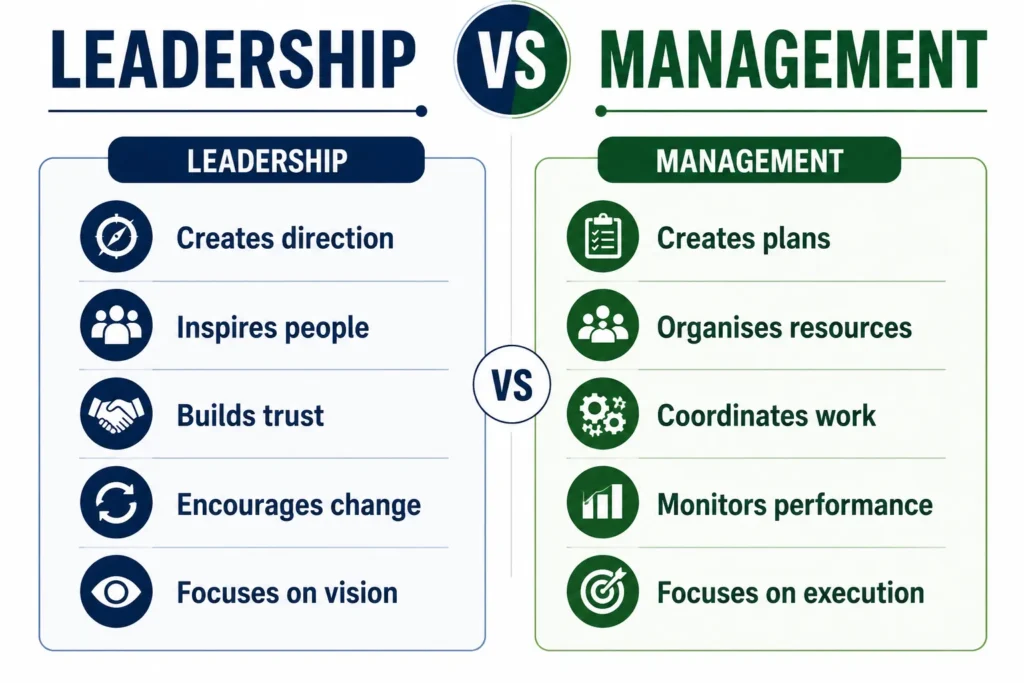
Difference Between Leadership and Management
The simplest distinction is:
- Leadership focuses on direction, influence, vision, people and change.
- Management focuses on planning, organisation, resources, processes and execution.
For example, if a company wants to enter a new international market, leadership may establish the strategic direction, communicate the purpose of expansion and build commitment to the change. Management may then develop budgets, allocate employees, establish timelines, coordinate activities and monitor progress.
The two functions are different, but they are complementary. Vision without effective execution may remain an idea, while efficient execution without a clear direction can result in teams working hard without moving toward the right strategic outcome. ESCP similarly describes management as coordinating resources to achieve defined objectives and leadership as setting direction, inspiring people and driving change.
What Is Leadership?
Leadership is the process of influencing, guiding and motivating people toward a shared purpose or goal.
Leadership is not necessarily dependent on a formal job title. A person can demonstrate leadership by taking initiative, helping colleagues solve problems, challenging ineffective practices, communicating a clear direction or encouraging others to work toward a common objective.
Effective leadership commonly involves:
- Creating or communicating a vision
- Building trust
- Influencing people
- Motivating teams
- Encouraging innovation
- Supporting change
- Making strategic decisions
- Developing people
- Communicating purpose
- Creating alignment around goals
Modern leadership therefore extends beyond simply giving instructions. It involves helping people understand what the organisation is trying to achieve, why it matters and how their contribution supports the wider objective.
For example, imagine a company introducing a new digital system. A leader may explain why the change is necessary, address concerns, demonstrate confidence in the new direction and encourage employees to see the opportunity rather than focusing only on the disruption.
What Is Management?
Management is the process of planning, organising, coordinating and controlling resources to achieve defined objectives.
Managers commonly work with:
- People
- Budgets
- Equipment
- Information
- Time
- Processes
- Projects
- Performance targets
Typical management activities include setting operational objectives, allocating resources, delegating responsibilities, establishing schedules, monitoring performance, controlling costs and correcting problems.
For example, if a business launches a new product, management may coordinate the project timetable, allocate staff, monitor the budget, organise suppliers, track milestones and ensure that agreed deliverables are completed.
Asana similarly describes management as organising, planning and coordinating resources to achieve specific goals, with managers translating organisational direction into actionable plans.
Leadership vs Management: Key Differences
The difference becomes clearer when the two functions are compared across several areas.
| Area | Leadership | Management |
|---|---|---|
| Primary focus | Direction and people | Planning and execution |
| Main question | Where and why? | How and when? |
| Time orientation | Often future-focused | Often present and short-term focused |
| Core purpose | Create direction and commitment | Achieve objectives efficiently |
| Approach | Influence and inspiration | Coordination and organisation |
| Change | Encourages and guides change | Implements and controls change |
| People | Motivates and develops | Assigns, supports and evaluates |
| Resources | Considers strategic priorities | Allocates and controls resources |
| Authority | Can come from influence and trust | Usually comes from formal responsibility |
| Performance | Considers purpose, engagement and strategic progress | Tracks targets, quality, cost and delivery |
| Risk | Considers strategic opportunities and uncertainty | Identifies and manages operational risks |
| Success | Sustainable direction and organisational alignment | Effective and efficient execution |
These differences should not be treated as absolute rules. A manager may set strategy, inspire employees and lead major change, while a leader may also need strong organisational and management skills.
1. Vision vs Execution
One of the most commonly discussed differences is the distinction between vision and execution.
Leadership often asks:
Where should we go?
Management often asks:
How will we get there?
Consider a growing technology company. Its leadership team may decide that the business needs to expand into new international markets. Management then has to translate that strategic direction into operational plans.
This could involve:
- Preparing budgets
- Assigning project teams
- Researching markets
- Setting milestones
- Establishing responsibilities
- Monitoring costs
- Managing implementation
Neither activity is sufficient by itself. A vision needs execution, and execution needs direction.
2. Influence vs Formal Authority
Leadership can exist without formal authority.
An employee who persuades colleagues to adopt a better process, mentors new staff and helps the team respond positively to change may be demonstrating leadership even without being a manager.
Management, by contrast, is usually connected to formal organisational responsibility. Managers may have authority over budgets, workloads, performance reviews, schedules or operational decisions.
However, formal authority does not automatically create effective leadership.
A manager can instruct employees to complete a task because of their position. A leader may gain commitment because people trust their judgement and believe in the purpose behind the task.
3. Change vs Stability
Leadership is often strongly associated with change.
Leaders may identify emerging opportunities, challenge established practices and help organisations respond to uncertainty.
Management is particularly important for maintaining reliable operations while change occurs.
For example, during a major technology transformation:
Leadership may:
- Explain the need for transformation
- Establish the desired future state
- Build commitment
- Address resistance
- Encourage innovation
Management may:
- Create implementation plans
- Allocate resources
- Schedule training
- Monitor progress
- Manage operational disruption
- Track performance
This illustrates why organisations need both functions during transformation.
4. People vs Process
Leadership tends to place greater emphasis on people, purpose, culture and commitment.
Management tends to place greater emphasis on processes, systems, resources and delivery.
However, this distinction should not be exaggerated. Good managers also need strong people skills, while effective leaders must understand operational realities.
For instance, a manager dealing with poor team performance cannot simply increase supervision. They may need to understand motivation, workload, communication problems, skills gaps and team dynamics.
Similarly, a leader proposing a major strategic change must understand whether the organisation actually has the resources and capabilities to implement it.
5. Long-Term Direction vs Short-Term Delivery
Leadership frequently considers the longer-term direction of an organisation.
Management often converts that direction into achievable short- and medium-term objectives.
Suppose a company wants to become a market leader in sustainable products over the next five years.
Leadership may establish the strategic ambition.
Management may create annual targets, budgets, product-development schedules and performance measures that move the organisation toward that ambition.
This relationship between long-term direction and operational delivery is one of the most important connections between leadership and management.
Real-World Examples of Leadership and Management
Understanding the difference becomes easier when the concepts are applied to realistic business situations.
Example 1: Launching a New Product
Leadership:
The leader communicates why the product is strategically important, builds enthusiasm and establishes the broader direction.
Management:
The manager coordinates product development, assigns responsibilities, controls the budget and monitors deadlines.
Example 2: Declining Employee Performance
Leadership:
A leader investigates the underlying causes, listens to employees and considers whether changes in culture, motivation or direction are needed.
Management:
A manager reviews performance data, clarifies expectations, establishes improvement actions and monitors progress.
Example 3: Organisational Restructuring
Leadership:
Leadership explains why restructuring is necessary, communicates the future direction and maintains trust during uncertainty.
Management:
Managers implement new reporting structures, allocate responsibilities, update processes and monitor the transition.
Example 4: Customer Complaints Increase
Leadership:
Leadership may question whether the problem indicates a deeper issue with organisational culture, product strategy or customer experience.
Management:
Management may analyse complaint data, review procedures, assign corrective actions and monitor service performance.
Example 5: A Team Is Introducing Artificial Intelligence
Leadership:
Leadership establishes how AI should support the organisation’s strategic objectives and addresses concerns about change.
Management:
Management identifies appropriate tools, allocates resources, develops implementation schedules and monitors adoption.
| Business Situation | Leadership Role | Management Role |
|---|---|---|
| New product launch | Create enthusiasm | Manage deadlines |
| Business expansion | Set direction | Allocate resources |
| Employee problems | Build trust | Monitor performance |
| Digital transformation | Lead change | Implement systems |
| Customer complaints | Identify wider issues | Correct processes |
| Business crisis | Provide confidence | Coordinate response |
Leadership vs Management in Different Business Situations
The balance between leadership and management changes according to the situation.
| Business situation | Leadership emphasis | Management emphasis |
| Business growth | Vision and strategic direction | Resources and implementation |
| Crisis | Confidence and communication | Coordination and control |
| Digital transformation | Change and adoption | Systems and implementation |
| New project | Purpose and alignment | Planning and scheduling |
| Poor performance | Motivation and root causes | Monitoring and corrective action |
| Organisational change | Vision and engagement | Structure and execution |
| Innovation | New possibilities | Testing and resource control |
| Routine operations | Continuous improvement | Efficiency and consistency |
This is an important point that many simple leadership-versus-management explanations overlook: the most effective approach depends on context.
When Is Leadership More Important?
Leadership becomes particularly important when an organisation needs direction, adaptation or significant behavioural change.
Examples include:
- Entering a new market
- Responding to disruption
- Changing organisational culture
- Introducing major technology
- Developing a new business strategy
- Building commitment around a difficult decision
- Encouraging innovation
- Responding to a major crisis
In these situations, employees may need more than instructions. They need clarity, confidence, purpose and trust.
When Is Management More Important?
Management becomes especially important when reliable execution, coordination and control are critical.
Examples include:
- Managing a project schedule
- Controlling a budget
- Allocating staff
- Monitoring quality
- Managing inventory
- Coordinating suppliers
- Tracking performance
- Meeting regulatory or organisational procedures
- Delivering agreed targets
Strong management prevents good ideas from becoming poorly executed projects.
Can Someone Be Both a Leader and a Manager?
Yes.
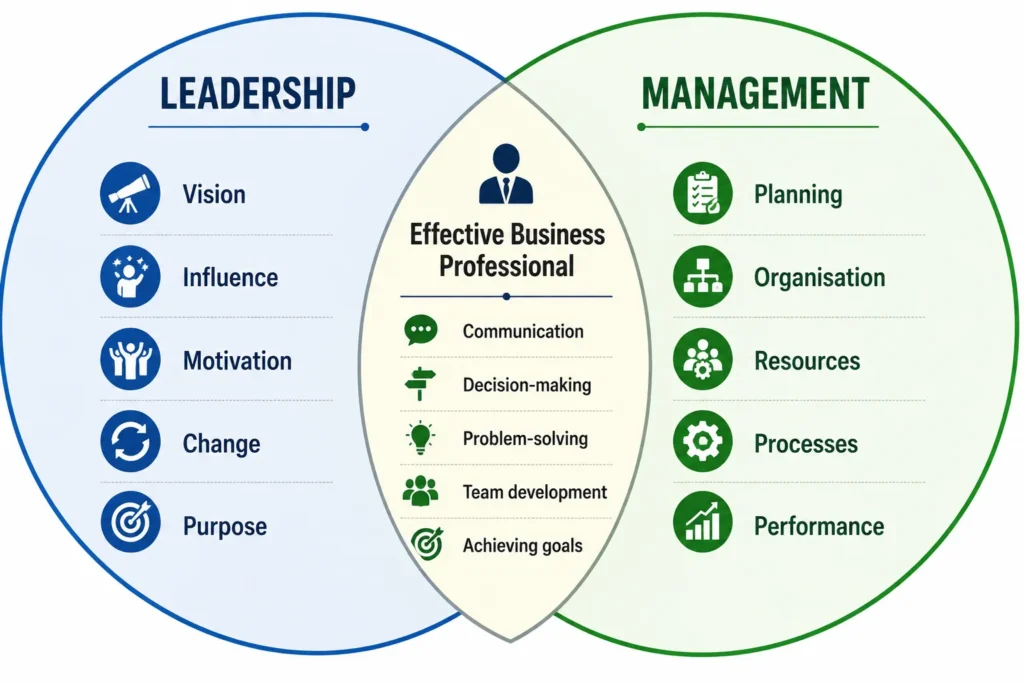
In modern organisations, many effective professionals perform both functions.
A department manager may spend the morning reviewing budgets and workloads, then spend the afternoon communicating a new strategic direction and motivating employees through organisational change.
This means the question should not always be:
“Am I a leader or a manager?”
A better question is:
“What does this situation require from me right now?”
If the team lacks direction, leadership may be required.
If the team understands the direction but lacks coordination, management may be required.
If the organisation is experiencing both problems, both capabilities are necessary.
Asana’s current guidance similarly emphasises that the same person can perform both roles and that effective teams need both leadership and management.
Can You Be a Leader Without Being a Manager?
Yes.
Leadership is not restricted to people with managerial titles.
An employee can demonstrate leadership by:
- Taking responsibility for solving a problem
- Supporting colleagues
- Sharing knowledge
- Challenging ineffective practices
- Encouraging collaboration
- Taking initiative
- Helping colleagues adapt to change
- Influencing decisions positively
- Mentoring less experienced colleagues
This is sometimes called informal leadership.
The ability to influence others without relying on formal authority is increasingly valuable in organisations where teams are cross-functional, remote, project-based or less hierarchical.
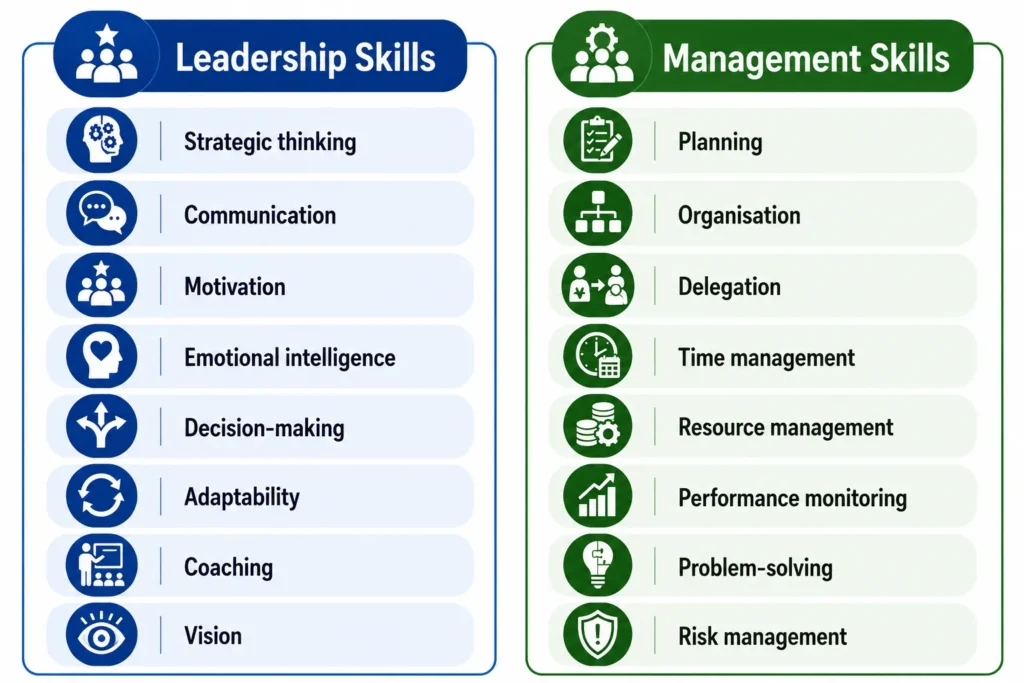
Essential Leadership Skills
Strong leadership requires a combination of strategic, interpersonal and behavioural capabilities.
Vision and strategic thinking
Leaders need to understand the wider environment and consider where the organisation should go next.
Communication
Leaders must communicate direction clearly and adapt their communication to different audiences.
Emotional intelligence
Understanding emotions, relationships and team dynamics can improve trust and collaboration.
Decision-making
Leaders frequently make decisions under uncertainty and must balance competing priorities.
Adaptability
Business environments change rapidly. Leaders need to respond without losing sight of strategic objectives.
Motivation
Effective leaders help people connect their individual contribution with broader organisational goals.
Coaching and development
Developing other people strengthens organisational capability and creates future leadership capacity.
Essential Management Skills
Management requires a different but complementary group of capabilities.
Planning
Managers translate objectives into practical plans.
Organising
They coordinate people, resources, activities and responsibilities.
Delegation
Managers need to assign work according to capability, workload and organisational priorities.
Performance management
Managers monitor results, identify gaps and support improvement.
Resource management
Budgets, time, people, equipment and information must be used efficiently.
Problem-solving
Managers must identify operational problems and develop practical corrective actions.
Risk management
Managers need to identify potential threats to cost, quality, time, resources and performance.
How Leadership and Management Work Together
The strongest organisations do not treat leadership and management as competing alternatives.
Instead, they combine them.
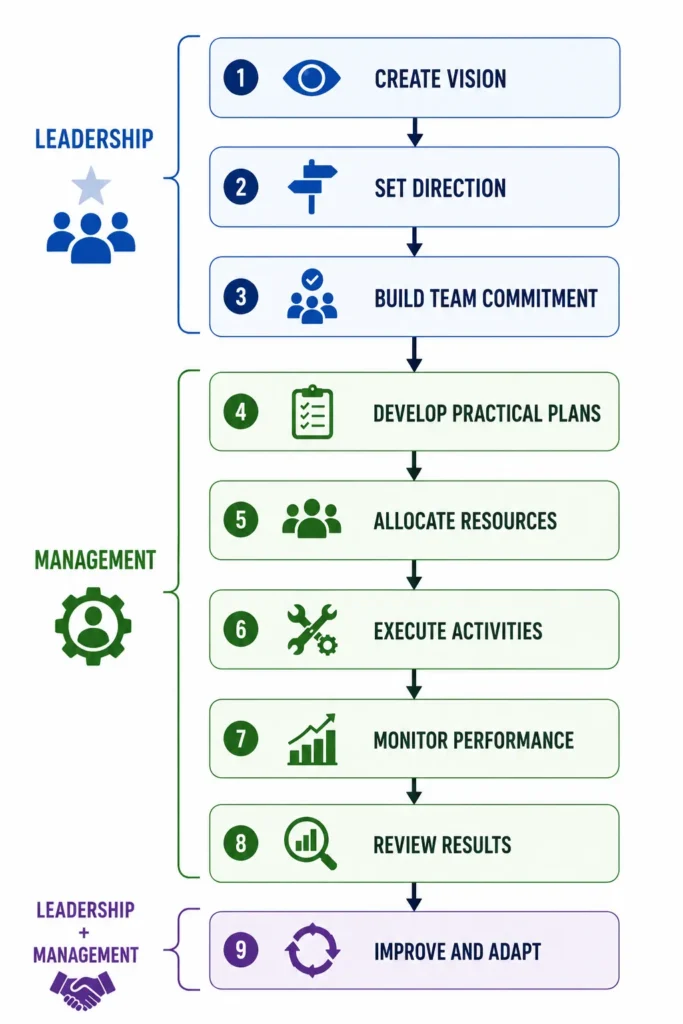
A useful way to think about the relationship is:
Leadership establishes direction → Management plans the route → Teams execute the work → Management monitors results → Leadership learns and adapts the direction.
For example, suppose a business wants to reduce its environmental impact.
Leadership may establish sustainability as a strategic priority.
Management may then:
- Identify current resource use.
- Set operational targets.
- Allocate responsibilities.
- Develop improvement projects.
- Monitor performance.
- Report results.
- Correct underperformance.
Leadership then reviews whether the organisation’s progress supports the broader strategic objective.
This creates a continuous relationship between strategic direction and operational execution.
Common Misconceptions About Leadership and Management
Misconception 1: Leaders are more important than managers
Neither function should automatically be considered more important.
Leadership without management can produce ambitious ideas without reliable implementation.
Management without leadership can produce efficient processes without meaningful strategic direction.
Misconception 2: Every manager is a leader
Holding a managerial position provides formal responsibility, but effective leadership requires trust, influence, communication and the ability to motivate people.
Misconception 3: Leaders only think about the future
Leaders also need to understand present realities. Strategic decisions that ignore budgets, capabilities, customers or operational constraints may be unrealistic.
Misconception 4: Managers only perform administrative tasks
Modern managers frequently contribute to strategy, innovation, employee development, change and organisational improvement.
Misconception 5: Leadership requires a senior job title
People can demonstrate leadership at different levels of an organisation.
How to Develop Leadership and Management Skills
Developing both skill sets requires more than learning definitions.
A practical development approach includes:
1. Improve self-awareness
Identify your strengths, weaknesses, communication style and decision-making habits.
2. Develop communication skills
Practise explaining objectives clearly, listening actively and adapting messages to different audiences.
3. Take responsibility for projects
Project work provides opportunities to practise planning, delegation, coordination and decision-making.
4. Develop strategic thinking
Look beyond individual tasks and consider how decisions affect customers, employees, finances and long-term organisational performance.
5. Practise delegation
Delegation allows managers to build capability rather than simply completing every task themselves.
6. Learn to manage conflict
Constructive conflict management can protect relationships while keeping teams focused on organisational objectives.
7. Seek feedback
Feedback from colleagues, supervisors and team members can reveal leadership and management behaviours that may otherwise be difficult to recognise.
8. Learn from real situations
Workplace scenarios, projects, case studies, simulations and reflective practice can help connect theoretical concepts with practical decision-making.
UCD Professional Academy also emphasises the development of communication, problem-solving, decision-making, strategic thinking and related interpersonal capabilities across leadership and management.
How Can Leadership and Management Effectiveness Be Measured?
Another important area often underdeveloped in basic comparison articles is measurement.
Leadership effectiveness may be assessed through indicators such as:
- Employee engagement
- Team trust
- Staff retention
- Innovation
- Strategic progress
- Change adoption
- Employee development
- Organisational alignment
Management effectiveness may be assessed through:
- Productivity
- Budget performance
- Project delivery
- Quality
- Customer satisfaction
- Resource utilisation
- Process efficiency
- Target achievement
These measurements should not be considered completely separate.
For example, poor employee engagement may eventually affect productivity, while poor management processes may contribute to employee frustration.
Therefore, organisations should consider both people-related and operational indicators.
A Simple Leadership vs Management Decision Framework
When deciding whether a situation requires leadership, management or both, ask five questions:
1. Is the main problem direction?
If yes, leadership may be needed.
2. Is the main problem execution?
If yes, management may be needed.
3. Is the organisation facing significant change?
Increase the leadership focus.
4. Are resources, processes or deadlines failing?
Increase the management focus.
5. Does the situation involve both people and execution?
Use both leadership and management.
A practical model is:
Direction → Alignment → Planning → Execution → Measurement → Learning → Improvement
Leadership is particularly important in direction, alignment and learning.
Management is particularly important in planning, execution and measurement.
Both contribute to improvement.
Leadership vs Management: Which Is Better?
Neither is universally better.
The more useful question is:
Which capability is most important for the situation?
If a business has no clear strategic direction, stronger management alone may not solve the problem.
If a business has an excellent strategy but consistently misses deadlines, wastes resources and fails to control quality, stronger management may be required.
If a business is experiencing both strategic uncertainty and operational problems, it needs integrated leadership and management.
This is why successful business professionals increasingly need competence in both areas.
Related Leadership and Management Courses
If you want to strengthen your leadership, management and business skills, the following related courses can help you develop practical knowledge and support your career growth:
- Qualifi Level 3 Diploma in Business Management – Develops essential business, management, communication and organisational skills.
- Qualifi Level 4 Diploma in Business Management – Builds knowledge of management, leadership, business operations and decision-making.
- Qualifi Level 5 Extended Diploma in Business Management – Develops advanced management, leadership, strategic planning and business skills.
- OTHM Level 3 Diploma in Business Management – Introduces business management principles, workplace skills and organisational practices.
- OTHM Level 5 Extended Diploma in Business Management – Focuses on leadership, strategic management, business planning and organisational performance.
- Leadership and Management Courses – Help develop communication, team leadership, decision-making, delegation and performance management skills.
- Human Resource Management Courses – Develop skills in employee management, recruitment, performance and workplace relationships.
- Strategic Management Courses – Focus on strategic planning, business decisions, organisational development and long-term performance.
- Project Management Courses – Develop planning, leadership, resource allocation, risk management and project delivery skills.
- Business Administration Courses – Build practical skills in business operations, administration, organisation and workplace coordination.
Conclusion
Leadership and management are different but equally important. Leadership focuses on guiding and motivating people, while management focuses on planning and achieving goals. Strong businesses need both to work effectively and succeed.