
Business Management Strategies: How Organisations Achieve Their Goals
Business management strategies help organisations turn goals into real results. Effective managers plan, use resources wisely, lead teams, manage risks and monitor performance.
Successful organisations treat management as an ongoing process. They set clear goals, assign responsibilities, measure results and make changes when needed.
This guide explains key business management strategies and how they can improve efficiency, employee performance, customer satisfaction, innovation and business growth.
What Are Business Management Strategies?
Business management strategies are structured approaches used by managers and organisations to achieve defined business goals. They influence how an organisation plans its activities, uses resources, manages employees, responds to competition, serves customers and measures performance.
A management strategy can operate at different levels. Senior leaders may use strategic management to determine the organisation’s long-term direction, while departmental managers may translate those priorities into operational plans, team targets and performance measures.
Effective business management therefore connects three important questions:
- Where does the organisation want to go?
- How will it get there?
- How will management know whether it is succeeding?
A strategy becomes valuable when it moves beyond a written plan and influences actual decisions, resource allocation and employee behaviour.
Why Are Business Management Strategies Important?
Without a clear management approach, organisations can experience duplicated work, poor communication, inefficient resource use and conflicting priorities.
Well-designed strategies can help organisations:
- establish clear priorities
- align teams around common objectives
- improve resource allocation
- strengthen employee performance
- improve operational efficiency
- manage business risks
- increase customer satisfaction
- support innovation
- improve decision-making
- measure organisational performance
- respond to changing market conditions
- support sustainable business growth
Business management is closely connected with planning, organising, leading and controlling organisational resources. This broad management perspective is also reflected in established business-management guidance.
However, effective management should not be treated as a collection of isolated techniques. SWOT analysis, employee engagement, financial planning, risk management and performance measurement become much more useful when they are connected to a coherent business strategy.
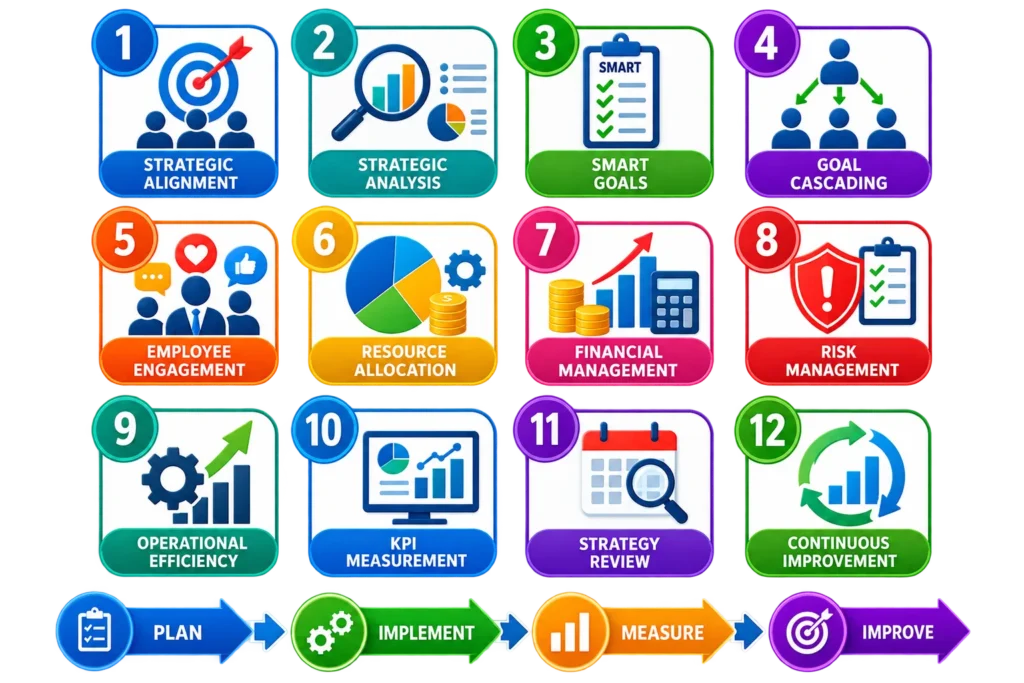
12 Effective Business Management Strategies
1. Align Business Strategy With Vision and Mission
One of the first responsibilities of management is establishing a clear direction.
A business may have ambitious targets, but individual departments can easily move in different directions if employees do not understand the organisation’s wider purpose.
Managers should therefore connect:
Mission → Vision → Strategic priorities → Business goals → Team objectives → Individual actions
For example, suppose a company’s strategic priority is to become known for exceptional customer service. The objective should not remain at senior-management level.
It could translate into:
- customer-service training
- shorter response times
- improved complaint handling
- customer satisfaction targets
- service-quality KPIs
- regular customer feedback analysis
This creates strategic alignment between what the organisation wants to achieve and what employees actually do.
2. Use Strategic Analysis Before Making Major Decisions
Good management decisions should be based on evidence rather than assumptions.
Managers can use tools such as:
- SWOT analysis
- PESTLE analysis
- competitor analysis
- customer research
- market analysis
- financial analysis
- stakeholder analysis
- internal performance data
SWOT helps organisations examine internal strengths and weaknesses alongside external opportunities and threats, while PESTLE helps managers consider wider political, economic, social, technological, legal and environmental influences.
The important point is not simply knowing what these tools mean.
The real value comes from using the information to make decisions.
For example:
Market trend → identified opportunity → strategic decision → resources allocated → KPI established → result reviewed
This turns business analysis into management action.
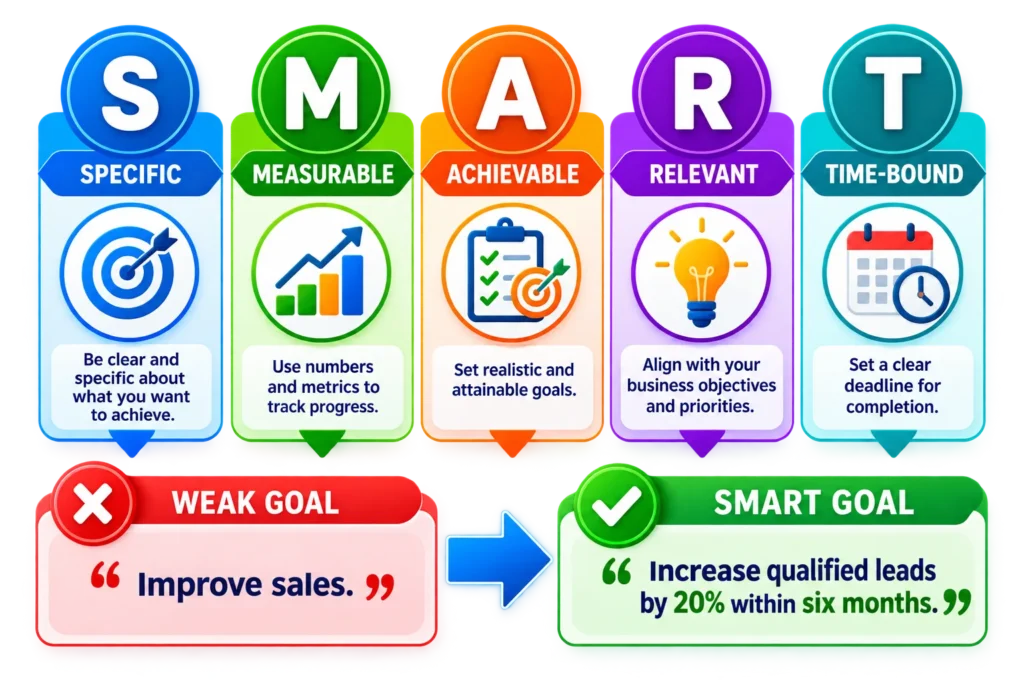
3. Set SMART and Measurable Business Goals
Vague goals make performance difficult to manage.
“Improve sales” provides direction, but it does not clearly define what improvement means.
A stronger objective could be:
Increase qualified B2B leads by 20% within six months while maintaining the existing lead-conversion rate.
This provides a measurable outcome and timeframe.
Business goals generally provide broad direction, while objectives translate that direction into more specific and measurable outcomes. This distinction is also emphasised in current business-goal guidance.
Managers should ensure that goals are:
- specific
- measurable
- achievable
- relevant
- time-bound
They should also identify who owns each objective and what resources are required.
4. Cascade Organisational Goals Into Team Objectives
A common management problem occurs when senior leaders establish goals but employees do not understand how their work contributes to them.
Goal cascading helps solve this problem.
For example:
Organisational goal:
Increase customer retention.
Marketing objective:
Improve customer education and engagement.
Sales objective:
Increase successful onboarding.
Customer-service objective:
Reduce unresolved complaints.
Individual objective:
Respond to priority customer cases within an agreed timeframe.
This approach creates accountability while helping employees understand the relationship between their work and organisational performance.
Research and practical guidance across the competitor landscape repeatedly emphasise alignment, accountability and breaking broad goals into manageable objectives.
5. Strengthen Employee Engagement and Leadership
Business strategies are implemented by people.
Even an excellent strategic plan can fail when employees do not understand it, lack resources or have little motivation to support it.
Effective managers should therefore focus on:
- clear communication
- employee involvement
- appropriate delegation
- coaching
- recognition
- training
- feedback
- team collaboration
- role clarity
- supportive leadership
Employee engagement is particularly important because employees need to understand not only what they are expected to do but why their contribution matters.
Managers should create regular opportunities for employees to raise concerns, suggest improvements and discuss progress.
This changes management from simply giving instructions to creating shared ownership of organisational objectives.
6. Allocate Resources According to Strategic Priorities
A strategy without resources is unlikely to succeed.
Resources may include:
- people
- finance
- technology
- equipment
- information
- time
- facilities
- external expertise
Managers must determine which initiatives deserve priority and how limited resources should be distributed.
For example, if an organisation wants to improve digital customer service but allocates almost no technology budget or employee training time, the strategy is unlikely to deliver the intended outcome.
Strategic management therefore requires decisions about where resources create the greatest organisational value. Strategic-management literature similarly places resource management alongside objectives, environmental analysis and implementation.
7. Build a Strong Financial Management Strategy
Financial management is not only the responsibility of accountants.
Managers need sufficient financial awareness to understand how decisions affect:
- revenue
- costs
- profit margins
- cash flow
- investment
- budgets
- financial risk
- return on investment
A growth strategy, for example, may increase revenue while simultaneously creating cash-flow pressure if the organisation must spend heavily before customers pay.
Effective business management therefore considers both growth and financial sustainability.
Managers should regularly compare:
Budget → Actual performance → Variance → Cause → Corrective action
This provides a practical basis for financial decision-making.
8. Manage Business Risk Proactively
Risk management should not begin after something goes wrong.
Managers should identify potential risks before major decisions are implemented.
Common business risks can include:
- financial risk
- operational disruption
- cybersecurity threats
- supply-chain problems
- regulatory changes
- employee turnover
- reputational damage
- market changes
- technology failure
- customer-demand changes
A useful risk-management process is:
Identify → Assess → Prioritise → Treat → Monitor → Review
Managers should consider both the likelihood of a risk and its potential impact.
Importantly, risk management should be connected to business strategy rather than treated as a separate administrative exercise.
9. Improve Operational Efficiency
Strategic goals ultimately depend on effective operations.
Managers should regularly examine how work is performed and identify unnecessary delays, duplication, waste and bottlenecks.
Operational improvement may involve:
- process mapping
- workflow redesign
- automation
- standardisation
- quality management
- performance monitoring
- technology adoption
- continuous improvement
For example, if customer enquiries pass through five unnecessary approval stages, reducing those stages may improve response times without requiring additional employees.
The objective is not simply to reduce costs. It is to create better outcomes while maintaining appropriate quality and customer value.
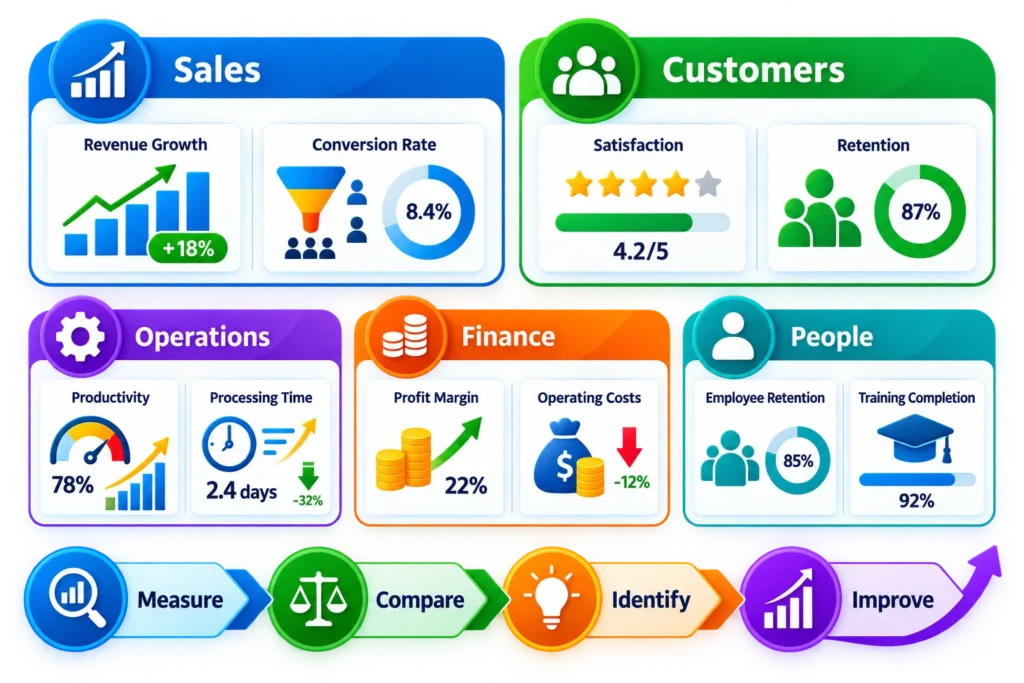
10. Use KPIs to Measure Business Performance
A strategy should produce measurable evidence of progress.
Key performance indicators, or KPIs, help managers determine whether objectives are being achieved.
Possible KPIs include:
| Business area | Example KPI |
|---|---|
| Sales | Revenue growth rate |
| Marketing | Qualified lead conversion |
| Customer service | Customer satisfaction score |
| Operations | Order processing time |
| Finance | Operating profit margin |
| Human resources | Employee retention rate |
| Quality | Defect rate |
| Projects | Percentage completed on schedule |
The most important principle is to avoid measuring everything.
A useful KPI should help management make a decision.
For example, if customer complaints increase significantly, management should be able to investigate the cause and determine whether action is required.
Business-goal guidance also highlights KPIs as a mechanism for connecting objectives with measurable outcomes and tracking progress.
11. Review Strategy and Adapt to Change
A strategy should not become a rigid document that is ignored when the business environment changes.
Markets evolve. Customer expectations change. Technology develops. Competitors introduce new products. Economic conditions fluctuate.
Managers therefore need regular strategy reviews.
A useful review cycle is:
Plan → Implement → Measure → Learn → Adjust → Implement again
This creates a continuous improvement approach.
CMA Consult similarly emphasises regular goal reviews, employee involvement, resource support and adaptability as important factors in sustaining organisational progress.
The key is to distinguish between abandoning a strategy too quickly and adapting intelligently when evidence shows that assumptions have changed.
12. Encourage Innovation and Continuous Improvement
Organisations that only protect existing processes can struggle when customer expectations or competitive conditions change.
Managers can support innovation by:
- encouraging employee ideas
- testing new approaches
- using customer feedback
- analysing competitors
- adopting appropriate technologies
- reviewing unsuccessful initiatives
- rewarding useful improvements
Innovation does not always mean developing a revolutionary new product.
It can involve improving a process, reducing customer effort, automating repetitive work or finding a more efficient way to deliver an existing service.
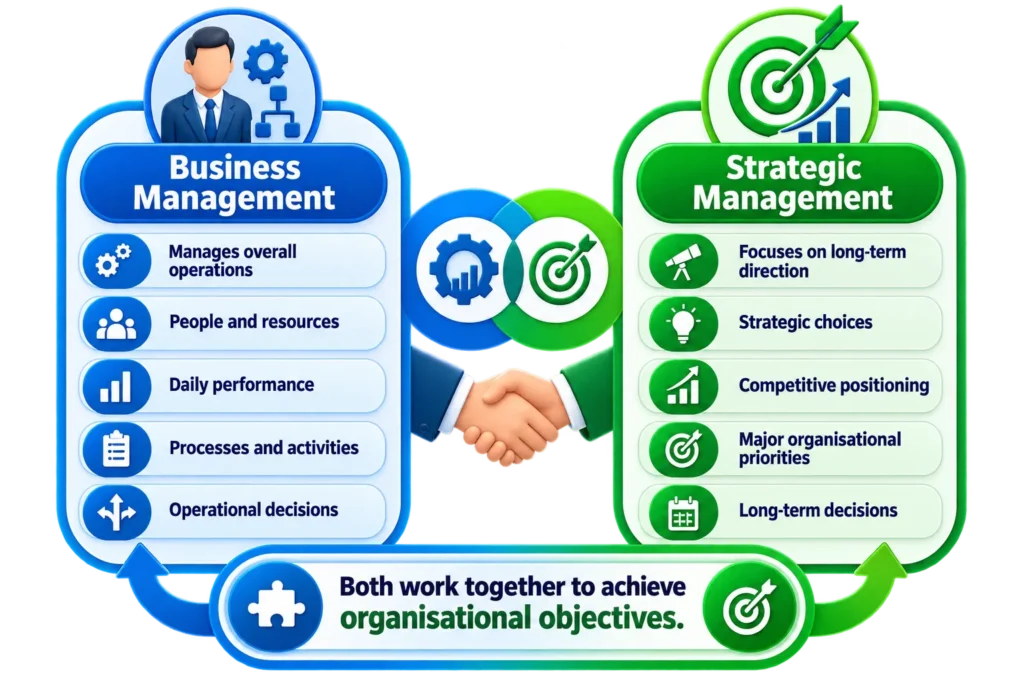
Business Management Strategy vs Strategic Management
These concepts are closely related but should not be treated as identical.
Business management covers the broader process of planning, organising, leading and controlling organisational activities and resources.
Strategic management focuses more heavily on long-term direction, competitive positioning, strategic choices, implementation and the allocation of resources needed to achieve major objectives.
Strategic management therefore forms an important part of effective business management.
A simple way to understand the relationship is:
Business management = managing the organisation effectively
Strategic management = deciding and implementing the direction that helps the organisation compete and achieve long-term objectives
Strategic management commonly involves setting objectives, analysing internal and external conditions, evaluating strategic alternatives and implementing selected strategies.
How to Implement a Business Management Strategy
Creating a strategy is only the beginning.
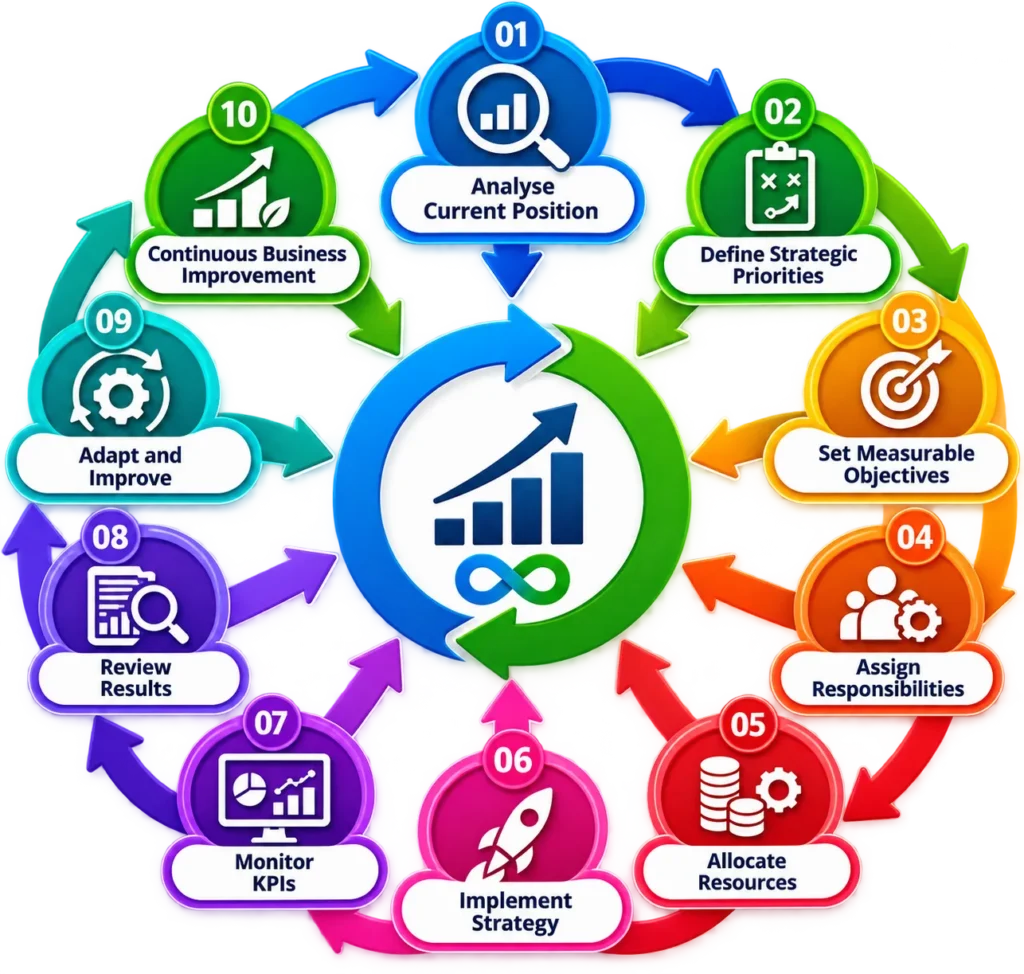
A practical implementation framework can follow these seven stages.
Step 1: Diagnose the Current Position
Understand the organisation’s current performance, resources, customers, competitors and major challenges.
Step 2: Define Strategic Priorities
Determine the most important outcomes rather than creating an excessive number of priorities.
Step 3: Establish Measurable Objectives
Translate priorities into specific objectives with clear measures and deadlines.
Step 4: Assign Ownership
Every major objective should have an accountable owner.
Step 5: Allocate Resources
Provide the people, budget, technology and time required for implementation.
Step 6: Monitor Performance
Use KPIs and regular reviews to determine whether the strategy is producing the expected results.
Step 7: Adapt and Improve
Change activities when evidence, market conditions or organisational priorities require it.
This approach closes one of the most important gaps in many business-management articles: explaining not only what a strategy is, but how it moves from an idea into operational execution.
Common Business Management Mistakes to Avoid
Even well-designed strategies can fail because of poor implementation.
Setting Too Many Goals
When everything is a priority, employees can struggle to identify what matters most.
Using Vague Objectives
Objectives such as “improve performance” are difficult to measure.
Ignoring Employees
Managers may create strategies without considering the people responsible for implementation.
Failing to Allocate Resources
Strategic ambitions need appropriate financial, technological and human resources.
Measuring Activity Instead of Outcomes
Completing tasks does not necessarily mean achieving results.
Ignoring External Change
A strategy based on outdated assumptions can become ineffective.
Reviewing Performance Too Infrequently
Waiting until the end of the year to discover that a strategic initiative is failing can be costly.
Treating Strategy as a One-Time Exercise
Effective management requires continuous evaluation and adaptation rather than a single annual planning exercise.
A Practical Business Management Strategy Framework
For organisations looking for a simple framework, the following model can bring the major principles together:
1. Analyse
Understand the internal organisation and external environment.
2. Prioritise
Identify the most important strategic challenges and opportunities.
3. Plan
Define goals, objectives, actions, resources and responsibilities.
4. Execute
Put the strategy into operation through teams, processes and resources.
5. Measure
Track KPIs and compare results with expected outcomes.
6. Review
Identify what is working, what is underperforming and why.
7. Adapt
Change priorities, resources or activities when evidence indicates that improvement is required.
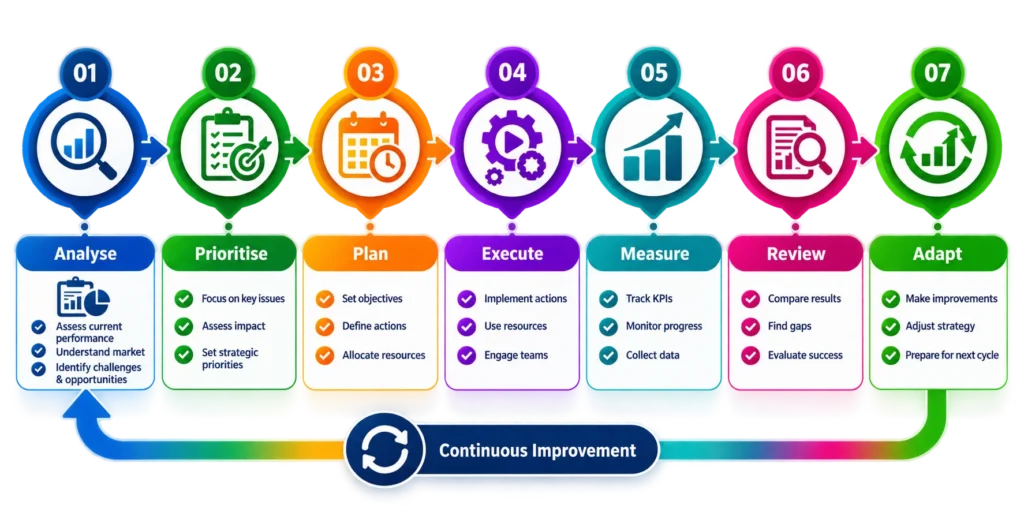
This framework combines the strongest recurring themes across the competitor content—strategic planning, goal setting, employee engagement, resource allocation, performance measurement and adaptability—while placing them into one continuous management cycle.
Example: Applying Business Management Strategies in a Growing Company
Consider a growing online business experiencing increasing sales but declining customer satisfaction.
Management could approach the problem systematically.
Current problem
Customer numbers are increasing, but complaints and response times are also increasing.
Strategic analysis
Management reviews customer feedback, operational capacity, staffing levels and competitor service standards.
Business objective
Reduce average customer-response time by 30% within six months while maintaining service quality.
Management actions
The organisation could:
- redesign the customer-service workflow
- introduce appropriate technology
- provide staff training
- establish service KPIs
- allocate additional resources during peak periods
- review customer feedback monthly
Measurement
Management tracks:
- average response time
- customer satisfaction
- complaint resolution rate
- repeat-contact rate
- employee workload
Review
If response time improves but customer satisfaction does not, managers investigate why.
This illustrates an important principle: a management strategy should be treated as a testable system rather than a fixed list of intentions.
How Technology Is Changing Business Management
Digital technologies are increasingly influencing how organisations manage information, people, customers and operations.
Managers can use technology to support:
- business intelligence
- performance dashboards
- customer relationship management
- workflow automation
- financial forecasting
- project management
- employee collaboration
- data analysis
- artificial intelligence-assisted decision support
However, technology should support strategy rather than replace strategic thinking.
Buying a new system does not automatically improve organisational performance. Managers must first identify the business problem, establish the desired outcome and then determine whether technology provides an appropriate solution.
Related Business Management Courses
1. Qualifi Level 3 Diploma in Business Management
The Qualifi Level 3 Diploma in Business Management introduces learners to key business areas such as business environment, marketing, human resources, communication, and business resources.
2. Qualifi Level 4 Diploma in Business Management
The Qualifi Level 4 Diploma in Business Management develops knowledge of business operations, management, leadership, organisational practices, and business decision-making.
3. Qualifi Level 5 Extended Diploma in Business Management
The Qualifi Level 5 Extended Diploma in Business Management provides advanced knowledge of management, leadership, organisational decision-making, and contemporary business practices.
4. OTHM Level 3 Diploma in Business Management
The OTHM Level 3 Diploma in Business Management covers essential business concepts, including the business environment, communication, customer service, finance, marketing, and people management.
5. OTHM Level 5 Extended Diploma in Business Management
The OTHM Level 5 Extended Diploma in Business Management develops knowledge across leadership, finance, marketing, human resources, operations, business strategy, and business law.
6. OTHM Level 6 Diploma in Business Management
The OTHM Level 6 Diploma in Business Management focuses on advanced management and strategic areas, including leadership, financial decision-making, operations, sustainability, and strategic human resource management.
7. ICTQual AB Level 3 Diploma in Business Management
The ICTQual AB Level 3 Diploma in Business Management provides foundational knowledge of marketing, business communication, human resources, finance, operations, and business performance.
8. ABMA Education Level 6 Diploma in Business Management (RQF)
The ABMA Education Level 6 Diploma in Business Management (RQF) develops advanced knowledge in strategic management, leadership, finance, marketing, project management, economics, and international business.
Conclusion
Effective business management helps organisations achieve their goals, use resources wisely and improve performance. By setting clear objectives, leading teams, managing risks and reviewing results, businesses can make better decisions and support long-term success.