
How Businesses Are Managed: A Simple Guide to Key Management Function
Management is the process of guiding people, resources, and activities to achieve business goals. Effective management helps organisations turn their plans into clear and organised actions.
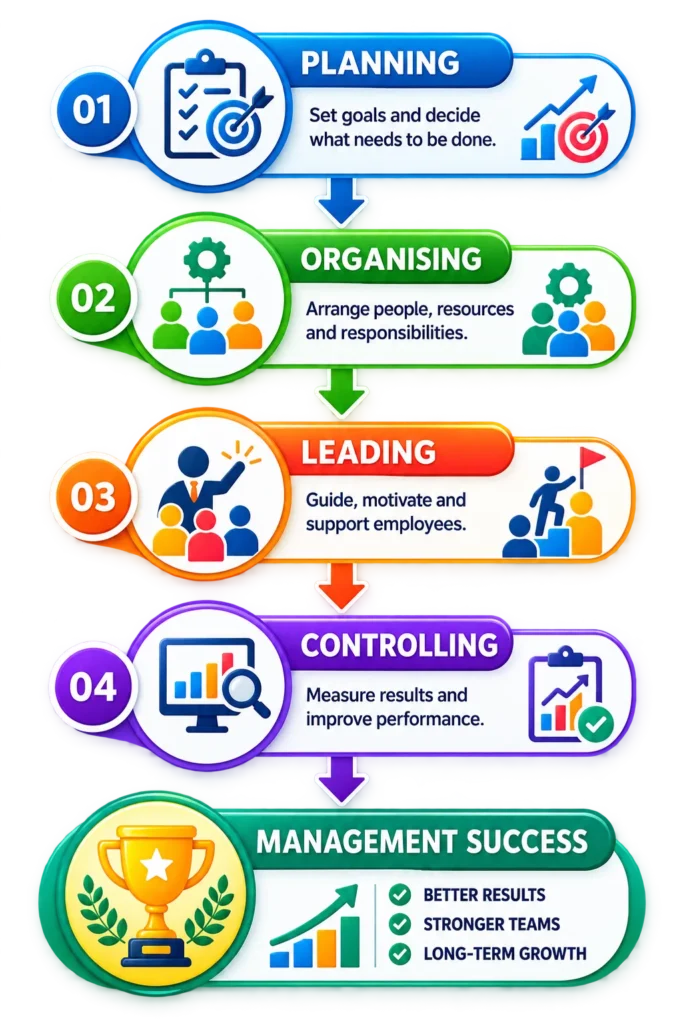
The four main functions of management are planning, organising, leading, and controlling. These functions help managers set goals, allocate resources, guide employees, and monitor performance. Together, they form a continuous process that helps businesses respond to changes and improve results.
What Is Management?
Management is the coordinated process of planning, organising, leading and controlling organisational resources to achieve objectives efficiently and effectively.
Resources can include:
- People and employee skills
- Financial resources
- Equipment and technology
- Materials and information
- Time
- Business processes
- Knowledge and organisational capabilities
The purpose of management is not simply to tell employees what to do. Managers make decisions, allocate resources, establish priorities, coordinate activities, solve problems, communicate objectives and evaluate performance.
For example, if a company wants to launch a new product, management must determine the business objective, develop a suitable plan, allocate responsibilities, coordinate marketing and operations, support employees during implementation and measure whether the launch achieves its targets.
This demonstrates why management is both a people-focused and results-focused activity.
What Are the Four Functions of Management?
| Management Function | What It Means | Main Focus |
|---|---|---|
| Planning | Set goals and decide actions | Direction |
| Organising | Arrange people, resources, and tasks | Coordination |
| Leading | Guide, motivate, and support people | Leadership |
| Controlling | Monitor results and improve performance | Performance |
These functions are commonly associated with the management framework that developed from Henri Fayol’s work. Fayol originally identified five functions, including planning, organising, commanding, coordinating and controlling. Modern management education commonly presents the framework as planning, organising, leading and controlling.
The important point is that these functions should not be viewed as completely separate activities. They support one another throughout the management process.
1. Planning
Planning is the process of deciding what an organisation wants to achieve and determining how those objectives can be accomplished.
It provides direction before resources are committed and activities begin.
Effective planning may involve:
- Setting organisational objectives
- Analysing current performance
- Assessing opportunities and threats
- Forecasting future conditions
- Establishing priorities
- Identifying required resources
- Setting budgets
- Developing timelines
- Establishing performance measures
- Preparing alternative courses of action
Planning can operate at different levels.
Strategic Planning
Strategic planning focuses on the long-term direction of an organisation.
Senior managers may consider questions such as:
- Where should the organisation compete?
- What markets should it enter?
- What capabilities will it need?
- What risks could affect future performance?
- How can the organisation create sustainable value?
Tactical Planning
Tactical planning translates strategic objectives into departmental or functional plans.
For example, a company’s strategic goal may be to increase market share. The marketing department might then develop a campaign plan, while operations may increase production capacity.
Operational Planning
Operational planning focuses on the activities required to deliver day-to-day objectives.
This can include staffing schedules, task allocation, purchasing, customer service activities, production schedules and operational targets.
Example of Planning
Imagine a retailer wants to open five new stores.
Management would need to assess potential locations, estimate costs, forecast demand, establish opening dates, determine staffing requirements and prepare budgets.
Without effective planning, the organisation could commit resources without having a clear route to its objectives.
Why Is Planning Important?
Planning reduces uncertainty and gives employees a clear sense of direction.
It also helps managers anticipate challenges instead of reacting to every problem after it occurs.
However, effective planning should not become rigid. Business conditions can change because of customer behaviour, economic conditions, technology, competitors or unexpected events. Therefore, managers should review and update plans when new information becomes available.
2. Organising
Organising involves arranging people, responsibilities, resources and processes so that planned objectives can be achieved.
Once management knows what needs to be accomplished, it must determine how the work will be structured.
Organising may involve:
- Defining responsibilities
- Allocating resources
- Delegating tasks
- Creating reporting relationships
- Establishing communication channels
- Coordinating departments
- Assigning people according to skills
- Managing workloads
- Establishing processes and procedures
For example, if a company is implementing a new customer service system, managers may need to identify who will manage the project, who will configure the system, who will train employees and who will monitor customer outcomes.
Good organising prevents confusion and duplication.
It helps employees understand:
What am I responsible for?
Who do I work with?
Who makes decisions?
What resources are available?
What results are expected?
Modern organisations may use flexible, cross-functional or decentralised structures rather than relying exclusively on traditional hierarchies. Contemporary management discussions increasingly recognise the importance of flexible structures and effective resource allocation.
3. Leading
Leading is the process of guiding, motivating and influencing people so that they can contribute effectively towards organisational objectives.
This function highlights the human side of management.
A manager may have an excellent plan and sufficient resources, but the plan can still fail if employees do not understand the objectives, lack motivation or cannot work effectively together.
Effective leadership involves:
- Communicating clearly
- Setting expectations
- Motivating employees
- Building trust
- Providing feedback
- Resolving conflict
- Supporting employee development
- Encouraging collaboration
- Making decisions
- Managing change
Leadership does not necessarily mean giving orders.
A modern manager may need to coach an employee in one situation, facilitate collaboration in another and make a firm decision during a critical operational problem.
Example of Leading
Suppose a business introduces a new digital system.
Some employees may welcome the change while others may be concerned about unfamiliar technology.
An effective manager would explain why the change is necessary, provide appropriate support, listen to concerns, communicate expectations and help employees develop confidence with the new system.
This is leadership in practice.
Why Is Leadership Important?
Leadership connects organisational objectives with employee action.
Good leaders help people understand not only what needs to be done but also why it matters.
Modern management also places increasing emphasis on emotional intelligence, communication, adaptability and the ability to make decisions under uncertainty.
4. Controlling
Controlling is the process of measuring performance, comparing actual results with planned objectives and taking corrective action where necessary.
The term “controlling” does not mean micromanaging employees.
Instead, it is about maintaining organisational direction and identifying performance gaps.
A typical control process involves:
- Establishing performance standards
- Measuring actual performance
- Comparing results with expectations
- Identifying significant deviations
- Investigating causes
- Taking corrective action
- Reviewing whether the action worked
For example, suppose a business planned to achieve 95% on-time delivery but actual performance falls to 87%.
Management should investigate why the target was missed.
Possible causes might include:
- Supplier delays
- Staffing shortages
- Production problems
- Poor scheduling
- Transportation issues
- Increased customer demand
The manager can then decide what corrective action is appropriate.
Modern management systems may use KPIs, dashboards, analytics and real-time reporting to support this function.
How Do the Four Functions of Management Work Together?
One of the most important concepts to understand is that the four functions are interconnected.
Consider a business preparing to launch a new service.
Planning determines the objectives, budget, timeline and required activities.
Organising assigns people, resources, responsibilities and processes.
Leading communicates the plan, motivates employees and manages implementation.
Controlling measures results and identifies whether performance is meeting expectations.
But the process does not end there.
Suppose customer demand is lower than expected.
Management may return to the planning function and change the marketing strategy.
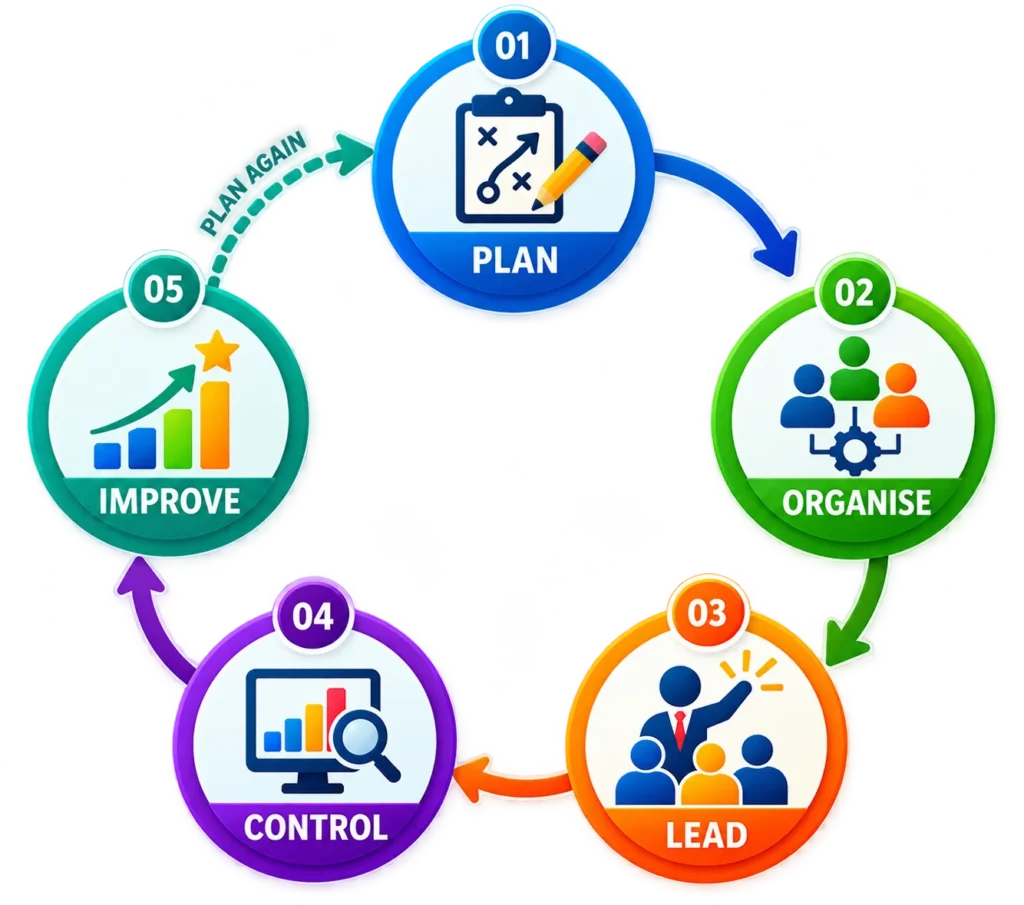
This creates a continuous management cycle:
Plan → Organise → Lead → Measure → Correct → Improve → Re-plan
This cyclical approach is particularly important in environments where customer expectations, technology and market conditions change rapidly.
Management Functions Are Not a Rigid Sequence
A common misunderstanding is that managers complete planning once, move to organising, then leading and finally controlling.
In reality, managers often perform several functions simultaneously.
For example, a department manager may:
- Plan next month’s targets
- Organise today’s workload
- Lead a team meeting
- Control current performance
- Adjust resources because of an unexpected problem
Therefore, the four functions provide a framework for understanding management rather than a strict timetable.
This distinction is important because modern management requires flexibility and continuous adjustment.
Why Are the Functions of Management Important?
The functions of management help organisations convert objectives into coordinated action.
1. They Provide Direction
Planning establishes priorities and helps employees understand what the organisation is trying to achieve.
2. They Improve Resource Use
Organising helps ensure that people, money, equipment, information and time are used appropriately.
3. They Support Employee Performance
Leading helps managers communicate expectations, motivate employees and create conditions for effective performance.
4. They Identify Performance Problems
Controlling enables managers to identify deviations before they become larger problems.
5. They Support Decision-Making
Managers can use information from performance monitoring to make better decisions.
6. They Encourage Continuous Improvement
The results of controlling can feed back into future planning, allowing organisations to learn from experience.
Effective management processes can also improve resource utilisation, departmental alignment, business readiness and employee engagement.
Examples of the Four Functions of Management
The functions become easier to understand when applied to real situations.
| Business Situation | Planning | Organising | Leading | Controlling |
| New product launch | Set launch objectives | Assign project roles | Motivate project team | Track launch KPIs |
| Retail expansion | Forecast demand | Allocate staff | Guide store teams | Monitor sales |
| Digital transformation | Define technology goals | Allocate implementation resources | Support employees | Measure adoption |
| Customer service improvement | Set service targets | Redesign responsibilities | Coach employees | Monitor satisfaction |
| Cost reduction | Establish savings targets | Reallocate resources | Explain changes | Track expenditure |
This shows that management functions are relevant across industries rather than being limited to one type of organisation.
Management Functions at Different Levels
The four functions apply across management levels, but the emphasis may change.
Senior Management
Senior managers generally focus more heavily on strategic planning, organisational direction, major resource decisions, risk and long-term performance.
Middle Management
Middle managers translate strategic objectives into departmental plans and coordinate people and resources.
First-Line Management
First-line managers are often more closely involved with operational planning, daily supervision, employee support, task coordination and performance monitoring.
The same four functions therefore operate at different levels of the organisation.
Management Functions vs Management Roles
These concepts are related but not identical.
Management functions describe the major activities managers perform:
- Planning
- Organising
- Leading
- Controlling
Management roles describe the different ways managers operate within an organisation, such as communicating information, representing the organisation, coordinating people and making decisions.
Understanding this distinction helps learners avoid treating every management concept as the same thing.
Traditional and Modern Management Functions
The fundamental functions of management remain relevant, but their application has changed.
Traditional management often placed greater emphasis on hierarchy, formal structures, supervision and standardised procedures.
Modern management increasingly requires:
- Agility
- Data-informed decision-making
- Digital literacy
- Collaboration
- Emotional intelligence
- Change management
- Stakeholder engagement
- Risk awareness
- Continuous improvement
- Remote and hybrid team management
For example, controlling may once have depended heavily on periodic reports. Today, managers can use real-time dashboards and analytics to identify emerging performance problems much earlier. SmartSuite similarly highlights real-time progress tracking and data visibility as tools supporting management control.
How Technology Is Changing Management
Technology does not replace the fundamental functions of management, but it changes how managers perform them.
Planning
Managers can use data analytics, forecasting tools and scenario analysis to support decisions.
Organising
Digital platforms can help allocate tasks, manage workloads and coordinate teams.
Leading
Collaboration technologies allow managers to communicate with distributed and hybrid teams.
Controlling
Dashboards and automated reporting can provide faster visibility of performance.
Artificial intelligence is also becoming increasingly relevant to management decision-making. Managers may use AI-supported tools for analysing information, identifying patterns, forecasting demand or automating routine activities.
However, technology should support managerial judgement rather than replace it. Managers still need to evaluate information, consider risks and understand the human and organisational consequences of decisions.
Common Management Mistakes
Understanding what management functions are also means understanding how they can fail.
Focusing on Planning Without Execution
A detailed strategy has little value if employees do not have the resources, responsibilities and support required to implement it.
Organising Without Communication
A formal structure cannot compensate for unclear communication.
Leading Without Measurement
Motivating employees is important, but managers also need objective information to determine whether goals are being achieved.
Controlling Without Trust
Excessive monitoring can create frustration and reduce employee autonomy.
Failing to Adapt the Plan
A plan developed under yesterday’s conditions may not remain appropriate when the business environment changes.
The strongest management approach therefore balances direction, structure, leadership and performance information.
Essential Skills for Effective Management
Managers need more than technical knowledge.
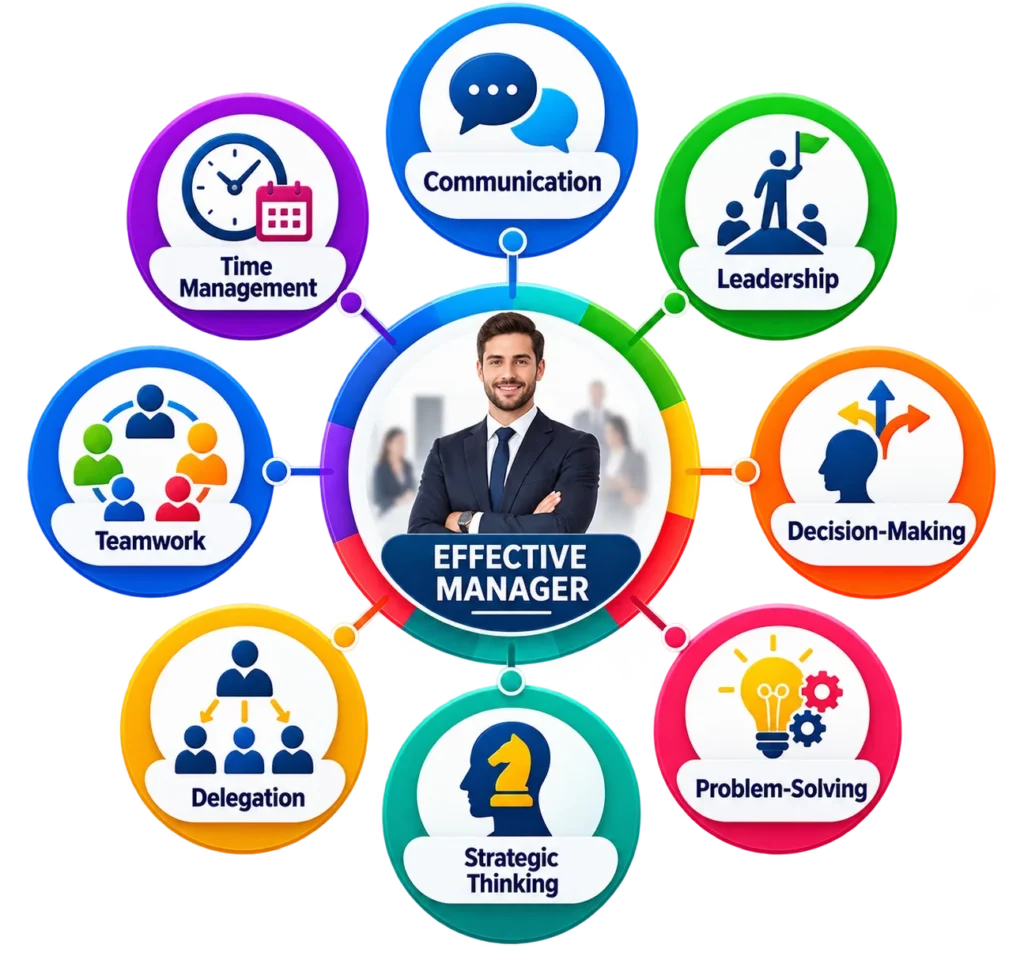
Important management skills include:
- Communication
- Leadership
- Strategic thinking
- Decision-making
- Problem-solving
- Delegation
- Time management
- Financial awareness
- Analytical thinking
- Conflict management
- Change management
- Emotional intelligence
- Digital literacy
The relative importance of each skill depends on the manager’s role, industry and organisational environment.
How Can Managers Improve Their Effectiveness?
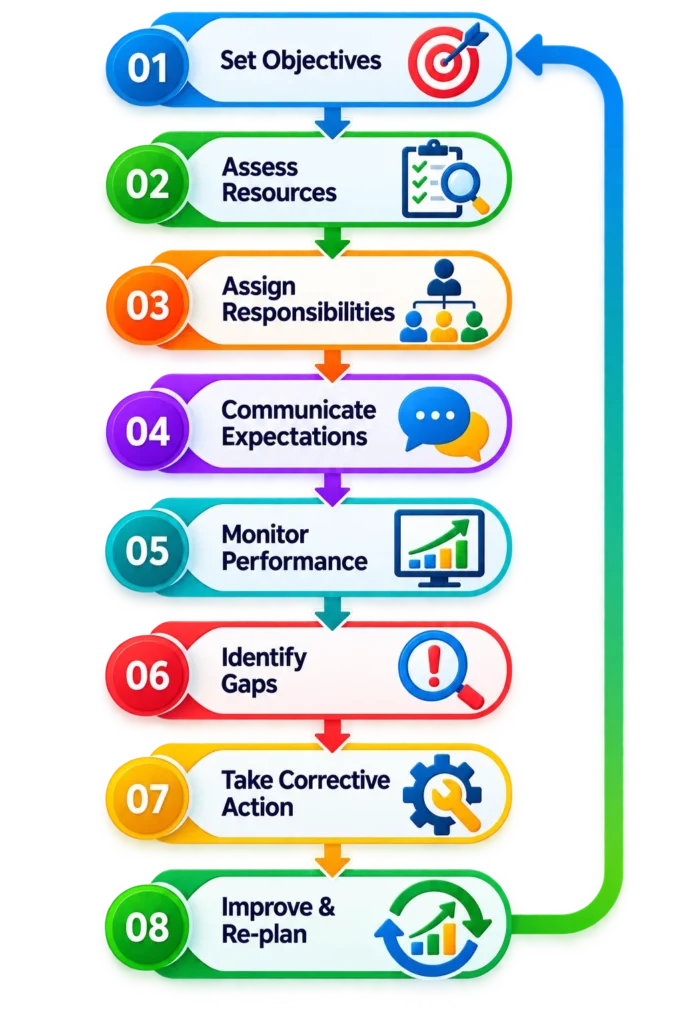
Managers can improve performance by making the four functions part of a continuous improvement cycle.
Step 1: Clarify Objectives
Make sure organisational and team objectives are specific and understandable.
Step 2: Assess Resources
Determine whether people, finances, technology and time are sufficient.
Step 3: Assign Responsibilities
Ensure employees understand their responsibilities and decision-making authority.
Step 4: Communicate Expectations
Explain priorities, standards and expected outcomes.
Step 5: Monitor Performance
Use meaningful measures rather than relying solely on assumptions.
Step 6: Investigate Deviations
When results differ from expectations, identify the underlying cause.
Step 7: Take Corrective Action
Make proportionate changes to resources, processes, priorities or plans.
Step 8: Learn and Re-plan
Use the lessons gained from performance results to improve future decisions.
This final step is what turns management from a repetitive administrative process into a learning system.
Related Business Management Courses
1. Qualifi Level 3 Diploma in Business Management
The Qualifi Level 3 Diploma in Business Management introduces learners to key business areas such as business environment, marketing, human resources, communication, and business resources.
2. Qualifi Level 4 Diploma in Business Management
The Qualifi Level 4 Diploma in Business Management develops knowledge of business operations, management, leadership, organisational practices, and business decision-making.
3. Qualifi Level 5 Extended Diploma in Business Management
The Qualifi Level 5 Extended Diploma in Business Management provides advanced knowledge of management, leadership, organisational decision-making, and contemporary business practices.
4. OTHM Level 3 Diploma in Business Management
The OTHM Level 3 Diploma in Business Management covers essential business concepts, including the business environment, communication, customer service, finance, marketing, and people management.
5. OTHM Level 5 Extended Diploma in Business Management
The OTHM Level 5 Extended Diploma in Business Management develops knowledge across leadership, finance, marketing, human resources, operations, business strategy, and business law.
6. OTHM Level 6 Diploma in Business Management
The OTHM Level 6 Diploma in Business Management focuses on advanced management and strategic areas, including leadership, financial decision-making, operations, sustainability, and strategic human resource management.
7. ICTQual AB Level 3 Diploma in Business Management
The ICTQual AB Level 3 Diploma in Business Management provides foundational knowledge of marketing, business communication, human resources, finance, operations, and business performance.
8. ABMA Education Level 6 Diploma in Business Management (RQF)
The ABMA Education Level 6 Diploma in Business Management (RQF) develops advanced knowledge in strategic management, leadership, finance, marketing, project management, economics, and international business.
Conclusion
The functions of management—planning, organising, leading, and controlling—help businesses achieve their goals effectively. Each function supports the others by providing direction, managing resources, guiding employees, and monitoring results.
When these functions work together, managers can make better decisions, solve problems, improve performance, and help their organisations grow successfully.