
How to Become a Health and Safety Officer in Construction
The construction industry is one of the most significant sectors in the global economy, playing a crucial role in the development of modern infrastructure and urban environments. From highways and bridges to residential buildings, commercial complexes, and large-scale industrial facilities, construction projects support economic growth and improve the quality of life for communities around the world.
Despite its importance, construction is widely recognized as one of the most hazardous industries. Construction workers are frequently exposed to a variety of workplace risks, including falls from height, heavy machinery accidents, electrical hazards, structural collapses, confined space dangers, and exposure to hazardous substances such as dust, chemicals, and asbestos. These risks make effective health and safety management essential for protecting workers and ensuring the successful completion of construction projects.
To minimize workplace accidents and maintain safe working conditions, organizations employ Health and Safety Officers who are responsible for overseeing safety practices on construction sites. These professionals play a vital role in identifying hazards, implementing safety policies, conducting inspections, and ensuring that all construction activities comply with occupational health and safety regulations.
A well-trained Health and Safety Officer helps organizations create a strong safety culture, reduce workplace incidents, and maintain compliance with legal safety standards. Their presence on construction sites not only protects workers but also improves productivity, reduces project delays, and prevents financial losses caused by accidents or regulatory violations.
What is a Construction Health and Safety Officer?
A Construction Health and Safety Officer is a trained professional responsible for ensuring that all construction activities are carried out in a safe and controlled manner. Their primary responsibility is to protect workers, contractors, and visitors by ensuring that construction sites comply with established occupational health and safety regulations, industry standards, and organizational safety policies.
These professionals act as safety leaders on construction projects, monitoring site operations and identifying potential hazards before they result in accidents or injuries. They work closely with project managers, engineers, supervisors, and workers to implement effective safety measures and promote safe working practices across the entire construction site.
Construction Health and Safety Officers are also responsible for educating workers about safety procedures, ensuring the proper use of protective equipment, and maintaining accurate safety documentation. By proactively identifying risks and implementing preventive measures, they help organizations reduce accidents and create a safer working environment.
Key Responsibilities
Health and Safety Officers perform a wide range of duties on construction sites, including:
- Conducting workplace risk assessments
- Inspecting construction equipment and safety systems
- Ensuring workers wear personal protective equipment (PPE)
- Investigating accidents and near-miss incidents
- Delivering safety training and toolbox talks
- Monitoring compliance with safety regulations
- Developing safety policies and procedures
- Preparing safety reports and documentation
- Coordinating emergency response procedures
Their primary objective is to create a safe working environment for all employees and contractors on the construction site.
Primary Objective of a Construction Health and Safety Officer
The primary objective of a Construction Health and Safety Officer is to create and maintain a safe working environment by preventing accidents, minimizing workplace hazards, and promoting a strong safety culture within construction projects.
Through continuous monitoring, training, and proactive safety management, safety officers help organizations protect their workforce while ensuring that construction activities are completed efficiently and responsibly.
Why Health and Safety Officers Are Essential in Construction
Construction projects involve multiple hazards and complex activities. Without proper safety management, the risk of injuries and fatalities increases significantly.
Benefits of Having Safety Officers on Construction Sites
- Prevent workplace accidents and injuries
- Improve worker awareness of safety practices
- Ensure compliance with national and international safety regulations
- Reduce financial losses caused by accidents
- Protect company reputation and project timelines
Companies that invest in professional safety management often experience better productivity, fewer delays, and improved worker morale.
Common Hazards in Construction Projects
Construction safety officers must manage many different workplace hazards.
1. Working at Height
Falls from scaffolding, ladders, or roofs are one of the leading causes of injuries in construction.
2. Heavy Machinery and Equipment
Crane operations, forklifts, and excavators can cause serious accidents if not operated safely.
3. Electrical Hazards
Construction workers often deal with exposed wiring and electrical installations.
4. Excavation and Trenching Risks
Cave-ins and unstable soil conditions pose serious threats during excavation work.
5. Hazardous Materials
Exposure to chemicals, dust, and asbestos can lead to long-term health problems.
A construction safety officer ensures that control measures are implemented to minimize these risks.

Step-by-Step Guide: How to Become a Health and Safety Officer in Construction
Step 1: Obtain a Relevant Educational Background
Although some entry-level positions accept candidates with diplomas, many employers prefer individuals with a relevant educational background.
Suitable fields include:
- Occupational Health and Safety
- Environmental Health and Safety
- Construction Management
- Civil Engineering
- Industrial Safety
Formal education provides a foundation in risk management, workplace safety laws, and hazard control techniques.
Step 2: Complete Professional Safety Certifications
Certifications are essential for building credibility as a health and safety professional.
Popular certifications include:
- NEBOSH International General Certificate
- IOSH Managing Safely
- OSHA Construction Safety Courses
- Level 3 Certificate in Occupational Health and Safety
- Diploma in Occupational Health and Safety
These qualifications provide knowledge in:
- Hazard identification
- Risk assessment techniques
- Safety management systems
- Workplace legislation
- Incident investigation
Professionals with recognized certifications are often preferred by employers in construction projects.
Step 3: Gain Practical Experience in Construction
Hands-on experience is extremely important in construction safety.
You can start with roles such as:
- Safety Assistant
- Site Supervisor
- Junior Safety Officer
- Construction Technician
Practical experience helps professionals understand real construction hazards and safety management practices.
Step 4: Learn Construction Safety Regulations and Standards
Safety officers must understand the safety regulations that apply to construction projects.
Important areas of knowledge include:
- Working at height safety standards
- Scaffolding safety procedures
- Excavation safety rules
- Electrical safety practices
- Machinery safety regulations
Knowledge of international standards such as ISO safety management systems also improves career prospects.
Step 5: Develop Essential Skills for Safety Professionals
A successful health and safety officer requires both technical and interpersonal skills.
Technical Skills
- Risk assessment and hazard identification
- Safety inspections and audits
- Accident investigation
- Emergency response planning
Soft Skills
- Leadership and team management
- Communication and training skills
- Problem-solving abilities
- Attention to detail
These skills help safety professionals manage workplace risks effectively.
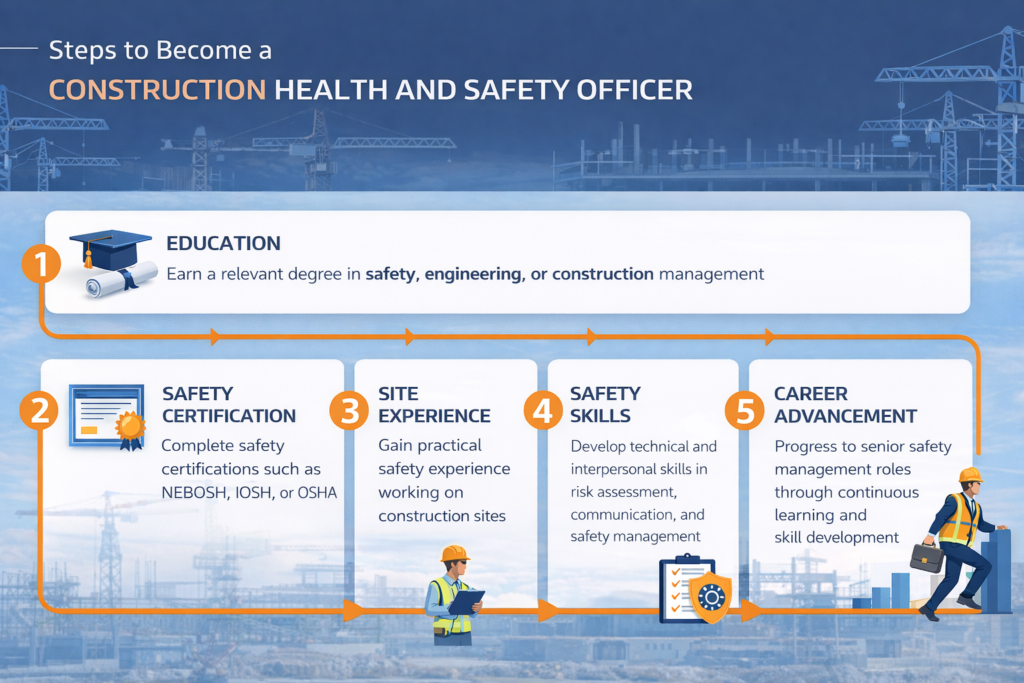
Certifications That Help You Become a Construction Safety Officer
Different certification levels support career growth in the safety profession.
Entry-Level Certifications
- IOSH Working Safely
- OSHA 30-Hour Construction Safety
Intermediate Certifications
- IOSH Managing Safely
- NEBOSH International General Certificate
- Level 3 Occupational Health and Safety Certificate
Advanced Certifications
- Level 6 Diploma in Occupational Health and Safety
- Professional Safety Certifications
- Chartered Safety Professional qualifications
Higher qualifications often lead to management roles in safety leadership.Before specializing in construction safety, many professionals begin by learning the general requirements of safety careers. You can read our complete guide on becoming a safety officer to understand the foundational certifications and career pathways.
Career Path in Construction Health and Safety
The field of construction health and safety offers excellent long-term career opportunities for professionals who are committed to protecting workers and improving workplace safety standards. As construction projects become more complex and safety regulations continue to evolve, organizations increasingly require qualified safety professionals to manage risks effectively.
A career in construction health and safety typically follows a structured progression, allowing individuals to gradually develop their technical knowledge, practical experience, and leadership skills. Professionals usually begin with entry-level positions and advance to senior management roles as they gain experience, professional certifications, and specialized safety expertise.
Below is a typical career progression pathway in the construction safety profession.
Safety Assistant
The Safety Assistant role is often the entry-level position in the construction health and safety field. Individuals in this role support senior safety professionals in implementing safety policies and maintaining safe working conditions on construction sites.
Safety Assistants typically perform tasks such as:
- Assisting with site safety inspections and hazard identification
- Supporting risk assessments and safety audits
- Monitoring workers to ensure proper use of personal protective equipment (PPE)
- Recording safety observations and reporting unsafe conditions
- Assisting in safety training sessions and toolbox talks
- Maintaining safety documentation and records
This role provides valuable practical exposure to construction site operations and safety procedures, helping individuals build a strong foundation in workplace safety management.
Construction Safety Officer
After gaining initial experience, professionals can progress to the role of Construction Safety Officer. At this stage, individuals take on greater responsibility for monitoring safety practices and ensuring compliance with health and safety regulations.
Key responsibilities of a Construction Safety Officer include:
- Conducting comprehensive workplace risk assessments
- Inspecting construction equipment, scaffolding, and work areas
- Investigating workplace accidents and near-miss incidents
- Implementing safety policies and procedures on site
- Providing safety training and awareness programs for workers
- Ensuring compliance with occupational health and safety regulations
Construction Safety Officers play a crucial role in maintaining safe working environments and preventing workplace incidents on construction sites.
Senior Safety Officer
With several years of experience, safety professionals may advance to the position of Senior Safety Officer. In this role, individuals typically oversee larger construction projects or supervise multiple safety officers working on different site areas.
Responsibilities of a Senior Safety Officer often include:
- Leading safety inspections and audits across construction sites
- Supervising and mentoring junior safety staff
- Developing advanced risk assessment strategies
- Coordinating safety management systems within projects
- Ensuring compliance with national and international safety standards
- Assisting project managers in integrating safety into project planning
Senior Safety Officers play an important leadership role in maintaining safety performance across large construction operations.
Safety Manager
The Safety Manager position represents a significant step into management within the safety profession. Safety Managers are responsible for developing and overseeing the overall safety strategy for construction projects or organizations.
Their responsibilities typically include:
- Designing and implementing safety management systems
- Developing company-wide health and safety policies
- Conducting safety performance evaluations and audits
- Managing safety teams and coordinating safety officers
- Ensuring compliance with regulatory safety requirements
- Reporting safety performance to senior management
Safety Managers also work closely with project managers and engineering teams to ensure that safety considerations are integrated into project planning and execution.
Health and Safety Manager
A Health and Safety Manager operates at a higher organizational level and is responsible for overseeing safety programs across multiple construction projects or entire companies.
Key responsibilities include:
- Developing long-term safety strategies and risk management frameworks
- Ensuring compliance with international safety standards and regulations
- Managing large safety teams and coordinating safety training programs
- Conducting safety culture improvement initiatives
- Analyzing safety performance data to identify improvement opportunities
- Communicating safety strategies with executive leadership
Health and Safety Managers play a critical role in establishing a strong organizational safety culture and ensuring consistent safety performance across all operations.
Safety Director
The Safety Director is a senior executive-level position responsible for leading the overall health and safety strategy within an organization. This role typically exists in large construction companies, multinational engineering firms, or major infrastructure projects.
Responsibilities of a Safety Director include:
- Developing corporate health and safety policies and strategic plans
- Leading safety leadership initiatives across the organization
- Ensuring compliance with international safety regulations and industry standards
- Overseeing risk management strategies across multiple projects
- Advising executive leadership on safety performance and improvements
- Representing the organization in regulatory and industry safety discussions
At this level, professionals focus not only on operational safety management but also on strategic decision-making and organizational safety leadership.
Continuous Professional Development
Progressing through the construction safety career path requires ongoing professional development. Safety professionals often enhance their career prospects by obtaining advanced qualifications, certifications, and specialized training in occupational health and safety.
Common professional certifications that support career advancement include:
- International health and safety certificates
- Occupational health and safety diplomas
- Advanced safety management qualifications
- Professional safety leadership certifications
Professionals who continuously develop their knowledge, gain experience in complex construction environments, and demonstrate strong leadership abilities can progress into senior leadership roles responsible for managing large construction projects and safety teams across multiple locations.
Salary of Construction Health and Safety Officers
The salary of a Construction Health and Safety Officer can vary significantly depending on several factors, including professional experience, level of education, safety certifications, and the geographic location where the individual is employed. As construction safety has become a critical component of modern project management, qualified safety professionals are increasingly in demand across many regions of the world.
Countries with large infrastructure development projects and strict safety regulations tend to offer higher salaries for skilled safety professionals. In addition, professionals who hold internationally recognized certifications and possess practical construction experience often receive better compensation and career opportunities.
Key Salary Drivers
Several factors influence the earning potential of construction safety professionals, including:
- Professional experience in construction safety management
- Internationally recognized safety certifications
- Size and complexity of construction projects
- Level of responsibility within the organization
- Demand for safety professionals in specific regions
Professionals who develop advanced qualifications and gain extensive site experience typically progress into higher-paying roles such as Safety Manager or Health and Safety Director.
Regional Salary Insights
Salary levels for construction safety officers vary across different regions due to economic conditions, construction activity, and regulatory requirements.
Pakistan
In Pakistan, the average gross annual salary for a construction safety officer is approximately PKR 1,921,437, which equates to around PKR 924 per hour. Entry-level professionals may earn less initially, but salaries increase significantly with experience, specialized certifications, and work on large infrastructure or industrial projects.
Middle East (GCC Countries)
The Middle East is one of the most attractive regions for construction safety professionals due to its large infrastructure and energy projects. Safety officers working in the Gulf Cooperation Council (GCC) countries typically earn competitive salaries.
- In Saudi Arabia, construction safety officers can earn around SAR 5,500 per month or more depending on experience and project size.
- In the United Arab Emirates, salaries often start from approximately AED 4,500 per month and can increase significantly for experienced professionals working on major construction developments.
The region’s strong demand for skilled safety professionals makes it a popular destination for individuals seeking international career opportunities.
United Kingdom
In the United Kingdom, salaries for construction health and safety professionals are generally higher due to strict safety regulations and the need for qualified safety personnel.
- Entry-level safety officers typically earn between £25,000 and £35,000 per year.
- Experienced safety officers can earn between £40,000 and £60,000 or more annually, depending on their qualifications and level of responsibility.
Senior professionals working as safety managers or directors in large organizations may earn even higher salaries.
Global Salary Progression by Experience
The earning potential of safety professionals generally increases with experience and leadership responsibilities.
Entry-Level Safety Officer
Approximately $25,000 – $40,000 per year
Experienced Safety Officer
Approximately $40,000 – $70,000 per year
Safety Manager / Senior Safety Professional
Approximately $70,000 – $120,000+ per year
Industries That Hire Construction Safety Officers
Safety professionals are needed in many sectors.
Common industries include:
- Construction companies
- Infrastructure development projects
- Oil and gas industry
- Manufacturing plants
- Engineering companies
- Government construction departments
Large infrastructure projects often require multiple safety officers to manage workplace safety effectively.
Challenges Faced by Construction Safety Officers
While a career in construction health and safety is highly rewarding and plays a crucial role in protecting workers, it also comes with a number of professional challenges. Construction sites are dynamic environments where multiple activities take place simultaneously, and safety officers must constantly monitor operations to ensure that work is carried out safely and in accordance with established safety regulations.
Safety professionals often work under demanding conditions and must balance productivity requirements with strict safety standards. As a result, construction safety officers regularly face several operational and management challenges in their day-to-day responsibilities.
Enforcing Safety Rules Under Tight Project Deadlines
Construction projects often operate under strict timelines and pressure to meet completion targets. In such situations, some workers or supervisors may prioritize speed over safety practices. Safety officers must ensure that safety regulations are followed even when projects are running behind schedule or under pressure to meet deadlines.
This requires strong communication and leadership skills to convince teams that maintaining safety standards is essential for both worker protection and project success.
Managing Unsafe Worker Behavior
One of the most common challenges faced by safety officers is addressing unsafe behaviors among workers. Some workers may become complacent or may ignore safety procedures due to familiarity with the job or time pressure.
Safety officers must continuously educate workers, reinforce safety rules, and encourage a proactive safety culture. Building trust and awareness among workers is essential to ensure consistent compliance with safety guidelines.
Working in Hazardous Environments
Construction sites are inherently hazardous environments that involve heavy machinery, working at heights, electrical systems, and potentially dangerous materials. Safety officers must regularly inspect these areas and monitor operations to ensure that risks are minimized.
Working in such environments requires constant vigilance, technical knowledge of hazard control measures, and the ability to quickly identify and mitigate potential dangers.
Handling Emergency Situations
Safety officers must also be prepared to respond effectively to workplace emergencies such as accidents, fires, equipment failures, or structural incidents. During emergencies, they play a critical role in coordinating evacuation procedures, providing initial incident response, and ensuring that emergency protocols are followed.
Their ability to remain calm, make quick decisions, and implement emergency response plans is vital for minimizing harm and protecting workers during critical situations.
Maintaining Continuous Safety Awareness
Another challenge is maintaining consistent safety awareness across all levels of the workforce. Construction sites involve workers from different trades, contractors, and subcontractors, each with varying levels of safety knowledge. Safety officers must ensure that everyone on site understands and follows the same safety standards.
Despite these challenges, the role of a construction safety officer remains highly valuable and impactful. By effectively managing risks, promoting safe work practices, and ensuring compliance with safety regulations, safety officers contribute significantly to preventing accidents and protecting the wellbeing of construction workers.

Tips for Building a Successful Career in Construction Safety
Professionals who want to excel in this field should focus on continuous improvement.
Career Tips
- Obtain internationally recognized safety certifications
- Gain practical construction site experience
- Stay updated with safety regulations and industry trends
- Participate in professional safety training programs
- Develop leadership and communication skills
Continuous professional development ensures long-term career growth in the safety profession.