
What Does a Business Manager Do? Roles, Responsibilities and Skills
A business manager helps an organisation run smoothly, manage resources, achieve goals and improve performance. Their duties can include operations, budgets, staff, customer relationships, business development, planning and reporting.
The role varies by industry and organisation. A business manager in retail may focus on sales and staff, while one in technology may focus on clients, projects and growth.
This guide explains the key duties, daily tasks, skills, qualifications, salary factors, career path and responsibilities of a business manager.

What Is a Business Manager?
A business manager is a professional who coordinates and oversees business activities to help an organisation achieve its operational and commercial objectives.
The role normally sits at the intersection of people, operations, finance, strategy and performance.
A business manager may work with senior leaders to translate organisational objectives into practical plans, monitor performance, manage resources, support employees, control expenditure and identify opportunities for improvement.
The exact job description depends on the employer. In some organisations, the business manager has broad responsibility for an entire business unit. In others, the position focuses on a particular function, client portfolio, branch, department or commercial area.
This is one of the most important points to understand about the role: there is no single universal business manager job description.
For example:
- A retail business manager may focus heavily on sales, staffing, customer experience and stock performance.
- A technology business manager may coordinate projects, budgets, clients and growth initiatives.
- A healthcare business manager may focus on operational performance, resources, compliance and service delivery.
- A manufacturing business manager may concentrate on production, workforce planning, costs and operational efficiency.
- A professional-services business manager may combine business development, client management, recruitment and profitability.
Therefore, the title describes a management function rather than one fixed set of duties.
What Does a Business Manager Do?
The core responsibility of a business manager is to help the organisation perform effectively while supporting its wider objectives.
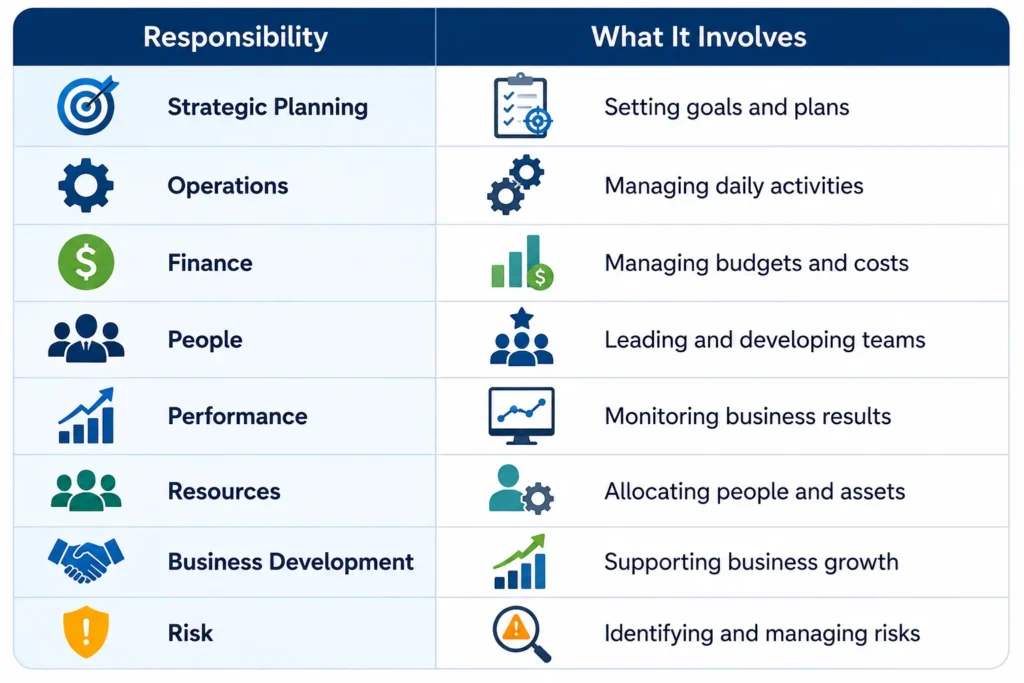
Typical responsibilities include:
- Strategic planning
- Operational management
- Budget and financial management
- Team leadership
- Performance monitoring
- Resource allocation
- Business development
- Customer and stakeholder management
- Risk and compliance management
- Reporting and decision-making
- Process improvement
- Supporting organisational growth
Universities, employers and career platforms identify many of these areas, although the emphasis differs between organisations.
1. Strategic Planning
Business managers help convert organisational goals into practical business plans.
This can involve:
- Setting departmental objectives
- Developing action plans
- Identifying growth opportunities
- Reviewing market conditions
- Allocating resources
- Setting performance targets
- Supporting strategic decisions
- Monitoring progress against objectives
Strategic planning is not simply about writing a plan. A strong business manager continually reviews whether the plan is delivering the expected results.
If sales decline, costs increase or customer expectations change, the manager may need to recommend adjustments.
2. Managing Daily Operations
Business managers help ensure that everyday activities run efficiently.
Operational responsibilities can include:
- Coordinating workflows
- Monitoring service delivery
- Allocating resources
- Reviewing procedures
- Resolving operational problems
- Managing schedules
- Identifying inefficiencies
- Coordinating different departments
The objective is to ensure that resources are being used effectively while maintaining the required level of quality and service.
For example, if a department is experiencing delays because employees are waiting for information from another team, the business manager may investigate the process and redesign the workflow.
3. Budget and Financial Management
Financial responsibility is another important part of many business manager roles.
A business manager may contribute to:
- Budget preparation
- Cost control
- Financial forecasting
- Expenditure monitoring
- Revenue analysis
- Resource allocation
- Financial reporting
- Profitability analysis
The manager does not necessarily act as the organisation’s accountant. Instead, they use financial information to make better business decisions.
For example, if a department is consistently exceeding its operating budget, the business manager may analyse the causes, identify unnecessary expenditure and recommend corrective action.
The key skill is understanding what financial information means for business performance.
4. Leading and Developing Employees
Business management is fundamentally a people-oriented role.
Depending on the organisation, a business manager may be involved in:
- Recruitment
- Onboarding
- Training
- Delegation
- Performance management
- Employee development
- Team motivation
- Conflict resolution
- Workforce planning
Effective managers do not simply assign tasks. They establish expectations, provide feedback and help employees understand how their work contributes to organisational objectives.
Employer-focused sources also show that business manager roles can involve recruitment, team management and responsibility for developing business units.
5. Monitoring Business Performance
A business manager needs to know whether the organisation or department is performing as expected.
This requires the use of measurable performance indicators.
Common KPIs may include:
| Area | Example KPI |
|---|---|
| Sales | Revenue growth |
| Finance | Operating cost |
| Customers | Customer retention |
| Operations | Productivity |
| Employees | Staff turnover |
| Projects | On-time completion |
| Service | Customer satisfaction |
| Growth | New business generated |
The important point is that KPIs should support decisions.
A business manager should not simply collect numbers. They should ask:
What is changing? Why is it changing? What does it mean? What action should be taken?
This analytical approach separates effective management from basic administration.
6. Resource Management
Businesses have limited resources, so managers must determine where those resources will have the greatest impact.
Resources may include:
- Employees
- Money
- Equipment
- Technology
- Materials
- Time
- Business information
- External suppliers
For example, if a business has a limited recruitment budget, the business manager may need to decide whether additional employees, training, technology or outsourcing would provide the greatest benefit.
This requires balancing cost, quality, time, capacity and business priorities.
7. Business Development and Growth
Some business managers have significant responsibility for growth.
This can involve:
- Identifying new markets
- Developing client relationships
- Supporting sales strategies
- Identifying new products or services
- Researching competitors
- Building commercial partnerships
- Developing existing accounts
The MIGSO-PCUBED model provides a useful example of a commercially focused business manager, where business development, client management, recruitment, revenue and profitability are closely connected.
However, this is not universal. In some organisations, sales and business development are managed by separate teams.
8. Customer and Stakeholder Management
Business managers frequently work across organisational boundaries.
Their stakeholders may include:
- Employees
- Senior managers
- Customers
- Suppliers
- Partners
- Investors
- Regulators
- Contractors
- Other departments
Strong stakeholder management requires clear communication, negotiation and relationship-building.
For example, a business manager may need to explain a budget reduction to employees while simultaneously assuring senior management that operational performance will be protected.
This means the role often involves balancing competing expectations rather than simply making isolated decisions.
9. Risk and Compliance Management
Business managers also need to understand the risks affecting their area of responsibility.
Potential risks can include:
- Financial risks
- Operational disruption
- Supplier problems
- Cybersecurity issues
- Regulatory changes
- Staff shortages
- Market changes
- Customer complaints
- Reputational damage
The manager may identify risks, assess their potential effect, establish controls and escalate significant issues.
Compliance responsibilities vary considerably between industries. A business manager in a regulated sector may have substantially greater compliance responsibilities than one working in a less regulated environment.
10. Reporting and Business Analysis
Business managers regularly communicate performance information to senior leaders or other stakeholders.
Reports may cover:
- Financial performance
- Sales
- Operational performance
- Workforce data
- Customer information
- Project progress
- Risks
- Forecasts
- Strategic initiatives
Modern business management increasingly involves interpreting data rather than simply preparing reports.
The real value comes from turning information into a recommendation.
For example:
Data: Customer complaints increased by 15%.
Analysis: Complaints are concentrated around one service process.
Recommendation: Redesign the process and introduce additional staff training.
That progression—from data to insight to action—is an important part of effective business management.
What Does a Business Manager Do on a Typical Day?
There is no single standard working day because responsibilities vary by industry and organisation.
However, a typical day might include:
Morning
- Reviewing performance dashboards
- Checking urgent operational issues
- Reviewing emails and priorities
- Meeting with team leaders
- Checking progress against targets
Midday
- Discussing budgets or resources
- Meeting customers or suppliers
- Reviewing a project or business-development opportunity
- Resolving operational issues
- Coordinating with other departments
Afternoon
- Analysing performance data
- Preparing management reports
- Reviewing staffing requirements
- Planning upcoming activities
- Meeting senior management
- Following up on strategic actions
A business manager may therefore move between strategic planning and operational problem-solving several times during the same day.
That variety is one reason the role can be demanding.
What Are the Most Important Business Manager Skills?
Successful business managers need a combination of technical, analytical and interpersonal skills.
Leadership
Managers must be able to set direction, motivate employees, delegate effectively and address performance issues.
Communication
Business managers communicate with people at different organisational levels. They need to explain complex information clearly and adapt their communication to different audiences.
Financial Awareness
Understanding budgets, costs, revenue, profitability and financial performance helps managers make commercially sound decisions.
Analytical Thinking
Managers need to interpret data, identify trends and determine the causes of performance problems.
Problem-Solving
Business managers regularly encounter unexpected operational, financial or people-related problems.
Strategic Thinking
Managers need to understand not only what is happening today but also how current decisions could affect future performance.
Negotiation
Negotiation may be required when dealing with customers, suppliers, employees, budgets or competing internal priorities.
Time Management
A business manager may have several competing priorities at once. Effective prioritisation is therefore essential.
Adaptability
Markets, technology, customer expectations and organisational priorities can change rapidly. Managers must be able to adjust plans when circumstances change.
Digital and Data Literacy
Modern managers increasingly use dashboards, business software, collaboration platforms, customer systems and analytical tools to monitor performance and support decisions.
Sources such as the University of North Dakota and Bay Atlantic University similarly emphasise communication, leadership, financial understanding, critical thinking, adaptability and strategic thinking.
What Qualifications Do You Need to Become a Business Manager?
There is no single qualification that guarantees entry into business management.
Employers may consider a combination of:
- Academic qualifications
- Management experience
- Industry experience
- Leadership ability
- Business knowledge
- Professional qualifications
- Technical skills
A business-related degree can provide knowledge of areas such as finance, marketing, operations, human resources and management. However, experience is also important because many management capabilities develop through workplace responsibility.
Some organisations may value professional certifications or specialist qualifications, particularly where the role involves project management, finance, supply chain, business analysis or another defined discipline.
The University of North Dakota, for example, identifies education, relevant experience, leadership development, credentials and networking as potential components of becoming a business manager.
Do You Need a Degree to Become a Business Manager?
Not necessarily.
Requirements depend on the employer, industry, seniority and specific job description.
Some organisations may prefer a bachelor’s degree or higher, while others place greater emphasis on professional experience and demonstrated management capability.
Career data from Alabama Nonprofits, for example, shows bachelor’s-level education as the most common educational category in its dataset, while also showing master’s and other educational backgrounds.
The practical lesson is that aspiring business managers should look beyond qualifications alone.
A strong profile can combine:
Business knowledge + leadership experience + analytical ability + communication + industry understanding.
Business Manager Salary: What Determines Earnings?
Business manager salaries vary considerably.
Factors affecting pay can include:
- Country
- Location
- Industry
- Organisation size
- Management level
- Years of experience
- Business responsibilities
- Specialist expertise
- Performance
- Employer
For example, salary figures published by different organisations are not directly comparable because they may use different countries, datasets, job definitions and experience levels.
Indeed UK currently reports an average salary of £38,199 for business managers, while noting differences according to location, sector, experience and other factors.
The University of Huddersfield also emphasises that business manager earnings vary according to factors such as location, industry, company size and experience.
Therefore, anyone researching business manager salaries should treat headline figures as indicative rather than guaranteed.
Where Do Business Managers Work?
Business managers can work across many sectors.
Common examples include:
- Retail
- Technology
- Finance
- Healthcare
- Manufacturing
- Education
- Hospitality
- Construction
- Professional services
- Non-profit organisations
- Logistics
- Telecommunications
The underlying management principles remain similar, but the specific responsibilities change according to the organisation.
For example, a business manager in a manufacturing organisation may focus heavily on production costs and operational efficiency, whereas a business manager in professional services may spend more time on clients, recruitment, business development and profitability.
Business Manager vs Operations Manager
These roles can overlap, but they are not necessarily identical.
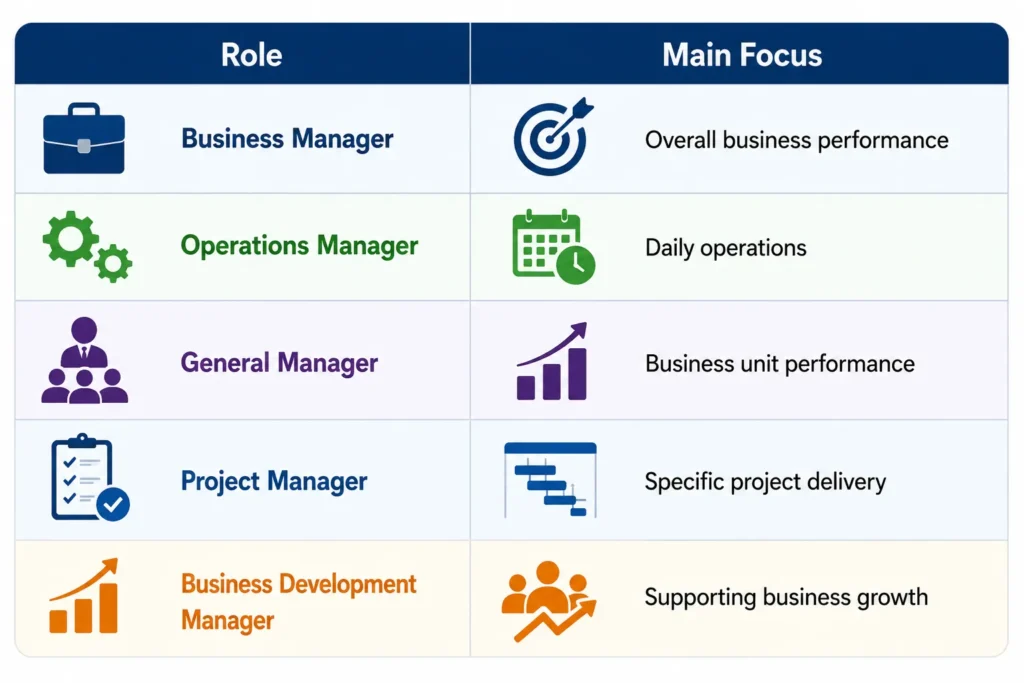
A business manager usually has a broader focus that can include strategy, finance, people, operations, customers and growth.
An operations manager generally has a stronger focus on the efficient delivery of day-to-day operational activities.
However, organisational structures differ. In some businesses, the two positions may have considerable overlap.
Business Manager vs General Manager
A general manager often has broad responsibility for the performance of an entire business unit, branch or operation.
A business manager may have a broader or narrower remit depending on the organisation.
The job title alone does not determine the level of authority. The actual job description, reporting structure, budget responsibility and decision-making authority are more useful indicators.
Business Manager vs Project Manager
A project manager normally focuses on delivering a defined project within agreed scope, time, cost and quality requirements.
A business manager usually has a continuing responsibility for business performance rather than one temporary project.
However, business managers may oversee projects or work closely with project managers.
What Challenges Does a Business Manager Face?
Business management is not simply about giving instructions and monitoring employees.
Managers often have to make decisions when priorities conflict.
Common challenges include:
Balancing Cost and Quality
Reducing expenditure may appear attractive, but excessive cost cutting can damage service quality or employee performance.
Managing Competing Priorities
A manager may need to address an urgent operational issue while also delivering a strategic initiative.
Handling Employee Performance
Managers must deal with performance issues fairly while maintaining team morale and productivity.
Responding to Change
Changes in technology, competition, customer behaviour or regulation may require business plans to be adjusted.
Managing Limited Resources
Managers frequently have to decide which activities deserve priority when budgets, people or time are limited.
Making Decisions with Incomplete Information
Business decisions often need to be made before every fact is available. Managers therefore need judgement as well as analytical ability.
How Can a Business Manager Improve Business Performance?
An effective business manager should avoid treating every problem as a separate issue.
A stronger approach is to connect:
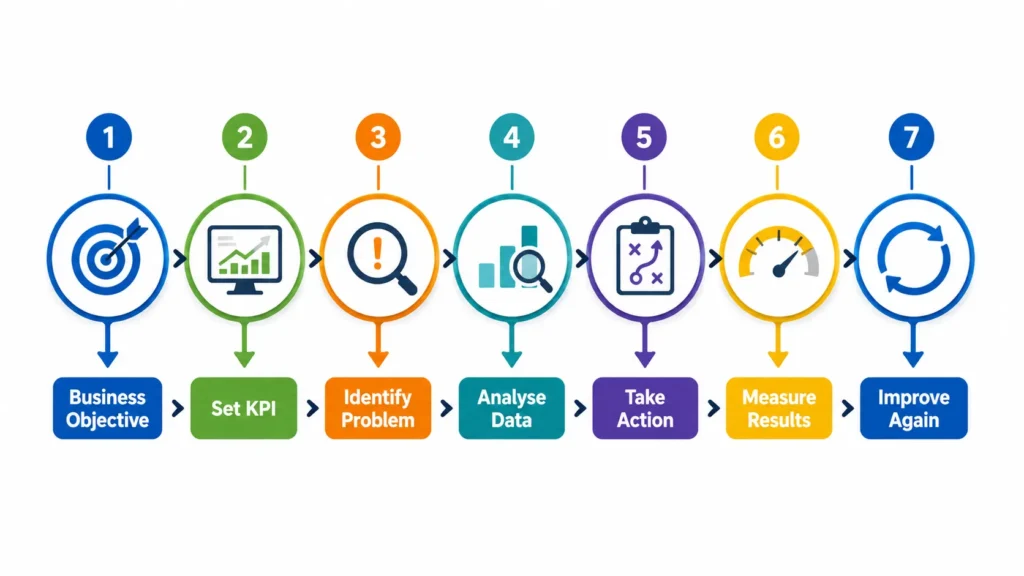
Business objective → KPI → problem → analysis → action → measurement
For example:
A company wants to improve customer retention.
The business manager identifies customer retention as a key performance indicator. Data shows that customers are leaving after experiencing delays in service delivery. The manager investigates the process, identifies the operational bottleneck, allocates additional resources and introduces a revised workflow.
The manager then measures whether customer retention improves.
This creates a continuous management cycle rather than a one-time intervention.
Business Manager Career Path
Business management can lead to different career directions depending on experience and sector.
A possible progression could include:
Entry-Level Role
↓
Team Leader
↓
Operations / Department Manager
↓
Business Manager
↓
Senior Business Manager
↓
Senior Leadership
However, career progression is not always linear.
A business manager may move into:
- Operations management
- General management
- Commercial management
- Business development
- Project management
- Strategy
- Consultancy
- Senior leadership
Career pathways vary by organisation and industry. Career information from Alabama Nonprofits, for example, describes progression through management roles toward Business Manager, Senior Business Manager and potentially executive roles such as CEO or COO.
Is Business Management a Good Career?
Business management can be a strong career choice for people who enjoy combining leadership, commercial thinking, problem-solving and organisational decision-making.
The role offers the opportunity to work across different functions and industries, develop transferable skills and influence organisational performance.
However, it also comes with responsibility.
Business managers may have to manage conflicting priorities, difficult decisions, financial pressures, employee issues and demanding performance targets.
It is therefore particularly suitable for people who are comfortable accepting responsibility and making decisions rather than simply following established procedures.
How to Become a Business Manager
A practical pathway can involve the following steps:
1. Develop Business Knowledge
Learn the fundamentals of finance, operations, marketing, leadership, strategy and organisational management.
2. Gain Workplace Experience
Experience in areas such as operations, administration, sales, customer service, finance or project coordination can help develop an understanding of how organisations function.
3. Take on Responsibility
Look for opportunities to coordinate people, resources, projects or processes.
4. Develop Leadership Skills
Learn how to delegate, communicate expectations, manage performance and resolve workplace problems.
5. Strengthen Analytical Skills
Become comfortable using data, KPIs, budgets and business reports to support decisions.
6. Build Industry Knowledge
Understanding the market and operating environment of a particular industry can make a significant difference.
7. Consider Relevant Qualifications
Business management, business administration and specialist professional qualifications can help strengthen knowledge and credibility, depending on your career goals and employer requirements.
8. Demonstrate Results
One of the strongest ways to progress into management is to demonstrate measurable improvements—for example, reducing costs, improving productivity, increasing customer satisfaction or improving operational performance.
Related Business Management Courses
1. Qualifi Level 3 Diploma in Business Management
The Qualifi Level 3 Diploma in Business Management introduces learners to key business areas such as business environment, marketing, human resources, communication, and business resources.
2. Qualifi Level 4 Diploma in Business Management
The Qualifi Level 4 Diploma in Business Management develops knowledge of business operations, management, leadership, organisational practices, and business decision-making.
3. Qualifi Level 5 Extended Diploma in Business Management
The Qualifi Level 5 Extended Diploma in Business Management provides advanced knowledge of management, leadership, organisational decision-making, and contemporary business practices.
4. OTHM Level 3 Diploma in Business Management
The OTHM Level 3 Diploma in Business Management covers essential business concepts, including the business environment, communication, customer service, finance, marketing, and people management.
5. OTHM Level 5 Extended Diploma in Business Management
The OTHM Level 5 Extended Diploma in Business Management develops knowledge across leadership, finance, marketing, human resources, operations, business strategy, and business law.
6. OTHM Level 6 Diploma in Business Management
The OTHM Level 6 Diploma in Business Management focuses on advanced management and strategic areas, including leadership, financial decision-making, operations, sustainability, and strategic human resource management.
7. ICTQual AB Level 3 Diploma in Business Management
The ICTQual AB Level 3 Diploma in Business Management provides foundational knowledge of marketing, business communication, human resources, finance, operations, and business performance.
8. ABMA Education Level 6 Diploma in Business Management (RQF)
The ABMA Education Level 6 Diploma in Business Management (RQF) develops advanced knowledge in strategic management, leadership, finance, marketing, project management, economics, and international business.
Conclusion
A business manager helps an organisation operate efficiently, manage resources and achieve its business goals. The role can include managing teams, budgets, operations, customers, performance and business development.
Although responsibilities vary by industry and organisation, strong communication, leadership, problem-solving and business skills are important. With the right skills, qualifications and experience, business management can offer a wide range of career opportunities.