
What Is an Environmental Manager? Roles, Responsibilities, Skills & Career Guide
Environmental Managers help organisations reduce their environmental impact while ensuring compliance with environmental laws and supporting sustainable business practices. As businesses place greater emphasis on sustainability, climate action, and Environmental, Social, and Governance (ESG) goals, the demand for skilled Environmental Managers continues to grow across many industries.
These professionals are responsible for developing environmental policies, managing Environmental Management Systems (EMS), reducing pollution and waste, improving resource efficiency, and ensuring organisations meet environmental regulations. Their work helps businesses protect natural resources, minimise risks, and achieve long-term sustainability.
Environmental Managers are employed in sectors such as construction, manufacturing, energy, healthcare, transportation, government, consulting, and renewable energy. With increasing global focus on environmental responsibility, this career offers excellent opportunities for professional growth and long-term success.
What Is an Environmental Manager?
An Environmental Manager is a professional responsible for helping organisations protect the environment while ensuring compliance with environmental laws, regulations, and sustainability standards. They develop and implement environmental policies, monitor environmental performance, manage risks, and promote sustainable practices that reduce the organisation’s impact on the environment.
Environmental Managers work with senior leadership, employees, regulators, and other stakeholders to improve resource efficiency, reduce pollution, manage waste, and support sustainability goals. Their role is essential in helping organisations operate responsibly while achieving long-term environmental and business success.
Why Environmental Managers Matter
Environmental Managers play a crucial role in helping organisations operate responsibly while protecting the environment. As environmental regulations become stricter and businesses face growing pressure to meet sustainability and ESG goals, their expertise is more valuable than ever. They help organisations reduce environmental risks, improve resource efficiency, and build sustainable strategies that support long-term success.
Beyond ensuring legal compliance, Environmental Managers drive continuous improvement by reducing waste, conserving energy and water, lowering carbon emissions, and promoting environmentally responsible practices. Their work helps organisations minimise costs, strengthen their reputation, and contribute to global sustainability efforts.
Why Environmental Managers Are Essential
- Ensure compliance with environmental laws and regulations.
- Reduce pollution and minimise environmental impacts.
- Improve energy, water, and resource efficiency.
- Develop and implement sustainability strategies.
- Support Environmental, Social, and Governance (ESG) initiatives.
- Identify and manage environmental risks.
- Reduce carbon emissions and support climate action.
- Promote waste reduction and recycling programmes.
- Improve organisational reputation and stakeholder trust.
- Help businesses achieve long-term sustainability goals.
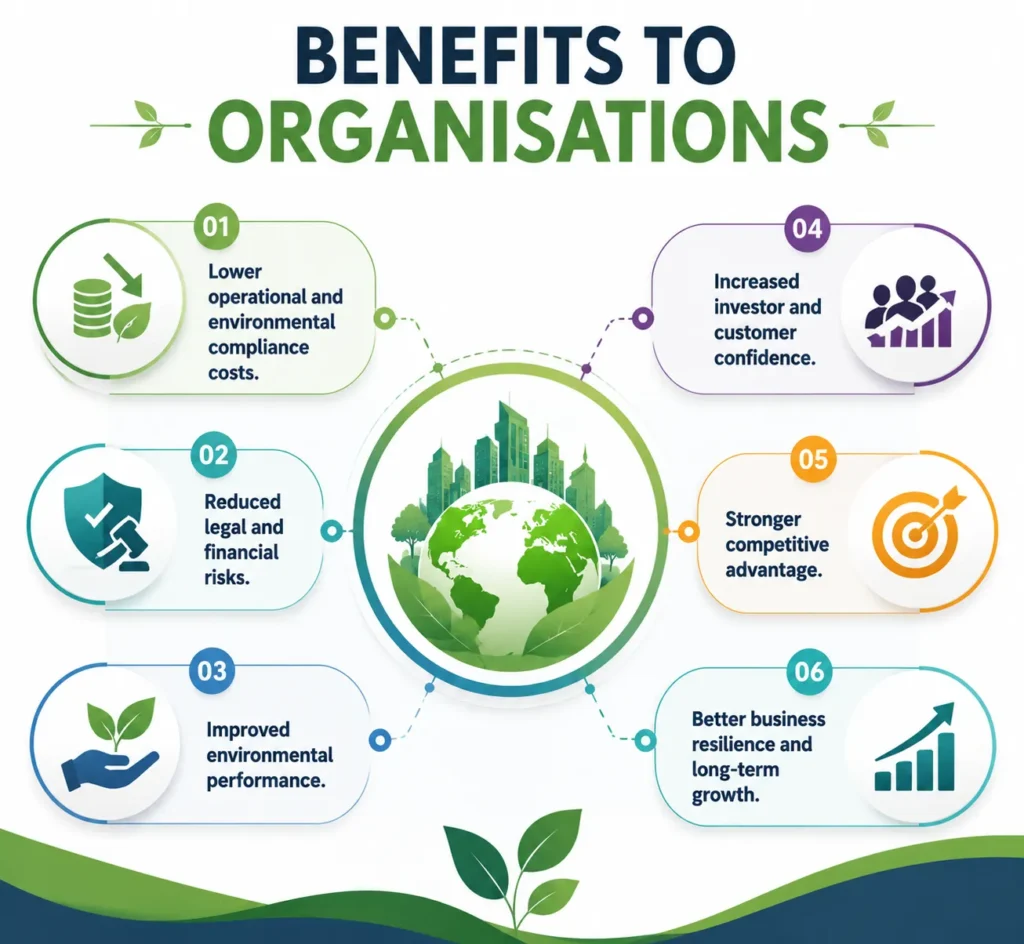
Benefits to Organisations
- Lower operational and environmental compliance costs.
- Reduced legal and financial risks.
- Improved environmental performance.
- Increased investor and customer confidence.
- Stronger competitive advantage.
- Better business resilience and long-term growth.
Environmental Managers are not only environmental experts—they are strategic leaders who help organisations balance environmental responsibility with business performance, making them essential in today’s rapidly changing world.
Roles and Responsibilities of an Environmental Manager
Environmental Managers are responsible for planning, implementing, and overseeing environmental programmes that help organisations minimise their environmental impact while complying with legal and industry requirements. Their role combines environmental expertise, strategic planning, and leadership to ensure sustainable business operations.
They work closely with management, employees, regulators, and external stakeholders to identify environmental risks, improve resource efficiency, and develop practical solutions that support both environmental protection and organisational goals.
Core Areas of Responsibility
| Responsibility Area | Key Duties |
|---|---|
| Environmental Compliance | Ensure the organisation complies with environmental legislation and regulations. |
| Environmental Risk Management | Identify, assess, and control environmental risks. |
| Sustainability | Develop and implement sustainability strategies and initiatives. |
| Environmental Auditing | Conduct audits and inspections to evaluate environmental performance. |
| Resource Management | Improve energy, water, and raw material efficiency. |
| Waste Management | Reduce waste generation and improve recycling and disposal practices. |
| Carbon Management | Monitor emissions and implement carbon reduction strategies. |
| Training and Awareness | Educate employees on environmental responsibilities and best practices. |
| Reporting | Prepare environmental reports, compliance records, and sustainability documentation. |
| Stakeholder Engagement | Work with regulators, clients, suppliers, and communities on environmental matters. |
Skills Every Environmental Manager Needs
To succeed as an Environmental Manager, professionals need a combination of technical expertise and strong interpersonal skills. These skills help them manage environmental challenges, ensure compliance, and lead sustainability initiatives effectively.
Technical Skills
- Environmental legislation and regulatory compliance
- Environmental Management Systems (EMS)
- ISO 14001 implementation
- Environmental risk assessment
- Environmental auditing and inspections
- Waste and pollution management
- Carbon footprint measurement
- ESG reporting
- Environmental data analysis
- Resource and energy management
Soft Skills
- Leadership and team management
- Communication and presentation skills
- Critical thinking
- Problem-solving
- Decision-making
- Project management
- Stakeholder engagement
- Time management
- Negotiation skills
- Adaptability and continuous learning
Environmental Manager Salary
Environmental Manager salaries vary depending on factors such as country, industry, experience, qualifications, and the size of the organisation. Professionals working in sectors such as energy, oil and gas, mining, construction, and manufacturing often earn higher salaries due to the complexity of environmental regulations and sustainability requirements.
The table below provides approximate annual salary ranges for Environmental Managers in different countries.
| Country | Average Annual Salary | Typical Salary Range |
|---|---|---|
| United States | USD 95,000 | USD 70,000 – 140,000 |
| United Kingdom | GBP 50,000 | GBP 35,000 – 75,000 |
| Canada | CAD 90,000 | CAD 65,000 – 130,000 |
| Australia | AUD 120,000 | AUD 90,000 – 170,000 |
| Germany | EUR 65,000 | EUR 45,000 – 90,000 |
| United Arab Emirates | AED 240,000 | AED 180,000 – 360,000 |
| Saudi Arabia | SAR 180,000 | SAR 120,000 – 300,000 |
| Singapore | SGD 75,000 | SGD 55,000 – 110,000 |
| India | INR 1,000,000 | INR 600,000 – 2,000,000 |
| Pakistan | PKR 2,400,000 | PKR 1,200,000 – 4,800,000 |
Tools Used by Environmental Managers
Environmental Managers use a range of tools and frameworks to monitor environmental performance, ensure compliance, manage risks, and support sustainability initiatives. These tools help organisations make informed decisions and continuously improve their environmental practices.
| Tool | Purpose |
|---|---|
| ISO 14001 | Provides a framework for implementing an Environmental Management System (EMS). |
| Environmental Management System (EMS) | Helps organisations manage environmental responsibilities and improve performance. |
| ESG Reporting | Measures and reports Environmental, Social, and Governance performance to stakeholders. |
| Carbon Accounting | Calculates and monitors greenhouse gas (GHG) emissions and carbon footprints. |
| Environmental Auditing | Evaluates compliance with environmental regulations and management systems. |
| Environmental Risk Assessment | Identifies and controls potential environmental risks and impacts. |
| Geographic Information Systems (GIS) | Maps, analyses, and monitors environmental data and natural resources. |
| Life Cycle Assessment (LCA) | Assesses the environmental impact of a product or process throughout its entire lifecycle. |
Challenges Environmental Managers Face
Environmental Managers play a critical role in improving environmental performance, but they often face complex challenges due to changing regulations, operational pressures, and increasing sustainability expectations. Managing these challenges requires strong technical knowledge, leadership skills, and strategic decision-making.
Common Challenges
- Changing Environmental Regulations – Keeping up with new environmental laws, standards, and compliance requirements.
- Balancing Business Goals and Sustainability – Helping organisations achieve profitability while reducing environmental impacts.
- Limited Resources and Budgets – Implementing environmental improvements with available financial and operational resources.
- Data Collection and Reporting – Gathering accurate environmental data for audits, ESG reports, and sustainability tracking.
- Reducing Carbon Emissions – Developing practical strategies to achieve carbon reduction and Net Zero targets.
- Managing Stakeholder Expectations – Balancing the needs of regulators, customers, employees, investors, and communities.
- Employee Awareness and Engagement – Encouraging employees to adopt environmentally responsible practices.
- Waste Reduction Challenges – Improving waste management and recycling across complex operations.
- Supply Chain Environmental Risks – Ensuring suppliers follow sustainable and responsible practices.
- Climate Change Impacts – Preparing organisations for environmental risks such as extreme weather events and resource shortages.
Future of Environmental Management Careers
The future of Environmental Management careers is highly promising as organisations worldwide focus on climate action, sustainability, and responsible business practices. Environmental Managers are becoming strategic professionals who help organisations achieve environmental targets, reduce risks, and adapt to new technologies and regulations.
Emerging trends such as artificial intelligence, ESG reporting, carbon reduction, and renewable energy are creating new opportunities for professionals with environmental expertise and sustainability skills.
AI in Environmental Management
Artificial Intelligence (AI) is transforming how organisations monitor, analyse, and improve environmental performance. Environmental Managers will increasingly use AI tools to process data, predict risks, and improve decision-making.
Key Opportunities:
- AI-based environmental monitoring.
- Predictive climate risk analysis.
- Automated sustainability reporting.
- Smart resource management.
- Improved environmental data analysis.
ESG Growth
Environmental, Social, and Governance (ESG) has become a major priority for businesses and investors. Environmental Managers will play an important role in developing ESG strategies, measuring performance, and ensuring transparent sustainability reporting.
Future Responsibilities:
- Managing ESG performance.
- Supporting sustainability reporting.
- Improving corporate environmental strategies.
- Meeting investor and stakeholder expectations.
Carbon Reporting and Management
As organisations work towards reducing greenhouse gas emissions, carbon reporting skills are becoming increasingly valuable. Environmental Managers will help businesses measure their carbon footprint and develop effective reduction strategies.
Career Opportunities Include:
- Carbon reporting specialist.
- Net Zero consultant.
- Emissions analyst.
- Climate risk advisor.
Net Zero Transition
The global move towards Net Zero emissions is increasing demand for environmental professionals who can design and implement carbon reduction strategies. Environmental Managers will support organisations in transitioning to cleaner and more sustainable operations.
Key Areas of Work:
- Developing Net Zero plans.
- Reducing greenhouse gas emissions.
- Improving energy efficiency.
- Supporting renewable energy adoption.
Circular Economy
The shift from a traditional “take, make, dispose” model to a circular economy is creating new roles for environmental professionals. Environmental Managers will help organisations reduce waste, reuse resources, and create more sustainable production systems.
Future Focus Areas:
- Waste reduction strategies.
- Sustainable product design.
- Resource efficiency.
- Recycling and recovery systems.
Smart Cities
As cities become more connected and sustainable, Environmental Managers will contribute to planning and managing environmentally responsible urban development.
Key Areas Include:
- Sustainable infrastructure.
- Energy-efficient buildings.
- Smart waste management.
- Sustainable transportation systems.
- Urban environmental monitoring.
Renewable Energy Growth
The expansion of renewable energy is creating significant opportunities for environmental professionals. Environmental Managers will support renewable projects by managing environmental impacts, compliance requirements, and sustainability goals.
Career Opportunities:
- Renewable energy environmental advisor.
- Environmental compliance specialist.
- Sustainability project manager.
- Environmental impact assessment professional.
Future Career Outlook
Environmental Management is expected to remain a high-demand profession as industries continue moving towards sustainable operations. Professionals who develop skills in ESG, carbon management, digital technologies, renewable energy, and sustainability strategy will have strong opportunities to progress into leadership roles.
Future Environmental Managers will not only protect the environment—they will help organisations create sustainable business models and contribute to a more resilient global economy.
How to Become an Environmental Manager: Step-by-Step Guide
Becoming an Environmental Manager requires a combination of education, practical experience, technical knowledge, and leadership skills. Professionals in this role help organisations manage environmental risks, improve sustainability performance, and comply with environmental regulations. The following steps can help you build a successful career in environmental management.
Step 1: Gain Relevant Education
Start by developing a strong foundation in environmental science, sustainability, or related fields. A relevant qualification helps you understand environmental principles, regulations, and management practices.
Common Study Areas Include:
- Environmental Management
- Sustainability
- Environmental Science
- Engineering
- Health and Safety
- Sustainable Development
- Environmental Policy
Step 2: Develop Environmental Knowledge and Skills
Build expertise in key areas that Environmental Managers use in their daily work.
Important Skills Include:
- Environmental legislation and compliance
- Environmental Management Systems (EMS)
- ISO 14001 standards
- Environmental auditing
- Risk assessment
- Waste management
- Carbon management
- ESG reporting
- Sustainability strategies
Step 3: Gain Practical Experience
Hands-on experience is essential for progressing into an Environmental Manager role. Many professionals begin in entry-level environmental positions before moving into management.
Entry-Level Roles May Include:
- Environmental Assistant
- Environmental Officer
- Sustainability Coordinator
- Environmental Technician
- Compliance Assistant
Step 4: Obtain Professional Qualifications
Professional qualifications can improve career opportunities by demonstrating advanced knowledge and practical competence.
Useful Qualifications Include:
- Environmental Management qualifications
- Sustainability certifications
- ISO 14001 training
- Environmental auditing certifications
- ESG and carbon management courses
Advanced programmes, such as the OTHM Level 7 Diploma in Environmental Management and Sustainability, can help professionals develop strategic skills required for senior environmental and sustainability roles.
Step 5: Build Industry Experience
Environmental Managers work across many industries, so gaining experience in a specific sector can strengthen career prospects.
Industries to Consider:
- Construction
- Manufacturing
- Energy
- Oil and gas
- Renewable energy
- Government
- Environmental consultancy
- Healthcare
- Transport
- Waste management
Step 6: Develop Leadership and Management Skills
Environmental Managers are responsible for leading teams, influencing decisions, and working with different stakeholders. Strong leadership skills are essential for career progression.
Important Management Skills:
- Communication
- Team leadership
- Project management
- Problem-solving
- Decision-making
- Stakeholder management
- Strategic planning
Step 7: Stay Updated with Environmental Trends
Environmental regulations and sustainability practices continue to change. Successful Environmental Managers continuously update their knowledge.
Stay Updated With:
- ESG developments
- Climate change policies
- Net Zero strategies
- Renewable energy trends
- Circular economy practices
- Environmental technologies
- Sustainability reporting standards
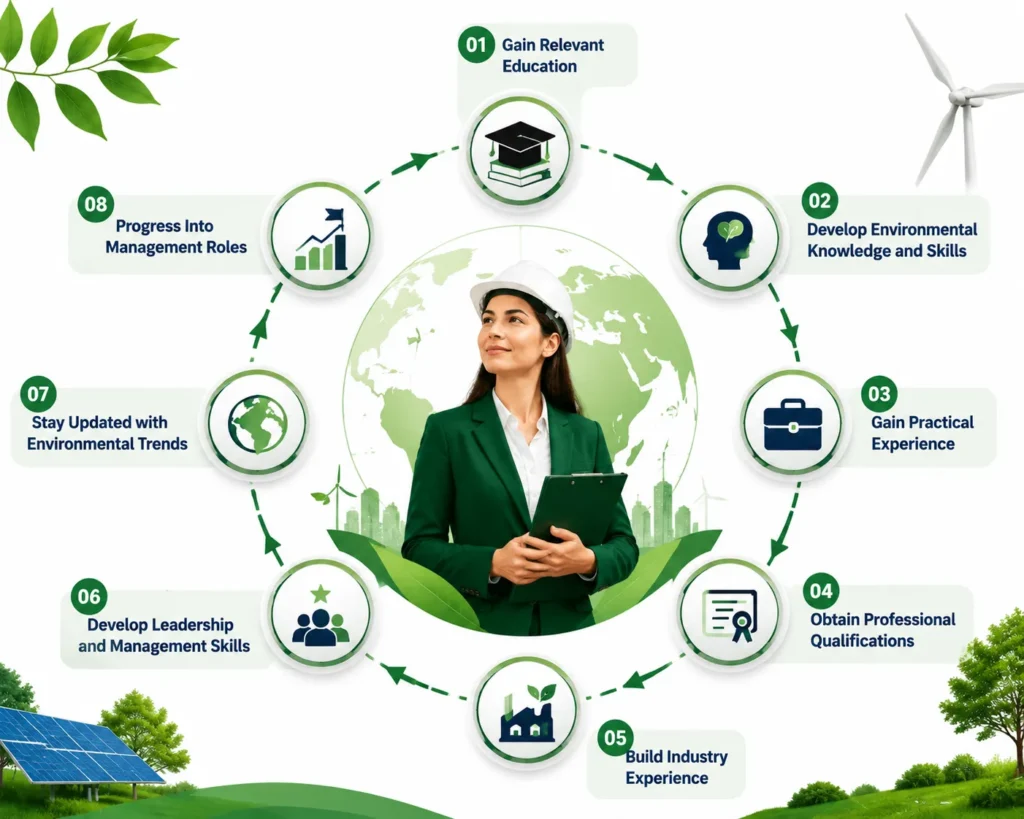
Step 8: Progress Into Management Roles
With experience and professional development, you can progress into senior environmental positions.
Typical Career Path:
Environmental Assistant
↓
Environmental Officer
↓
Environmental Coordinator
↓
Environmental Manager
↓
Senior Environmental Manager
↓
Head of Sustainability
↓
Environmental Director / Chief Sustainability Officer
Final Thoughts
Environmental Managers play an important role in helping organisations reduce environmental impacts, meet sustainability goals, and comply with regulations. As businesses focus more on climate action, ESG, and responsible growth, the demand for skilled environmental professionals continues to increase.
A career as an Environmental Manager offers opportunities across many industries and allows professionals to contribute to a more sustainable future. With the right skills, qualifications, and experience, you can build a rewarding career while making a positive impact on the environment.