
What Is an Environmental Scientist? Roles, Skills, Qualifications, Salary & Career Guide
Environmental scientists play a vital role in protecting the environment and improving public health. They study air, water, soil, ecosystems, and natural resources to identify environmental problems and develop practical solutions. Their work helps reduce pollution, conserve biodiversity, manage natural resources responsibly, and support sustainable development.
As climate change, pollution, and environmental regulations become more important worldwide, the demand for skilled environmental scientists continues to grow across industries such as construction, energy, manufacturing, government, consulting, agriculture, and renewable energy.
What Is an Environmental Scientist?
An Environmental Scientist is a professional who studies the environment to understand how natural systems work and how human activities affect air, water, soil, wildlife, and ecosystems. They collect and analyze environmental data, investigate pollution and other environmental issues, and develop practical solutions to protect natural resources and public health.
Environmental scientists work in a wide range of industries, including government agencies, environmental consulting firms, construction, renewable energy, manufacturing, agriculture, mining, and research organizations. Their responsibilities may include conducting field surveys, collecting samples, performing laboratory tests, preparing environmental reports, assessing environmental risks, and ensuring compliance with environmental laws and regulations.
The main goal of an environmental scientist is to help create a cleaner, safer, and more sustainable environment by balancing economic development with environmental protection. Their work plays a key role in addressing global challenges such as climate change, pollution, biodiversity loss, and sustainable resource management.
Importance of Environmental Scientists
Environmental scientists play a crucial role in protecting the environment and ensuring a sustainable future. Their work helps identify environmental problems, reduce pollution, conserve natural resources, and protect ecosystems. By providing scientific research and practical solutions, they support governments, businesses, and communities in making environmentally responsible decisions.
Their expertise is essential in tackling global challenges such as climate change, water scarcity, air pollution, waste management, and biodiversity loss. Environmental scientists also help organizations comply with environmental regulations, reduce environmental risks, and develop sustainable practices that balance economic growth with environmental protection.
As industries continue to focus on sustainability and environmental responsibility, the demand for environmental scientists is increasing worldwide. Their work not only protects the planet but also improves public health, supports innovation, and contributes to a cleaner and healthier future for generations to come.
What Does an Environmental Scientist Do?
An environmental scientist studies the environment to identify environmental problems and develop practical solutions that protect natural resources and public health. They collect and analyze data on air, water, soil, and ecosystems to understand the impact of human activities and recommend ways to reduce pollution and promote sustainability.
Environmental scientists work on a variety of projects, including environmental impact assessments, pollution control, climate change research, waste management, conservation, and natural resource management. Their work supports governments, businesses, industries, and communities in making environmentally responsible decisions.
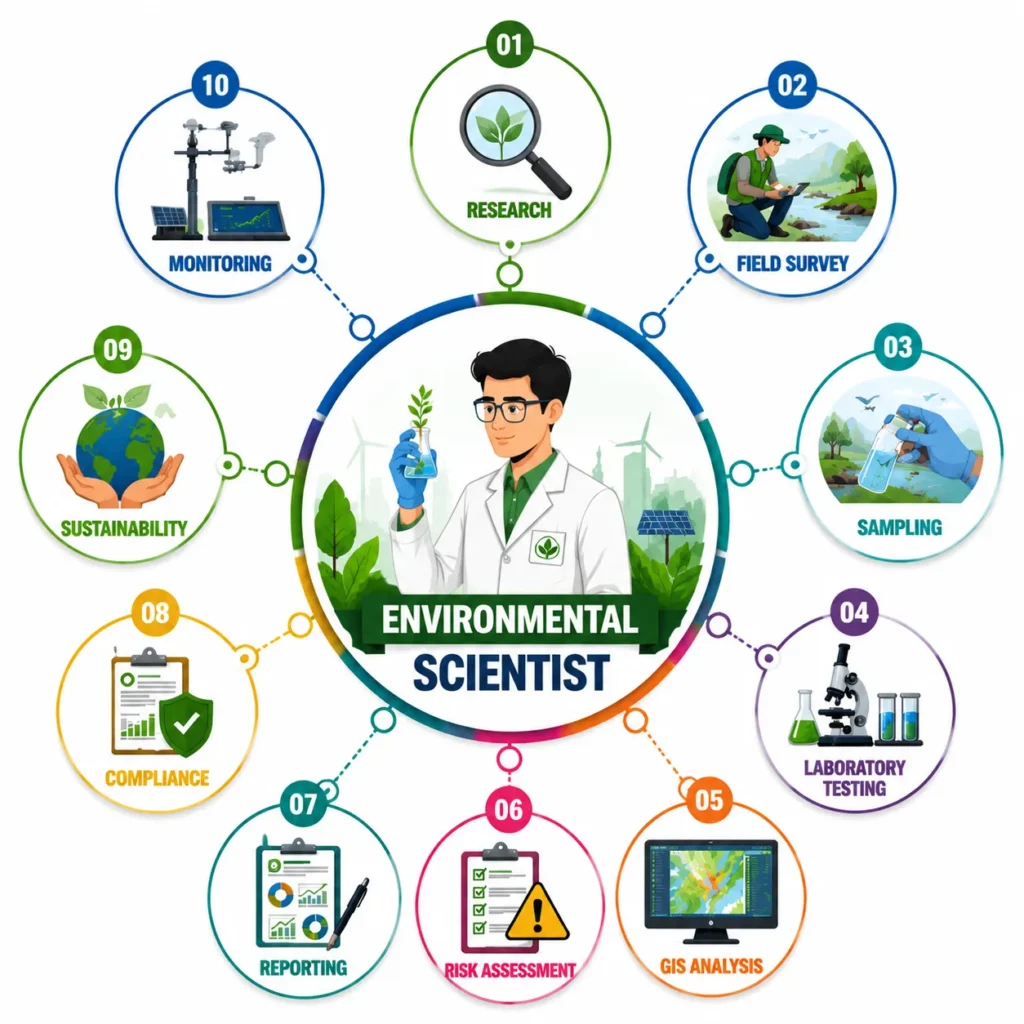
Responsibilities of an Environmental Scientist
Environmental scientists are responsible for studying environmental conditions, identifying potential risks, and developing solutions to protect natural resources and public health. Their work combines field research, laboratory analysis, data interpretation, and environmental planning to support sustainable development.
Some of the key responsibilities of an environmental scientist include:
- Conduct environmental surveys and field investigations.
- Collect and analyze air, water, soil, and biological samples.
- Monitor pollution levels and assess environmental quality.
- Identify environmental risks and recommend mitigation measures.
- Prepare environmental impact assessments (EIAs) and technical reports.
- Ensure compliance with environmental laws, regulations, and standards.
- Develop strategies to reduce pollution and improve sustainability.
- Advise organizations on environmental best practices and resource management.
- Use technologies such as GIS, remote sensing, drones, and environmental monitoring systems to collect and analyze data.
- Collaborate with engineers, government agencies, businesses, and local communities on environmental projects.
- Monitor the effectiveness of environmental protection programs and recommend improvements.
- Support conservation initiatives to protect ecosystems, wildlife, and biodiversity.
Modern Technologies Used by Environmental Scientists
Modern environmental scientists rely on advanced technologies to collect accurate data, monitor environmental conditions, and develop effective solutions. These tools improve the speed, accuracy, and efficiency of environmental research, helping scientists address complex challenges such as climate change, pollution, and natural resource management.
Geographic Information Systems (GIS)
GIS is used to collect, manage, analyze, and visualize geographic data. Environmental scientists use GIS to create maps, identify environmental trends, monitor land use changes, and support environmental planning and decision-making.
Remote Sensing
Remote sensing uses satellites, aircraft, and drones to gather information about the Earth’s surface without direct contact. It helps scientists monitor forests, water bodies, agricultural land, and environmental changes over large areas.
Satellite Mapping
Satellite mapping provides high-resolution images that help monitor climate change, deforestation, urban development, coastal erosion, and natural disasters. It allows environmental scientists to observe environmental changes over time and across different regions.
Drone Surveys
Drones provide fast and cost-effective aerial surveys for environmental monitoring. They are commonly used to inspect forests, wetlands, construction sites, wildlife habitats, mining areas, and disaster-affected regions while collecting detailed images and environmental data.
AI Environmental Monitoring
Artificial Intelligence (AI) helps analyze large environmental datasets, identify pollution patterns, predict environmental risks, and automate monitoring processes. AI enables faster decision-making and improves the accuracy of environmental assessments.
Machine Learning
Machine learning uses algorithms to identify patterns and make predictions from environmental data. Environmental scientists apply machine learning to forecast air quality, predict floods and wildfires, assess climate risks, and monitor ecosystem health.
Internet of Things (IoT) Sensors
IoT sensors continuously collect real-time environmental data, including air quality, water quality, soil moisture, temperature, humidity, and noise levels. These sensors provide instant updates that support early detection of environmental issues and improve monitoring efficiency.
Environmental Modelling
Environmental modelling uses computer simulations to predict how environmental systems may respond to different conditions. Scientists use these models to assess pollution dispersion, climate impacts, flood risks, groundwater movement, and ecosystem changes before implementing projects.
Digital Twins
Digital twins are virtual models of real-world environments, infrastructure, or ecosystems. By combining real-time data with computer simulations, environmental scientists can test different scenarios, predict environmental impacts, and optimize resource management without affecting the physical environment.
Climate Data Analytics
Climate data analytics involves processing and interpreting large volumes of weather and climate information. Environmental scientists use this technology to study temperature changes, rainfall patterns, sea-level rise, extreme weather events, and long-term climate trends to support climate adaptation strategies.
Carbon Accounting Software
Carbon accounting software measures and tracks greenhouse gas emissions produced by organizations and projects. It helps businesses calculate their carbon footprint, prepare sustainability reports, comply with environmental regulations, and develop strategies to achieve net-zero emissions.
Environmental Databases
Environmental databases store large amounts of scientific information related to air quality, water resources, biodiversity, soil conditions, climate records, and pollution levels. These databases enable environmental scientists to access reliable data for research, environmental assessments, policy development, and regulatory compliance.
Industries Hiring Environmental Scientists
Environmental scientists are employed across a wide range of industries where environmental protection, sustainability, and regulatory compliance are essential. Their expertise helps organizations manage environmental risks, reduce pollution, conserve natural resources, and meet environmental standards. Below are some of the major industries that actively hire environmental scientists.
Construction
Construction companies hire environmental scientists to conduct environmental impact assessments (EIAs), monitor construction activities, manage waste, protect natural habitats, and ensure projects comply with environmental regulations.
Mining
Mining companies rely on environmental scientists to assess environmental risks, manage land rehabilitation, monitor water and air quality, and minimize the environmental impact of mining operations.
Oil & Gas
Environmental scientists help oil and gas organizations reduce emissions, monitor pollution, assess environmental risks, manage contaminated sites, and ensure compliance with environmental legislation.
Renewable Energy
Solar, wind, hydroelectric, and other renewable energy companies employ environmental scientists to evaluate project sites, assess environmental impacts, protect biodiversity, and support sustainable energy development.
Government Agencies
Government departments hire environmental scientists to develop environmental policies, monitor natural resources, enforce environmental regulations, conduct inspections, and support environmental conservation programs.
Non-Governmental Organizations (NGOs)
Environmental NGOs employ scientists to conduct research, manage conservation projects, promote climate action, protect biodiversity, and educate communities about environmental issues.
Manufacturing
Manufacturing companies hire environmental scientists to reduce pollution, improve resource efficiency, manage industrial waste, monitor emissions, and develop sustainable production processes.
Agriculture
Environmental scientists support sustainable farming by improving soil health, managing water resources, reducing chemical pollution, protecting ecosystems, and promoting environmentally friendly agricultural practices.
Transportation
Transportation organizations employ environmental scientists to assess the environmental impact of roads, railways, airports, and ports while developing strategies to reduce emissions and environmental risks.
Waste Management
Waste management companies hire environmental scientists to improve recycling systems, develop waste reduction strategies, monitor landfill operations, and promote circular economy practices.
Water Utilities
Water authorities employ environmental scientists to monitor water quality, protect drinking water sources, manage wastewater treatment, and conserve water resources.
Forestry
Forestry organizations rely on environmental scientists to manage forests sustainably, prevent deforestation, protect biodiversity, restore ecosystems, and monitor forest health.
Marine Conservation
Marine conservation organizations hire environmental scientists to protect oceans, coastal ecosystems, coral reefs, fisheries, and marine biodiversity through research and environmental monitoring.
Wildlife Conservation
Environmental scientists work with wildlife organizations to protect endangered species, restore habitats, monitor ecosystems, and support biodiversity conservation programs.
Environmental Consultancies
Environmental consulting firms employ environmental scientists to provide expert advice on environmental compliance, impact assessments, sustainability planning, risk management, and environmental audits for clients across multiple industries.
Research Institutes
Research organizations hire environmental scientists to study climate change, pollution, biodiversity, environmental technologies, and sustainable resource management while developing innovative environmental solutions.
Universities and Academic Institutions
Universities employ environmental scientists as researchers, lecturers, and academic specialists who teach future professionals while conducting advanced environmental research.
Chemical Industry
Chemical manufacturers hire environmental scientists to monitor hazardous substances, manage waste, reduce emissions, improve environmental performance, and ensure regulatory compliance.
Healthcare
Healthcare organizations employ environmental scientists to manage medical waste, monitor environmental health risks, improve indoor environmental quality, and support sustainable healthcare practices.
Food Production
Food manufacturers hire environmental scientists to improve sustainability, reduce food waste, manage water usage, control pollution, and ensure environmentally responsible production processes.
Real Estate
Real estate developers work with environmental scientists to assess land conditions, evaluate environmental risks, conduct site investigations, and support sustainable property development.
Infrastructure
Infrastructure projects such as highways, bridges, rail systems, airports, and public utilities require environmental scientists to minimize environmental impacts and ensure compliance throughout project planning and construction.
Energy
Power generation companies employ environmental scientists to monitor emissions, improve environmental performance, support clean energy initiatives, and ensure compliance with environmental standards across conventional and renewable energy facilities.
Environmental Laboratories
Environmental laboratories hire environmental scientists to analyze air, water, soil, and biological samples, conduct laboratory testing, perform environmental research, and provide scientific data for environmental assessments.
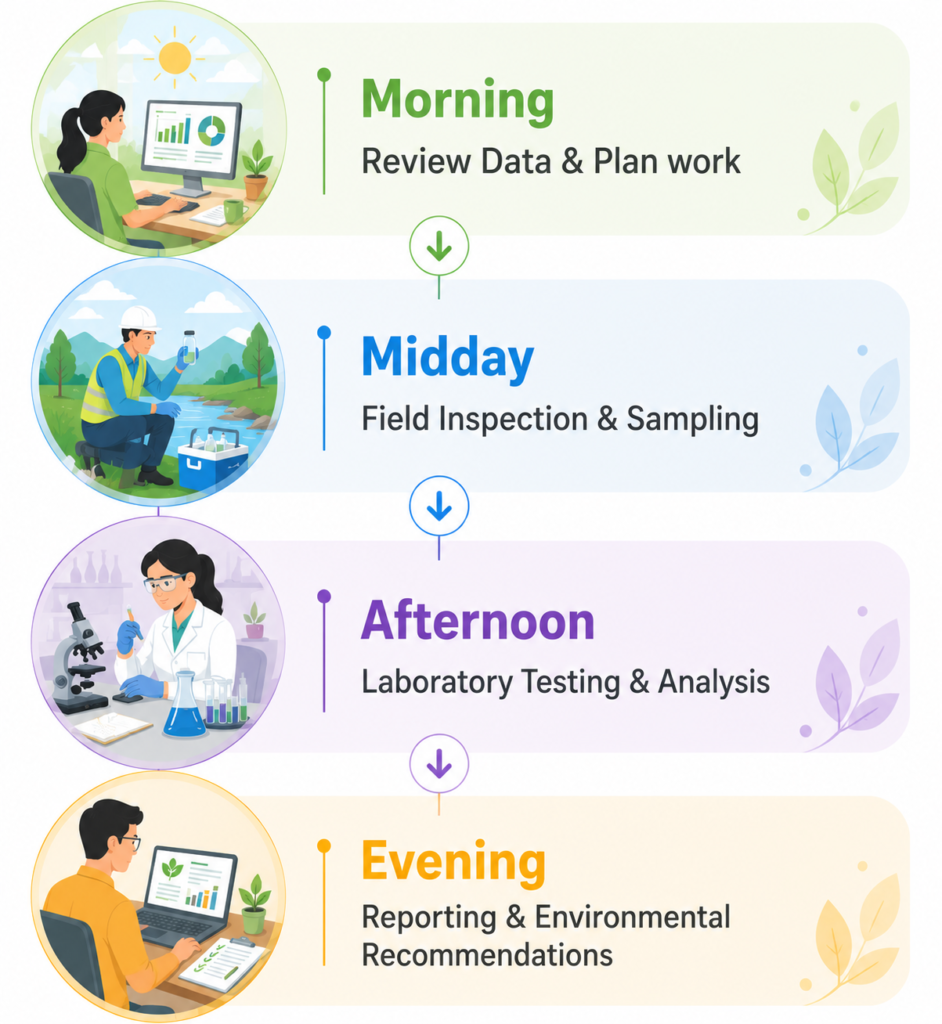
A Day in the Life of an Environmental Scientist
No two days are exactly the same for an environmental scientist. Their work is a combination of field investigations, laboratory analysis, data interpretation, and report preparation. Depending on the project, they may spend part of the day outdoors collecting environmental samples and the rest in an office or laboratory analyzing data and developing recommendations. Their role requires scientific knowledge, problem-solving skills, and collaboration with engineers, government agencies, and other environmental professionals.
A typical workday often follows a structured routine, although emergency environmental incidents or project deadlines may require changes. Below is an example of what a typical day may look like.
Morning: Reviewing Environmental Data
The day usually begins with reviewing environmental monitoring results and planning daily activities. Scientists analyze data collected from monitoring stations or previous fieldwork to identify trends and determine whether further investigation is required.
Typical morning tasks include:
- Reviewing air, water, and soil monitoring data
- Checking weather conditions before fieldwork
- Planning site visits and inspections
- Responding to emails and project updates
- Preparing sampling equipment and safety gear
- Meeting with project teams to discuss daily objectives
Midday: Field Surveys and Site Inspections
Many environmental scientists spend part of their day working outdoors. They visit construction sites, industrial facilities, rivers, forests, or conservation areas to inspect environmental conditions and collect samples for further analysis.
Common field activities include:
- Conducting environmental site inspections
- Collecting soil, water, and air samples
- Monitoring wildlife and vegetation
- Measuring noise, dust, and air quality
- Using GPS, GIS, drones, or environmental sensors
- Identifying potential environmental risks
- Recording field observations and photographs
Afternoon: Laboratory Analysis and Data Interpretation
After returning from the field, environmental scientists analyze collected samples and interpret the results. They compare findings with environmental standards and assess whether any corrective actions are needed.
Typical afternoon responsibilities include:
- Testing environmental samples in the laboratory
- Analyzing monitoring results
- Creating maps using GIS software
- Identifying pollution sources and environmental trends
- Discussing findings with colleagues and project managers
- Developing recommendations for environmental improvements
Evening: Reporting and Project Planning
The final part of the day is usually dedicated to documentation and communication. Accurate reporting is essential because environmental decisions are based on scientific evidence and regulatory requirements.
End-of-day activities often include:
- Preparing environmental reports
- Updating project documentation
- Writing Environmental Impact Assessment (EIA) findings
- Presenting results to clients or regulatory authorities
- Planning the next day’s field activities
- Reviewing project progress and deadlines
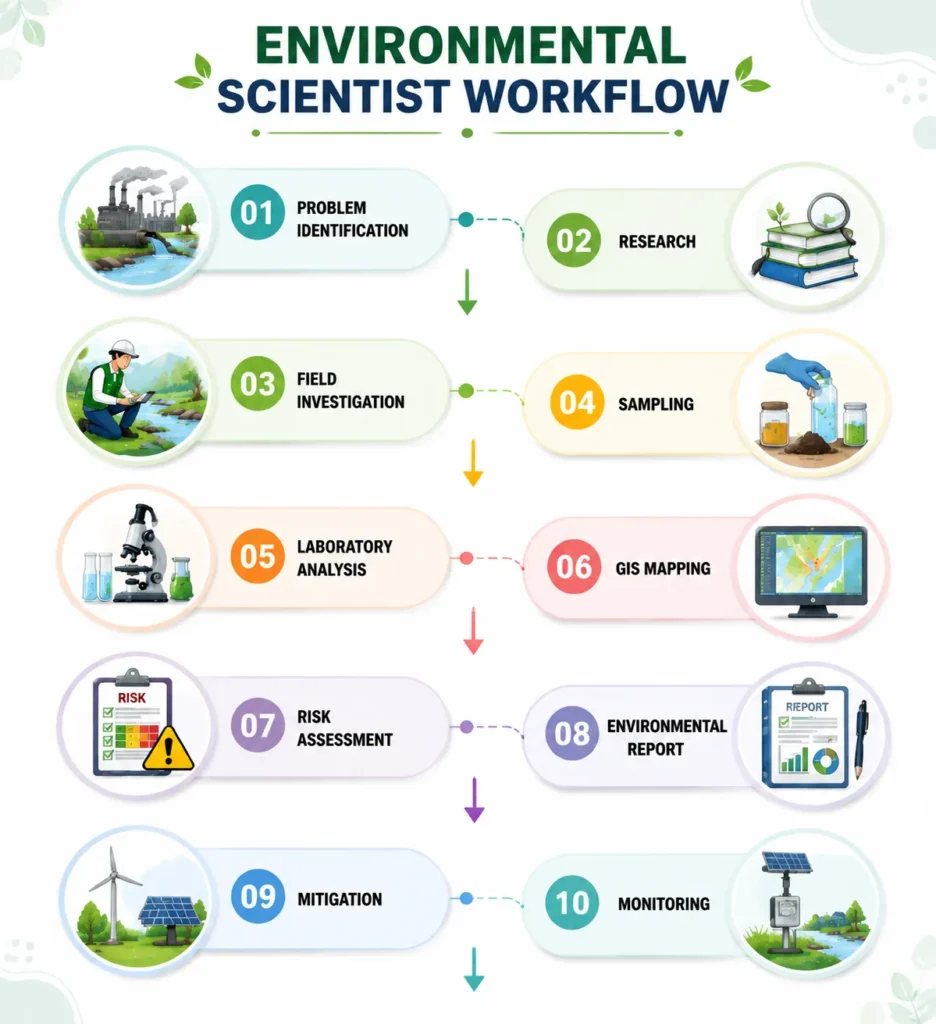
Environmental Scientist Workflow
Environmental scientists follow a systematic workflow to identify environmental issues, collect reliable data, evaluate risks, and recommend practical solutions. Although the exact process may vary depending on the project, most environmental investigations follow the same sequence. This structured approach helps ensure that decisions are based on scientific evidence and comply with environmental regulations.
Typical Environmental Scientist Workflow
1. Problem Identification
- Identify environmental issues such as pollution, habitat damage, water problems, or compliance concerns.
2. Research and Planning
- Review existing data, regulations, and scientific information.
- Plan the environmental investigation.
3. Field Investigation
- Visit sites to observe conditions.
- Identify possible environmental impacts.
4. Environmental Sampling
- Collect air, water, soil, or biological samples for testing.
5. Laboratory Analysis
- Test samples to identify pollutants and evaluate environmental quality.
6. GIS Mapping and Data Analysis
- Use GIS, satellite data, and drones to analyze environmental patterns.
7. Environmental Risk Assessment
- Evaluate risks, impacts, and compliance with environmental standards.
8. Environmental Reporting
- Prepare reports, Environmental Impact Assessments (EIAs), and recommendations.
9. Mitigation Recommendations
- Develop solutions to reduce impacts and improve sustainability.
10. Monitoring and Improvement
- Track environmental performance and improve solutions when needed.
Types of Environmental Scientists
Environmental science offers a wide range of specializations, allowing professionals to focus on specific environmental challenges and ecosystems. Some of the most common types of environmental scientists include:
- Air Quality Scientist – Studies air pollution, monitors emissions, and develops strategies to improve air quality.
- Water Quality Scientist – Analyzes rivers, lakes, groundwater, and drinking water to ensure water safety and quality.
- Marine Scientist – Researches oceans, coastal ecosystems, marine biodiversity, and the impact of human activities on marine life.
- Wildlife Scientist – Studies wildlife populations, habitats, and conservation methods to protect endangered species.
- Climate Scientist – Investigates climate change, weather patterns, greenhouse gas emissions, and global climate systems.
- Ecologist – Examines ecosystems and the relationships between living organisms and their environment.
- Environmental Chemist – Tests air, water, and soil for pollutants and studies the effects of chemical contaminants.
- Soil Scientist – Studies soil composition, fertility, contamination, erosion, and sustainable land management.
- Environmental Health Scientist – Assesses how environmental factors such as pollution and hazardous materials affect human health.
- Hydrologist – Studies the movement, quality, and distribution of surface water and groundwater.
- Environmental Toxicologist – Investigates the impact of toxic chemicals and pollutants on people, wildlife, and ecosystems.
- Restoration Scientist – Develops and manages projects to restore damaged ecosystems, wetlands, forests, and natural habitats.
- Waste Scientist – Specializes in waste management, recycling, landfill operations, and sustainable waste solutions.
- Sustainability Scientist – Helps organizations improve sustainability through resource management, carbon reduction, and environmental planning.
- Environmental Risk Scientist – Identifies, assesses, and manages environmental risks associated with industrial activities, infrastructure projects, and natural hazards.
Difference Between an Environmental Scientist and an Environmental Engineer
Although environmental scientists and environmental engineers both work to protect the environment, their roles, skills, and responsibilities are different. Environmental scientists focus on researching environmental problems, collecting and analyzing data, and recommending solutions based on scientific evidence. Environmental engineers use engineering principles to design and implement systems that solve environmental challenges, such as wastewater treatment plants, pollution control equipment, and sustainable infrastructure.
The table below highlights the key differences between these two professions.
| Feature | Environmental Scientist | Environmental Engineer |
|---|---|---|
| Primary Focus | Studies environmental problems and their impacts | Designs engineering solutions to environmental problems |
| Main Role | Research, monitoring, analysis, and environmental protection | Planning, designing, and implementing environmental systems |
| Typical Work | Field surveys, laboratory testing, data analysis, environmental assessments | Designing water treatment plants, waste management systems, pollution control technologies |
| Education | Environmental Science, Ecology, Biology, Chemistry, or related sciences | Environmental Engineering, Civil Engineering, Chemical Engineering, or related engineering disciplines |
| Work Environment | Laboratories, field sites, government agencies, research institutes, environmental consultancies | Engineering firms, construction sites, manufacturing plants, infrastructure projects, utilities |
| Key Skills | GIS, environmental monitoring, sampling, research, data analysis, environmental regulations | Engineering design, AutoCAD, hydraulics, wastewater treatment, project management |
| Common Tools | GIS, drones, remote sensing, laboratory equipment, environmental monitoring systems | AutoCAD, Civil 3D, hydraulic modelling software, engineering design tools |
| Primary Goal | Understand environmental issues and recommend solutions | Design and build systems that prevent or reduce environmental impacts |
| Industries | Government, consulting, research, conservation, renewable energy, mining | Construction, water utilities, manufacturing, energy, infrastructure, environmental consulting |
Environmental Scientist vs Related Careers
Environmental careers often have overlapping responsibilities, but each profession focuses on different areas of expertise. Understanding these differences can help students and professionals choose the career path that best matches their interests and skills.
| Career | Primary Focus | Main Responsibilities |
|---|---|---|
| Environmental Scientist | Environmental research and protection | Conducts field investigations, analyzes environmental data, assesses risks, monitors pollution, and develops solutions to protect natural resources. |
| Environmental Engineer | Engineering solutions for environmental challenges | Designs systems for pollution control, wastewater treatment, waste management, and sustainable infrastructure using engineering principles. |
| Ecologist | Ecosystems and biodiversity | Studies the relationships between plants, animals, and their environments to support conservation and ecosystem management. |
| Sustainability Consultant | Sustainable business practices | Advises organizations on reducing environmental impacts, improving ESG performance, achieving sustainability goals, and meeting environmental regulations. |
| Environmental Manager | Environmental compliance and management | Oversees environmental policies, compliance programs, audits, sustainability initiatives, and environmental performance within an organization. |
| Geologist | Earth’s structure and natural resources | Studies rocks, minerals, groundwater, soil, and geological processes to support mining, construction, environmental assessments, and resource exploration. |
| Climate Scientist | Climate systems and climate change | Researches weather patterns, greenhouse gas emissions, climate models, and long-term climate trends to support climate adaptation and mitigation strategies. |
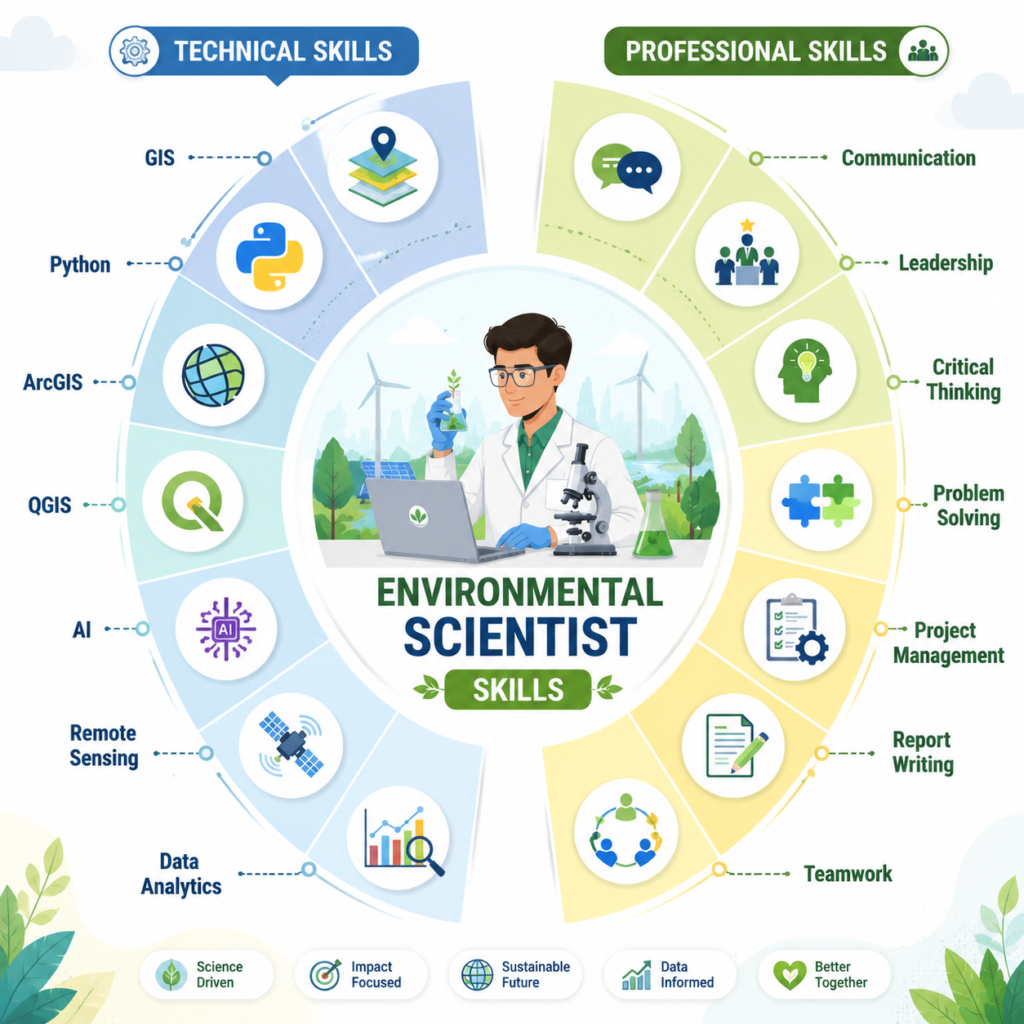
Modern Skills Required for an Environmental Scientist
Today’s environmental scientists need more than scientific knowledge. They must combine technical expertise, digital skills, data analysis, and regulatory knowledge to solve complex environmental challenges. As technology continues to evolve, employers increasingly look for professionals who can use advanced software, analyze large datasets, and support sustainable decision-making.
Some of the most valuable modern skills include:
- Geographic Information Systems (GIS)
- ArcGIS
- QGIS
- Python Programming
- R Programming
- AutoCAD
- Remote Sensing
- Drone Mapping
- Environmental Modelling
- Carbon Accounting
- ESG Reporting
- Environmental Impact Assessment (EIA)
- ISO 14001 Environmental Management
- Data Analytics
- Artificial Intelligence (AI) Tools
- Environmental Regulations and Compliance
- Scientific Research and Data Collection
- Technical Report Writing
- Risk Assessment
- Problem-Solving and Critical Thinking
- Project Management
- Communication and Presentation Skills
These skills help environmental scientists collect accurate data, evaluate environmental impacts, and develop practical solutions for industries and governments worldwide.
Professional Certifications for Environmental Scientists
Professional certifications demonstrate technical competence, improve career prospects, and help environmental scientists stay up to date with industry standards and regulations. Many employers prefer candidates who hold recognized environmental certifications in addition to academic qualifications.
Some of the most valuable certifications include:
- ISO 14001 Environmental Management Systems
- IEMA (Institute of Environmental Management and Assessment)
- NEBOSH Environmental Management Certificate
- ISO 14001 Lead Auditor Certification
- Environmental Impact Assessment (EIA) Certification
- ESG (Environmental, Social and Governance) Certifications
- Carbon Management Certification
- Sustainability Management Certification
- GIS Professional Certification
- Remote Sensing Certification
- Environmental Risk Assessment Certification
- Waste Management Certification
- Climate Change and Carbon Reduction Certifications
- Professional Memberships in Environmental Organizations
Obtaining relevant certifications can enhance professional credibility, increase job opportunities, and support career advancement in environmental science.
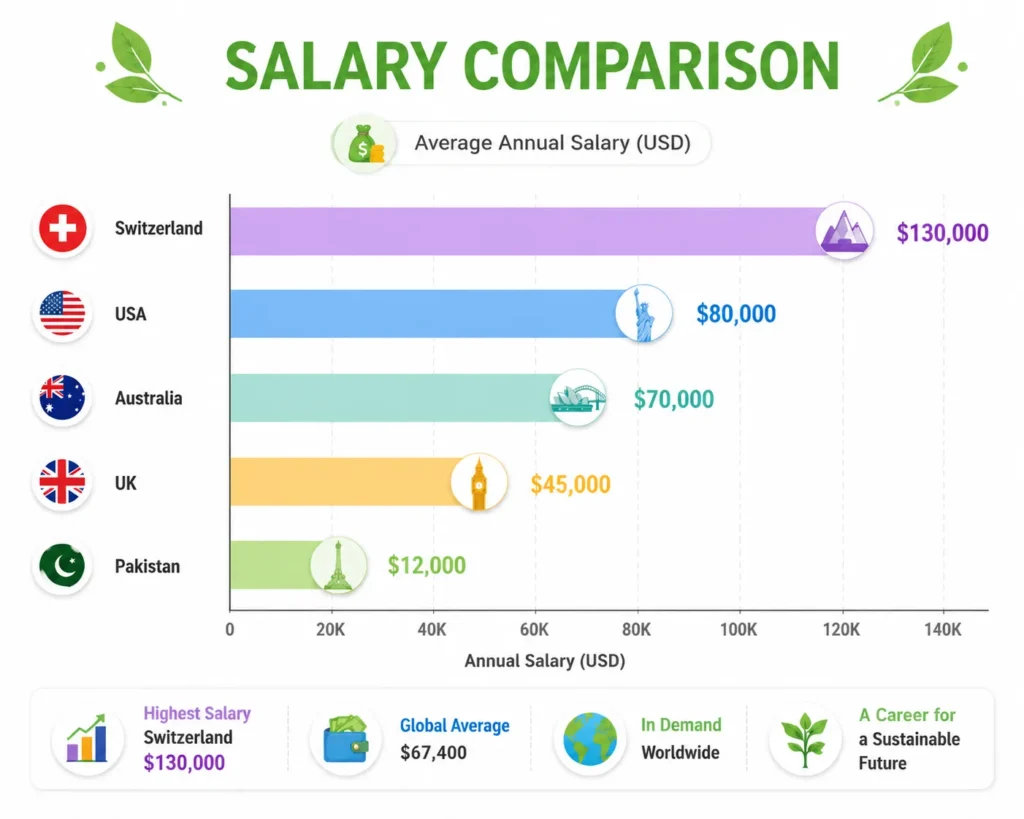
Environmental Scientist Salary
The salary of an environmental scientist varies depending on experience, qualifications, industry, employer, and geographic location. Professionals working in environmental consulting, renewable energy, mining, and oil & gas often earn higher salaries than those in academic or public sector roles.
| Country | Average Salary | Salary Range |
|---|---|---|
| United States | $76,000–$80,000 per year | Senior professionals can earn $147,000+ per year |
| Switzerland | 200,000–230,000 per year | Experienced environmental professionals and consultants |
| Australia | $90,000–$110,000 per year | Varies by state, city, and experience |
| United Kingdom | £39,000–£45,000 per year | Higher salaries for senior and specialist roles |
| Pakistan | PKR 40,000–64,000 per month | Depends on experience, industry, and city |
Future of Environmental Scientists
The future of environmental science is driven by technological innovation, climate action, and global sustainability goals. Governments and businesses are investing heavily in environmental protection, creating strong demand for professionals with advanced scientific and digital skills.
Key trends shaping the future include:
- Artificial Intelligence (AI)
- Climate Change Adaptation
- Net Zero Strategies
- Carbon Markets
- Green Buildings
- Renewable Energy
- ESG Reporting
- Biodiversity Conservation
- Nature-Based Solutions
- Smart Cities
- Circular Economy
- Environmental Digital Twins
- Climate Risk Assessment
- Satellite Monitoring
- Carbon Capture Technologies
- Sustainable Infrastructure
- Environmental Data Analytics
Environmental scientists who develop expertise in these emerging fields will have excellent career opportunities in both the public and private sectors.
Challenges Faced by Environmental Scientists
Although environmental science is a rewarding profession, it also presents several challenges. Environmental scientists often work in demanding conditions while addressing complex environmental issues that require scientific expertise, regulatory knowledge, and effective communication.
Some common challenges include:
- Working in remote or difficult locations
- Harsh weather conditions
- Exposure to hazardous materials
- Complex environmental regulations
- Managing large volumes of environmental data
- Budget and resource constraints
- Public resistance to environmental projects
- Climate uncertainty
- Balancing economic development with environmental protection
- Tight project deadlines
- Maintaining data accuracy and quality
- Coordinating with multiple stakeholders
- Rapidly changing environmental technologies
Successfully overcoming these challenges requires continuous learning, adaptability, and strong technical and analytical skills.
Tools Used by Environmental Scientists
Environmental scientists use a wide range of scientific instruments, software applications, and digital technologies to collect environmental data, analyze results, and support informed decision-making. These tools improve accuracy, efficiency, and the overall quality of environmental investigations.
Some of the most commonly used tools include:
- GPS Devices
- ArcGIS
- QGIS
- Drones (UAVs)
- Water Quality Meters
- Air Quality Monitors
- Soil Sampling Kits
- Noise Level Meters
- Spectrometers
- Gas Detectors
- Remote Environmental Sensors
- Satellite Imagery
- Artificial Intelligence (AI) Platforms
- Microsoft Excel
- Python
- R Programming
- Microsoft Power BI
- Environmental Modelling Software
- Carbon Accounting Software
- Laboratory Testing Equipment
These modern tools enable environmental scientists to collect reliable data, monitor environmental conditions in real time, create accurate environmental models, and develop science-based solutions for protecting natural resources and supporting sustainable development.
Conclusion
Environmental scientists play a vital role in protecting the environment, conserving natural resources, and promoting sustainable development. They use scientific knowledge, modern technology, and practical solutions to address challenges such as pollution, climate change, and biodiversity loss.
With growing global demand for environmental protection, this profession offers excellent career opportunities across many industries. By gaining the right education, skills, and certifications, you can build a rewarding career as an environmental scientist and make a positive impact on the world.