
What Is Business Management? A Complete Beginner’s Guide
Business management is one of the broadest areas of modern business because almost every organisation needs people who can plan activities, manage resources, coordinate teams, make decisions and work towards clearly defined goals.
But what exactly is business management? Is it simply about managing employees? Does it only apply to business owners and senior managers? What are the main functions of business management, and what skills does someone need to succeed in this field?
This complete beginner’s guide explains business management in simple terms. It covers its meaning, core functions, types, responsibilities, essential skills, real-world applications, benefits, challenges and the role of technology. It also explains how business management relates to business administration and why developing management knowledge can be valuable for students, professionals, entrepreneurs and aspiring managers.
What Is Business Management?
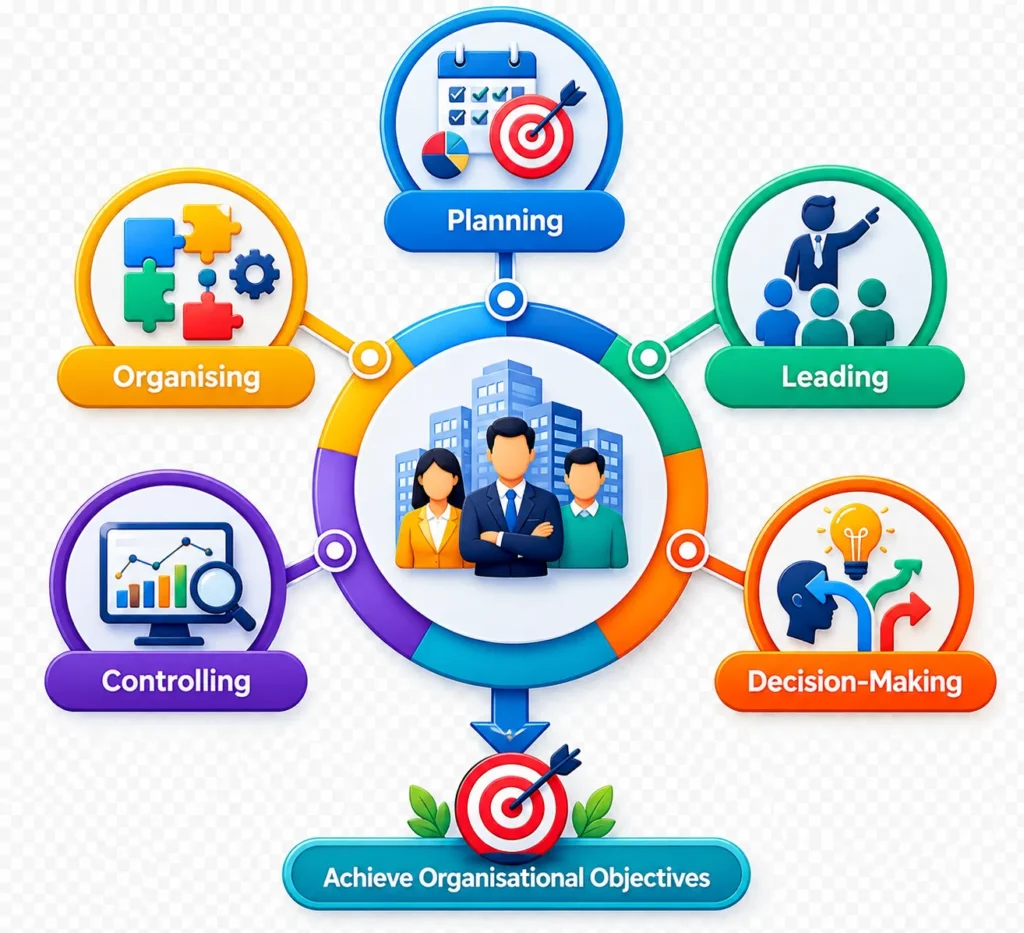
Business management is the process of planning, organising, directing and controlling an organisation’s resources and activities to achieve defined objectives.
These resources can include people, money, materials, technology, information and time. Effective business management brings these resources together so that different parts of an organisation can work towards common goals.
In simple terms, business management is about deciding what needs to be achieved, organising the resources required, guiding people and monitoring results.
Business management is therefore much broader than simply giving instructions to employees. A manager may need to analyse information, establish priorities, manage budgets, improve processes, respond to customer needs, deal with risks and make decisions when circumstances change.
The exact responsibilities vary according to the organisation, industry, management level and job role.
How Does Business Management Work?
Business management can be understood as a continuous management cycle:
Set objectives → Plan → Organise → Lead → Implement → Monitor → Improve
For example, imagine a company wants to increase customer satisfaction.
Management may first establish a measurable target. It could then analyse customer feedback, identify operational problems, allocate resources, train employees, introduce improvements and monitor customer satisfaction data.
If the results do not meet expectations, management can review the approach and make further changes.
This illustrates an important point: business management is not a one-time activity. It is an ongoing process of decision-making, coordination, performance management and improvement.
What Are the Core Functions of Business Management?
Although different organisations use different management frameworks, several functions appear consistently across business environments.
1. Planning
Planning involves deciding what an organisation wants to achieve and determining how it will achieve those objectives.
Managers may establish:
- Business objectives
- Operational targets
- Budgets
- Project priorities
- Resource requirements
- Performance measures
- Implementation timescales
Good planning helps an organisation establish direction before committing significant resources.
For example, a company launching a new product may need to research customer demand, estimate costs, establish a marketing strategy, identify required staff and determine expected sales.
2. Organising
Organising involves arranging resources, responsibilities and activities so that plans can be implemented effectively.
This can include:
- Allocating responsibilities
- Designing workflows
- Establishing reporting relationships
- Coordinating departments
- Allocating budgets
- Managing resources
- Setting priorities
Poor organisation can result in duplicated work, unclear responsibilities, delays and inefficient use of resources.
3. Leading and Directing
Leadership involves influencing and supporting people so that they can contribute effectively towards organisational objectives.
Managers may need to:
- Communicate expectations
- Motivate employees
- Resolve workplace issues
- Support team development
- Delegate responsibilities
- Make decisions
- Manage change
- Build effective working relationships
Leadership and management are closely connected, but they are not identical. Management focuses heavily on coordination, resources, processes and objectives, while leadership places greater emphasis on direction, influence, people and change.
Effective managers often need both.
4. Controlling and Monitoring
Control involves comparing actual performance with planned objectives and taking corrective action where necessary.
Managers may monitor:
- Revenue
- Costs
- Productivity
- Customer satisfaction
- Quality
- Employee performance
- Project progress
- Sales performance
- Operational efficiency
Control does not simply mean looking for mistakes. It helps management identify whether the organisation is moving towards its objectives and where improvements may be required.
5. Decision-Making
Decision-making is present throughout business management.
Managers make decisions about:
- People
- Budgets
- Suppliers
- Customers
- Products
- Marketing
- Operations
- Technology
- Risks
- Business growth
Strong decision-making involves considering evidence, alternatives, risks, costs and expected outcomes rather than relying entirely on assumptions.
What Are the Main Types of Business Management?
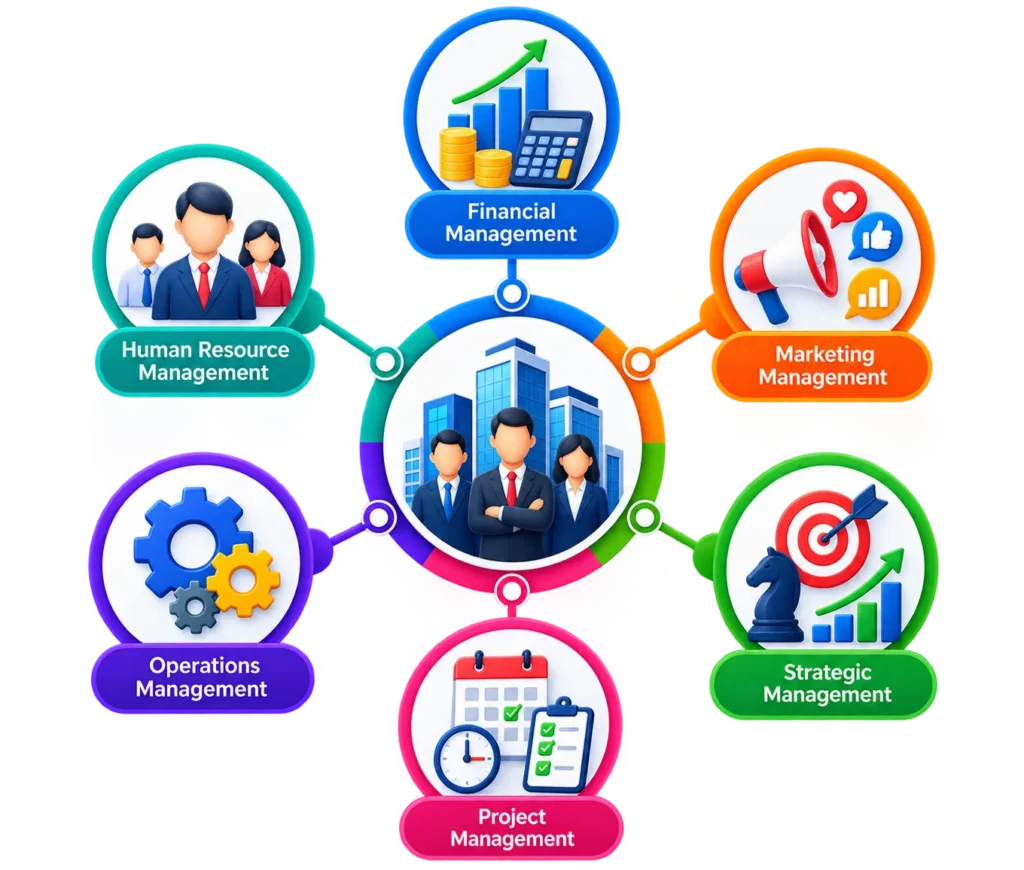
Business management covers several specialist areas. In larger organisations, these may be managed by different departments or functional leaders.
Financial Management
Financial management focuses on the effective use and control of financial resources.
It can involve:
- Budgeting
- Financial planning
- Cash-flow management
- Cost control
- Financial analysis
- Investment decisions
- Performance monitoring
Financial management helps organisations understand whether resources are being used efficiently and whether business activities are financially sustainable.
Human Resource Management
Human resource management focuses on people within the organisation.
It may include:
- Recruitment
- Employee development
- Training
- Performance management
- Workforce planning
- Employee engagement
- Workplace policies
People are central to business performance, so effective management of employees can have a significant influence on organisational outcomes.
Marketing Management
Marketing management involves understanding customers and developing strategies to communicate and deliver value.
It can include:
- Market research
- Customer analysis
- Branding
- Digital marketing
- Campaign planning
- Customer engagement
- Marketing performance
Marketing managers need to understand both customer expectations and the competitive environment.
Operations Management
Operations management focuses on how products and services are produced and delivered.
Typical areas include:
- Processes
- Production
- Supply chains
- Quality
- Logistics
- Inventory
- Productivity
- Service delivery
Effective operations management aims to provide consistent results while managing resources, quality, costs and customer expectations.
Strategic Management
Strategic management focuses on the organisation’s longer-term direction.
It may involve:
- Analysing competitors
- Identifying opportunities
- Assessing risks
- Setting strategic objectives
- Allocating resources
- Evaluating performance
- Responding to market changes
Strategic management connects the organisation’s current position with its desired future position.
Project Management
Project management involves planning and coordinating temporary activities designed to achieve a defined outcome.
Business managers may work with project teams on:
- New product development
- Technology implementation
- Business expansion
- Process improvement
- Organisational change
- New facilities
- Marketing campaigns
Project management requires careful attention to scope, time, cost, quality, resources and risk.
What Does a Business Manager Do?
A business manager’s responsibilities depend on the organisation and position.
A manager may be responsible for:
- Setting objectives
- Managing employees
- Allocating resources
- Monitoring budgets
- Reviewing performance
- Improving processes
- Managing risks
- Supporting customers
- Coordinating departments
- Making operational decisions
- Reporting performance
- Supporting organisational change
A business manager may therefore spend one part of the working day analysing performance data and another part resolving a team issue or discussing a resource requirement.
This variety is one reason business management can apply across many industries.
What Skills Are Important in Business Management?
Successful business management requires a combination of technical, analytical and interpersonal abilities.
Communication
Managers need to communicate objectives, expectations, decisions and feedback clearly.
Leadership
Managers need to influence, support and coordinate people while maintaining focus on organisational objectives.
Decision-Making
Managers frequently need to choose between competing options, often with incomplete information.
Problem-Solving
Business problems can involve customers, people, costs, processes, suppliers, technology or competition. Managers need to identify underlying causes and evaluate appropriate responses.
Financial Awareness
Even managers who do not work in finance may need to understand budgets, costs, revenue, profitability and financial performance.
Strategic Thinking
Strategic thinking involves looking beyond immediate tasks and considering how decisions affect longer-term organisational objectives.
Time Management
Managers often have competing priorities. Effective time management helps them focus attention on activities that create the greatest organisational value.
Adaptability
Markets, technologies, customer expectations and working practices can change rapidly. Managers therefore need to respond constructively to changing circumstances.
Data Literacy
Modern managers increasingly use business information, dashboards, performance indicators and analytics to support decisions.
Why Is Business Management Important?
Business management matters because organisations rarely achieve their objectives simply by having good products or talented employees.
They also need coordination.
Effective management can help an organisation:
- Use resources efficiently
- Establish clear objectives
- Improve employee coordination
- Control costs
- Improve customer experiences
- Monitor performance
- Manage risks
- Respond to change
- Support innovation
- Improve operational efficiency
- Pursue sustainable growth
For example, a business may have a strong product but still struggle if its costs are uncontrolled, employees lack direction, customers receive poor service or operations are poorly organised.
Management connects these different areas.
Business Management in a Real-World Example
Consider a growing online retailer.
The company has increasing sales but is experiencing delayed deliveries and rising customer complaints.
A weak response would be to focus only on increasing sales.
A business management approach would examine the wider situation.
Management could review:
- Customer complaints
- Inventory levels
- Supplier performance
- Delivery times
- Staffing
- Technology systems
- Operating costs
- Order-processing procedures
The business might discover that sales growth has increased order volumes beyond the capacity of its existing fulfilment process.
Management could then redesign the process, adjust staffing, improve inventory planning and monitor delivery performance.
This example demonstrates that business management is about understanding how different parts of an organisation affect one another.
Business Management vs Business Administration
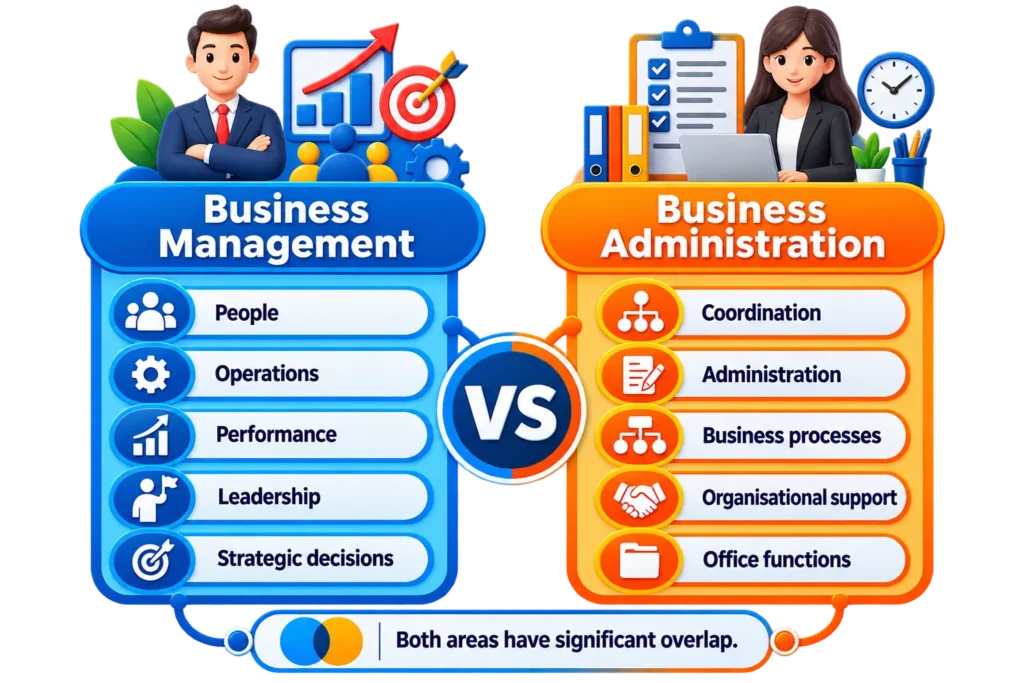
Business management and business administration overlap considerably, which can make the terms confusing.
Business administration is often associated with the broader administration and coordination of organisational activities, while business management commonly places greater emphasis on managing people, resources, operations and organisational performance.
However, the distinction is not universal. Different universities, employers and organisations may use the terms differently.
A useful way to think about the difference is:
| Business Management | Business Administration |
|---|---|
| Often focuses on managing people and operations | Often focuses on organisational administration |
| Emphasises leadership and performance | Emphasises coordination and business processes |
| Can involve strategic and operational decisions | Can involve administrative and organisational functions |
| Frequently involves managing teams | Frequently involves supporting business activities |
| Strong connection with organisational performance | Strong connection with business coordination |
There is significant overlap, and neither field should automatically be considered better than the other.
Business Management vs Leadership
Business management and leadership are also closely related.
Management commonly focuses on planning, organising resources, coordinating activities and monitoring performance.
Leadership focuses more heavily on direction, influence, motivation, relationships and change.
A manager may create a project plan, allocate resources and monitor deadlines. A leader may help the team understand why the project matters, build commitment and guide people through change.
In many workplaces, effective managers need both capabilities.
What Challenges Do Business Managers Face?
Business management is not simply about applying a fixed set of rules.
Managers regularly face competing priorities.
Common challenges include:
Managing Limited Resources
Businesses often have limited budgets, staff, time and equipment. Managers must decide where resources should be allocated.
Balancing Cost and Quality
Reducing costs may appear attractive, but excessive cost-cutting can affect product quality, customer service or employee performance.
Managing Change
New technology, competitors, customer expectations and economic conditions can require organisations to change.
Managing Different Stakeholder Expectations
Employees, customers, suppliers, investors and other stakeholders may have different expectations.
Making Decisions Under Uncertainty
Managers may need to make decisions before complete information is available.
Maintaining Employee Engagement
People may respond differently to workload, organisational change, leadership styles and workplace expectations.
These challenges demonstrate why business management requires judgement rather than simply following procedures.
How Technology Is Changing Business Management
Technology has changed how organisations plan, communicate, monitor performance and make decisions.
Modern businesses increasingly use:
- Business intelligence platforms
- Customer relationship management systems
- Enterprise software
- Cloud-based collaboration tools
- Data analytics
- Automation
- Artificial intelligence
- Digital communication platforms
Technology can help managers access information faster and automate repetitive activities.
However, technology does not remove the need for human judgement. Managers still need to understand context, evaluate information, consider risks and make responsible decisions.
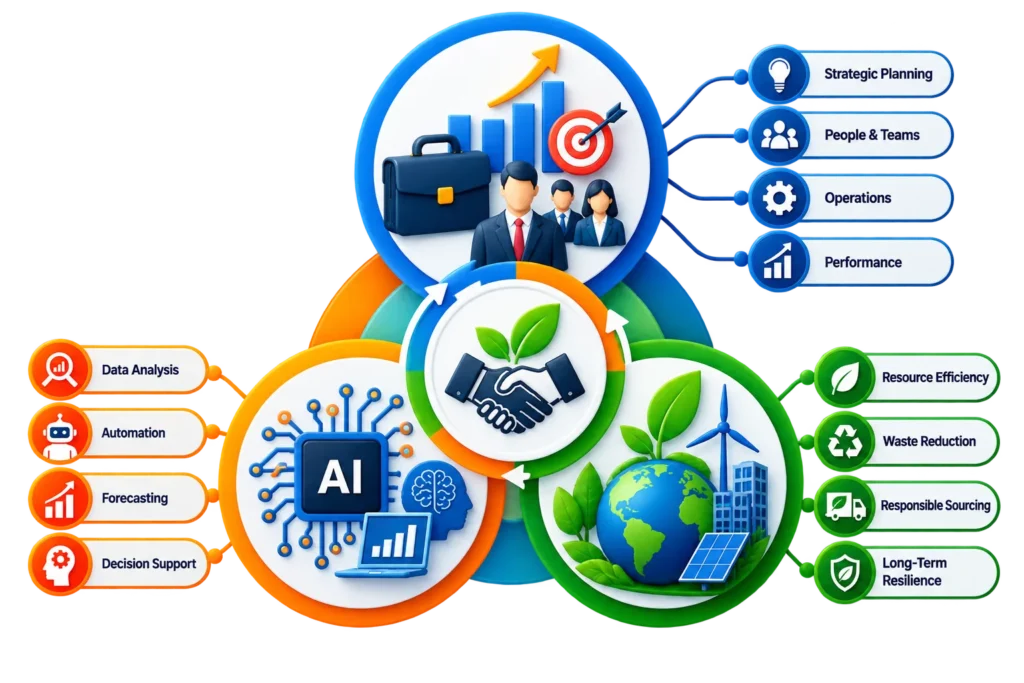
The Growing Role of AI in Business Management
Artificial intelligence is becoming increasingly relevant to business management.
Businesses can use AI-supported systems for activities such as:
- Data analysis
- Customer support
- Forecasting
- Process automation
- Content development
- Market analysis
- Decision support
- Business reporting
The important management question is not simply whether AI can be used, but where it should be used and how it should be governed responsibly.
Managers need to consider data quality, privacy, security, accuracy, human oversight, bias and organisational risk when introducing AI-supported processes.
This creates a new management requirement: understanding technology while retaining appropriate human judgement.
Business Management and Sustainability
Modern business management increasingly involves more than short-term financial performance.
Managers may also need to consider:
- Resource efficiency
- Environmental impacts
- Responsible sourcing
- Waste reduction
- Employee wellbeing
- Ethical decision-making
- Corporate responsibility
- Long-term organisational resilience
Sustainability can therefore become part of strategic planning, operations, supply-chain management and risk management rather than remaining a separate activity.
Who Can Benefit from Learning Business Management?
Business management knowledge can be useful for a wide range of people, including:
Students
Students can use business management knowledge to understand how organisations operate and how different business functions interact.
Entrepreneurs
Business owners need to manage finances, people, customers, operations, marketing and growth.
Supervisors
Employees moving into supervisory roles may need stronger skills in communication, delegation, planning and performance management.
Existing Managers
Experienced managers can use structured learning to strengthen their knowledge and improve decision-making.
Career Changers
People moving into business-related roles can develop a broader understanding of organisational functions.
Professionals in Other Fields
Business management knowledge can also benefit professionals in areas such as technology, engineering, healthcare, construction, logistics and education because many professional roles involve managing people, budgets, projects or organisational resources.
How Can You Develop Business Management Skills?
Developing management capability usually requires a combination of structured learning and experience.
A useful approach is to:
- Learn the fundamentals of business management.
- Understand finance, marketing, HR and operations.
- Develop communication and leadership skills.
- Practise structured decision-making.
- Learn how to interpret business information.
- Understand risk and performance management.
- Follow developments in technology and AI.
- Apply management concepts to realistic business situations.
- Seek feedback from colleagues and managers.
- Continue developing professional knowledge.
Formal qualifications can provide a structured way to study these areas, while workplace experience can help learners understand how management principles operate in real organisations.
What Should You Look for in a Business Management Qualification?
If you are considering studying business management, do not evaluate a course only by its title.
Consider:
- Qualification level
- Awarding organisation
- Accreditation or regulatory status where applicable
- Course content
- Learning outcomes
- Assessment method
- Credit value
- Entry requirements
- Study format
- Assessment workload
- Progression information
- Provider reputation
- Whether the content matches your career or learning goals
It is also important to distinguish between a qualification’s level and its recognition for a particular purpose. A qualification level does not automatically mean that it is equivalent to a specific degree or that every institution will provide the same progression or credit arrangements.
Always check the awarding organisation’s official specification and the requirements of the institution or employer you intend to approach.
What Is a Business Management Qualification Useful For?
A business management qualification can help learners develop structured knowledge across areas such as:
- Business operations
- Management principles
- Leadership
- Marketing
- Finance
- Human resources
- Strategic thinking
- Organisational performance
- Business decision-making
The value of a qualification ultimately depends on its content, level, recognition, assessment approach and how well it matches the learner’s objectives.
For someone beginning their business education, a structured qualification can provide a framework for understanding how different business functions connect.
Related Business Management Courses
1. Qualifi Level 3 Diploma in Business Management
The Qualifi Level 3 Diploma in Business Management introduces learners to key business areas such as business environment, marketing, human resources, communication, and business resources.
2. Qualifi Level 4 Diploma in Business Management
The Qualifi Level 4 Diploma in Business Management develops knowledge of business operations, management, leadership, organisational practices, and business decision-making.
3. Qualifi Level 5 Extended Diploma in Business Management
The Qualifi Level 5 Extended Diploma in Business Management provides advanced knowledge of management, leadership, organisational decision-making, and contemporary business practices.
4. OTHM Level 3 Diploma in Business Management
The OTHM Level 3 Diploma in Business Management covers essential business concepts, including the business environment, communication, customer service, finance, marketing, and people management.
5. OTHM Level 5 Extended Diploma in Business Management
The OTHM Level 5 Extended Diploma in Business Management develops knowledge across leadership, finance, marketing, human resources, operations, business strategy, and business law.
6. OTHM Level 6 Diploma in Business Management
The OTHM Level 6 Diploma in Business Management focuses on advanced management and strategic areas, including leadership, financial decision-making, operations, sustainability, and strategic human resource management.
7. ICTQual AB Level 3 Diploma in Business Management
The ICTQual AB Level 3 Diploma in Business Management provides foundational knowledge of marketing, business communication, human resources, finance, operations, and business performance.
8. ABMA Education Level 6 Diploma in Business Management (RQF)
The ABMA Education Level 6 Diploma in Business Management (RQF) develops advanced knowledge in strategic management, leadership, finance, marketing, project management, economics, and international business.
Conclusion
Business management is about planning, organising, leading people, managing resources and making effective decisions to achieve business goals. It helps organisations improve performance, manage challenges and use their resources efficiently.
For beginners, understanding these basic principles provides a strong foundation for studying business, developing management skills and progressing in different business-related roles.