
Circular Economy Consultant: Roles, Skills, Qualifications, Career Path & Salary Guide (2026)
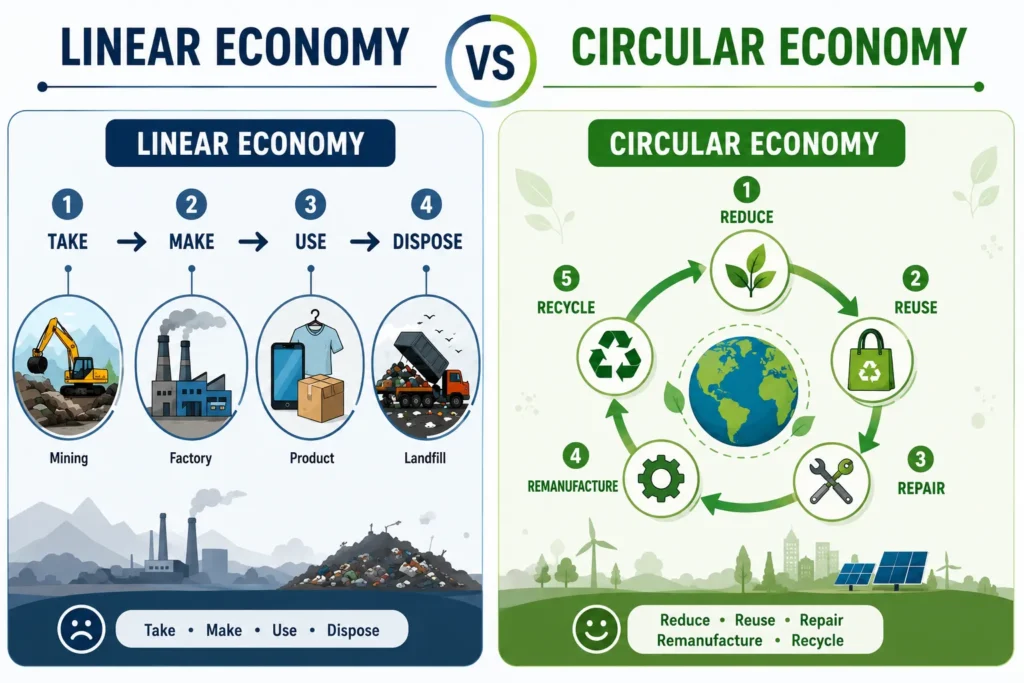
As businesses and governments strive to reduce waste, conserve natural resources, and achieve sustainability goals, the demand for circular economy expertise is growing rapidly. Organizations are increasingly moving away from the traditional “take, make, dispose” model and adopting circular practices that keep products, materials, and resources in use for as long as possible.
A Circular Economy Consultant helps organizations make this transition by developing strategies to improve resource efficiency, minimize waste, support sustainable innovation, and create long-term environmental and economic value. These professionals work across a wide range of industries, helping businesses design practical solutions that align with sustainability objectives and evolving regulations.
What is a Circular Economy Consultant?
A Circular Economy Consultant is a sustainability professional who helps businesses, governments, and organizations reduce waste, use resources more efficiently, and create environmentally responsible solutions. Instead of following the traditional “take, make, and dispose” approach, they help organizations adopt circular economy practices that keep materials, products, and resources in use for as long as possible.
These consultants assess existing processes, identify opportunities to reduce waste, improve recycling and reuse, increase resource efficiency, and develop strategies that support both environmental sustainability and business growth. They work with organizations across industries such as manufacturing, construction, retail, healthcare, energy, and the public sector to build more sustainable and resilient operations.
By combining environmental knowledge, business strategy, and problem-solving skills, a Circular Economy Consultant helps organizations lower costs, reduce their environmental impact, meet sustainability goals, and contribute to a more sustainable future.
What Does a Circular Economy Consultant Do?
A Circular Economy Consultant helps organizations redesign their operations to reduce waste, improve resource efficiency, and create sustainable business models. Their work involves analyzing existing systems, identifying opportunities for reuse and recycling, developing circular strategies, and supporting companies in achieving environmental and business goals.
Unlike traditional environmental roles that mainly focus on reducing negative impacts, Circular Economy Consultants help organizations create positive value by keeping materials, products, and resources in use for longer periods.
Daily Work of a Circular Economy Consultant
The daily activities of a Circular Economy Consultant vary depending on the project and industry, but common tasks include:
- Analyzing Business Processes: Reviewing how organizations use materials, manage waste, and operate supply chains to identify circular economy opportunities.
- Conducting Resource Assessments: Evaluating material flows, waste generation, energy use, and resource efficiency.
- Developing Circular Strategies: Creating plans for recycling, reuse, repair, remanufacturing, and sustainable product design.
- Researching Sustainability Trends: Monitoring environmental regulations, circular economy standards, and emerging technologies.
- Working with Stakeholders: Collaborating with business leaders, engineers, suppliers, government bodies, and sustainability teams.
- Preparing Reports and Recommendations: Creating sustainability reports, feasibility studies, and action plans for clients.
- Monitoring Project Progress: Tracking sustainability targets and measuring improvements in resource efficiency and environmental performance.
Types of Projects Managed by Circular Economy Consultants
Circular Economy Consultants work on different types of sustainability projects, including:
Circular Business Model Development
Helping organizations move from traditional linear models to circular approaches such as product-as-a-service, sharing models, and resource recovery systems.
Waste Reduction and Resource Recovery Projects
Identifying ways to reduce waste generation, improve recycling systems, and recover valuable materials from waste streams.
Sustainable Product Design
Supporting companies in designing products that are durable, repairable, recyclable, and easier to reuse.
Supply Chain Optimization
Analyzing supply chains to reduce material waste, improve sourcing practices, and create closed-loop systems.
Life Cycle Assessment (LCA) Projects
Evaluating the environmental impact of products and services throughout their entire life cycle, from raw materials to disposal.
Circular Economy Roadmaps
Creating long-term strategies that help organizations achieve sustainability and circularity goals.
Industries That Hire Circular Economy Consultants
Circular Economy Consultants are needed across many industries, including:
| Industry | Circular Economy Applications |
|---|---|
| Manufacturing | Resource efficiency, waste reduction, sustainable production |
| Construction | Material reuse, sustainable buildings, construction waste management |
| Energy | Resource optimization, renewable energy integration |
| Automotive | Vehicle recycling, remanufacturing, sustainable materials |
| Fashion | Textile recycling, sustainable supply chains |
| Food and Agriculture | Food waste reduction, bio-based solutions |
| Retail | Sustainable packaging and product lifecycle management |
| Electronics | E-waste recovery and responsible recycling |
| Healthcare | Waste minimization and sustainable operations |
| Government and NGOs | Circular economy policies and sustainability programs |
Types of Clients Served by Circular Economy Consultants
Circular Economy Consultants work with a wide range of clients, including:
- Private companies seeking sustainable business transformation
- Government organizations developing environmental policies
- International development organizations supporting sustainability programs
- Manufacturing companies improving production systems
- Construction firms reducing material waste
- Financial institutions evaluating sustainable investments
- Non-governmental organizations implementing environmental projects
- Startups developing circular products and services
Key Deliverables Created by Circular Economy Consultants
A Circular Economy Consultant typically provides professional outputs such as:
- Circular Economy Strategy Reports – Plans for implementing circular practices within organizations.
- Material Flow Analysis Reports – Assessments of how materials enter, move through, and leave a system.
- Waste Reduction Plans – Strategies to minimize waste and improve resource recovery.
- Sustainability Roadmaps – Long-term action plans for achieving circular economy goals.
- Life Cycle Assessment Reports – Analysis of environmental impacts across product lifecycles.
- Circular Business Model Recommendations – Guidance on developing sustainable revenue models.
- Environmental Performance Reports – Measurement of sustainability improvements and outcomes.
- Training Materials and Workshops – Educational resources to help organizations adopt circular practices.
Why Circular Economy Consulting Matters
Circular Economy Consulting plays an important role in helping organizations move away from the traditional linear model of “take, make, dispose” and adopt a more sustainable approach where resources are reused, recovered, and kept in circulation for longer. As businesses face increasing environmental challenges, rising resource costs, and sustainability expectations, Circular Economy Consultants provide the expertise needed to create practical and profitable solutions.
Environmental Impact
Circular Economy Consulting helps organizations reduce their environmental footprint by improving how materials are sourced, used, and managed. Consultants identify opportunities to reuse materials, reduce pollution, protect natural resources, and develop sustainable processes that minimize harm to the environment.
By supporting circular practices, businesses can contribute to:
- Reduced pressure on natural resources
- Lower waste generation
- Improved ecosystem protection
- More sustainable production and consumption patterns
Business Benefits
Circular economy strategies provide significant advantages for businesses beyond environmental improvements. Consultants help organizations discover new opportunities to reduce operational costs, improve efficiency, and create innovative products and services.
Key business benefits include:
- Lower material and operational costs
- Improved supply chain resilience
- Development of new circular business models
- Increased customer trust and brand reputation
- Better compliance with sustainability expectations
- Competitive advantage in sustainable markets
Supporting Net Zero Goals
Circular Economy Consulting supports organizations in achieving Net Zero targets by reducing emissions throughout product and service lifecycles. Since resource extraction, manufacturing, transportation, and waste management contribute significantly to carbon emissions, circular strategies help reduce these impacts.
Consultants support Net Zero efforts through:
- Promoting material reuse and recycling
- Reducing dependence on virgin resources
- Improving production efficiency
- Supporting low-carbon business models
- Identifying opportunities for emission reduction
Supporting ESG Performance
Environmental, Social, and Governance (ESG) requirements are becoming increasingly important for businesses, investors, and stakeholders. Circular Economy Consultants help organizations improve their environmental performance and demonstrate measurable sustainability progress.
They support ESG goals by helping companies:
- Develop sustainability strategies
- Measure environmental performance
- Improve resource management
- Prepare sustainability reports
- Meet investor and stakeholder expectations
Improving Resource Efficiency
Resource efficiency is one of the core principles of the circular economy. Consultants analyze how organizations use materials, energy, water, and other resources to identify areas for improvement.
They help businesses:
- Optimize material usage
- Reduce resource losses
- Improve production processes
- Increase the value gained from existing resources
- Develop closed-loop systems
Better resource efficiency helps organizations achieve sustainability goals while improving long-term profitability.
Reducing Waste Generation
Circular Economy Consultants help businesses transform waste from a disposal problem into a valuable resource. They assess waste streams and develop strategies for prevention, reuse, recycling, and recovery.
Waste reduction approaches include:
- Designing products for longer use
- Improving recycling systems
- Creating reuse and repair programs
- Recovering valuable materials
- Reducing landfill dependency
Reducing Carbon Emissions
Circular economy approaches directly contribute to carbon reduction by minimizing the need for new raw materials and reducing energy-intensive production activities.
Consultants help organizations lower carbon emissions through:
- Sustainable material selection
- Life Cycle Assessment (LCA)
- Circular supply chain design
- Renewable resource integration
- Improved waste management practices
Key Roles and Responsibilities of a Circular Economy Consultant
A Circular Economy Consultant plays a strategic role in helping organizations redesign their operations, products, and business models to reduce waste, improve resource efficiency, and create long-term sustainability value. Their responsibilities go beyond environmental assessments; they work with businesses, governments, and stakeholders to develop practical solutions that balance environmental goals with economic performance.
The role requires a combination of sustainability knowledge, business strategy, technical analysis, and stakeholder management skills. Depending on the industry and project requirements, Circular Economy Consultants may support organizations in developing circular strategies, improving supply chains, reducing waste, and implementing innovative sustainability solutions.
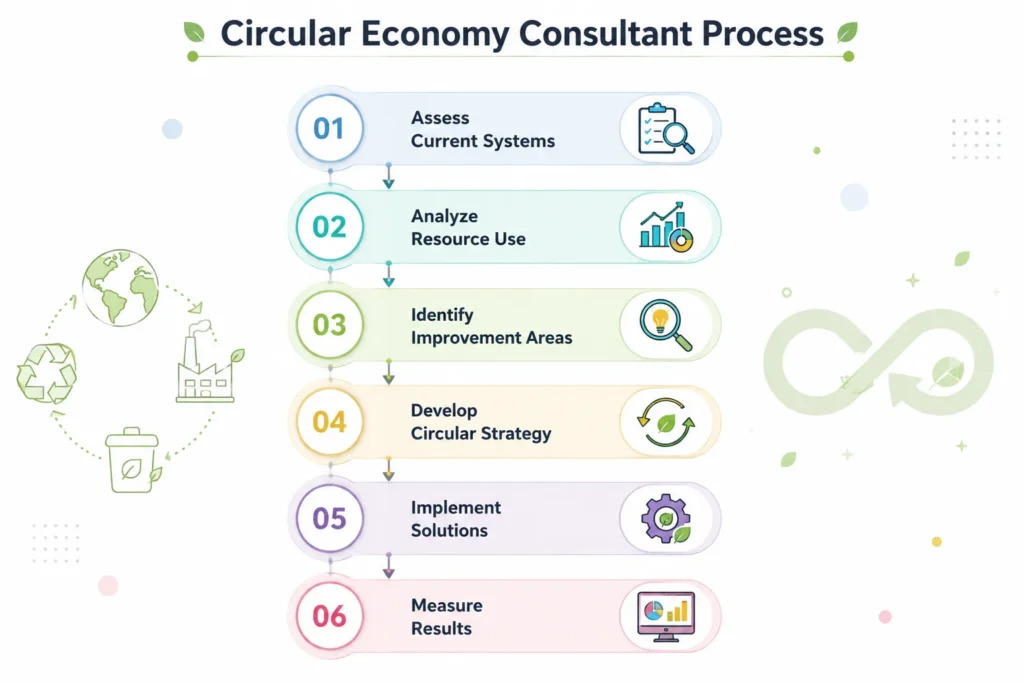
🔍 1. Assess Current Systems
Business review / checklist
↓
📊 2. Analyze Resource Use
Data analysis / material flow
↓
💡 3. Identify Improvement Areas
Search / opportunity
↓
♻️ 4. Develop Circular Strategy
Circular arrows / strategy plan
↓
⚙️ 5. Implement Solutions
Tools / sustainability action
↓
📈 6. Measure Results
Dashboard / performance tracking
Developing Circular Economy Strategies
One of the primary responsibilities of a Circular Economy Consultant is to develop customized circular economy strategies that help organizations transition from traditional linear models to circular systems.
Consultants analyze current business operations, identify opportunities for improvement, and create action plans that promote:
- Resource reuse and recovery
- Sustainable production methods
- Circular business models
- Product life extension
- Waste prevention strategies
They work with leadership teams to ensure that circular economy principles are integrated into business objectives, operational plans, and long-term sustainability goals.
Conducting Circular Economy Assessments
Circular Economy Consultants evaluate an organization’s current processes to understand how materials, energy, and resources are being used throughout operations.
Their assessments may include:
- Reviewing material consumption patterns
- Identifying waste generation points
- Evaluating resource losses
- Assessing recycling and recovery opportunities
- Measuring current sustainability performance
These assessments help organizations understand their existing environmental impact and identify areas where circular improvements can create value.
Performing Material Flow Analysis (MFA)
Material Flow Analysis is an important activity performed by Circular Economy Consultants to track how materials move through an organization’s systems.
Consultants analyze:
- Raw material inputs
- Production processes
- Product usage patterns
- Waste outputs
- Recovery opportunities
By understanding material flows, consultants help businesses identify where resources are being lost and develop strategies to keep valuable materials in circulation for longer periods.
Designing Circular Business Models
Circular Economy Consultants help organizations create new business approaches that reduce resource consumption and increase product value.
They support the development of models such as:
- Product-as-a-Service
- Sharing and leasing models
- Repair and refurbishment services
- Remanufacturing systems
- Recycling-based business models
These strategies allow companies to generate value while reducing environmental impacts and dependence on limited resources.
Supporting Sustainable Product Design
Consultants work with product development teams to improve product sustainability from the design stage.
They provide recommendations related to:
- Durable product design
- Recyclable materials
- Repairability
- Modular components
- Reduced material use
- Extended product lifespan
By applying circular design principles, organizations can create products that generate less waste and remain valuable throughout their lifecycle.
Improving Supply Chain Sustainability
Circular Economy Consultants analyze supply chains to identify opportunities for improving sustainability and resource efficiency.
Their responsibilities include:
- Evaluating supplier practices
- Promoting sustainable sourcing
- Reducing supply chain waste
- Supporting closed-loop supply chains
- Improving material traceability
They help organizations create supply networks where materials can be recovered, reused, and reintegrated into production cycles.
Developing Waste Reduction and Recovery Strategies
A major responsibility of circular economy consultants is helping organizations minimize waste and maximize resource recovery.
They evaluate waste management practices and develop strategies for:
- Waste prevention
- Recycling improvement
- Material recovery
- Industrial symbiosis
- Reuse systems
- Alternative disposal methods
The goal is to transform waste streams into valuable resources and reduce dependence on landfill disposal.
Conducting Life Cycle Assessments (LCA)
Circular Economy Consultants often perform or support Life Cycle Assessments to measure the environmental impacts of products, services, and processes.
They analyze impacts across different stages, including:
- Raw material extraction
- Manufacturing
- Transportation
- Product use
- End-of-life management
LCA results help organizations make evidence-based decisions about materials, designs, and sustainability improvements.
Supporting ESG and Sustainability Reporting
Many organizations require support in measuring and communicating their sustainability performance. Circular Economy Consultants help businesses collect relevant data and align circular economy initiatives with ESG reporting requirements.
They assist with:
- Environmental performance measurement
- Sustainability indicators
- Circularity metrics
- ESG disclosures
- Sustainability improvement plans
This enables organizations to demonstrate progress to investors, customers, regulators, and other stakeholders.
Advising on Environmental Regulations and Standards
Circular Economy Consultants help organizations understand and respond to changing environmental requirements and sustainability standards.
They provide guidance on:
- Circular economy policies
- Waste management regulations
- Environmental management systems
- Sustainability frameworks
- Industry-specific requirements
This ensures organizations remain compliant while improving their environmental performance.
Managing Stakeholder Engagement
Circular economy projects usually involve multiple stakeholders, including business leaders, employees, suppliers, customers, government agencies, and communities.
Consultants facilitate collaboration by:
- Conducting workshops
- Communicating sustainability goals
- Managing stakeholder expectations
- Building partnerships
- Supporting organizational change
Effective stakeholder engagement is essential for successfully implementing circular economy solutions.
Delivering Training and Knowledge Transfer
Circular Economy Consultants educate organizations about circular principles and help teams develop the knowledge required for implementation.
They may deliver:
- Employee training programs
- Circular economy workshops
- Sustainability awareness sessions
- Technical guidance documents
- Implementation frameworks
This ensures that organizations can maintain and improve circular practices over the long term.
Monitoring and Evaluating Circular Economy Performance
After implementing circular strategies, consultants monitor progress and evaluate results.
They measure improvements in areas such as:
- Waste reduction
- Resource efficiency
- Carbon emissions
- Recycling rates
- Cost savings
- Circularity performance
Regular evaluation helps organizations continuously improve their sustainability performance and achieve long-term circular economy objectives.
Skills Required to Become a Circular Economy Consultant
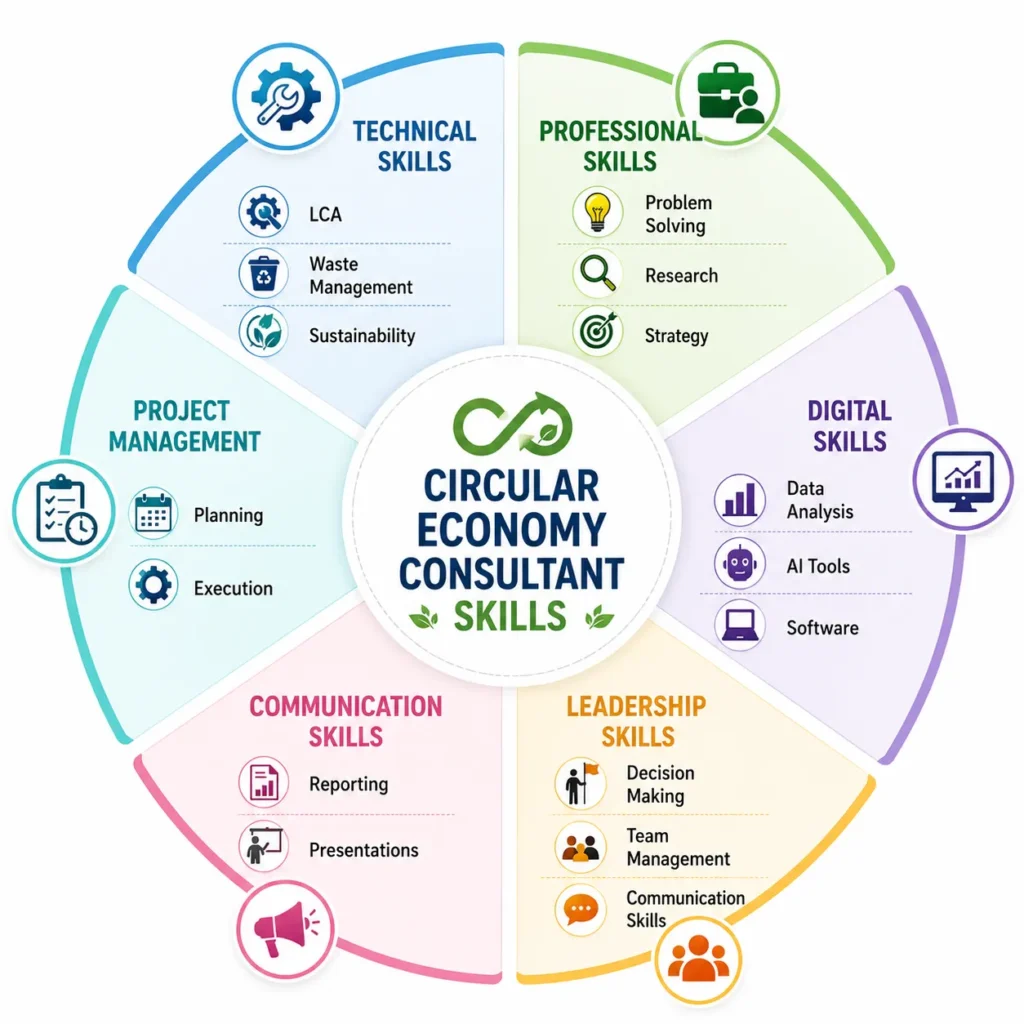
A successful Circular Economy Consultant needs a combination of technical knowledge, business understanding, and people skills. These skills help professionals develop sustainable solutions, manage projects, and support organizations in adopting circular economy practices.
Technical Skills
- Understanding of circular economy principles
- Knowledge of sustainability and environmental management
- Waste reduction and resource efficiency techniques
- Life Cycle Assessment (LCA) knowledge
- Carbon reduction and ESG concepts
- Understanding of sustainable supply chains
Professional Skills
- Problem-solving and analytical thinking
- Research and data analysis skills
- Strategic thinking
- Business understanding
- Ability to identify sustainability opportunities
Digital Skills
- Data analysis tools such as Excel and Power BI
- Sustainability reporting software
- Environmental assessment tools
- Digital tracking and monitoring systems
- Knowledge of emerging sustainability technologies
Leadership Skills
- Ability to lead sustainability initiatives
- Decision-making skills
- Team coordination
- Change management abilities
- Ability to inspire organizations toward sustainable practices
Communication Skills
- Clear report writing
- Presentation skills
- Stakeholder communication
- Training and workshop delivery
- Ability to explain complex sustainability concepts simply
Project Management Skills
- Planning and managing sustainability projects
- Setting goals and timelines
- Managing resources and budgets
- Monitoring project progress
- Working with different teams and stakeholders
These skills enable Circular Economy Consultants to create practical solutions that support environmental improvement, business growth, and long-term sustainability.
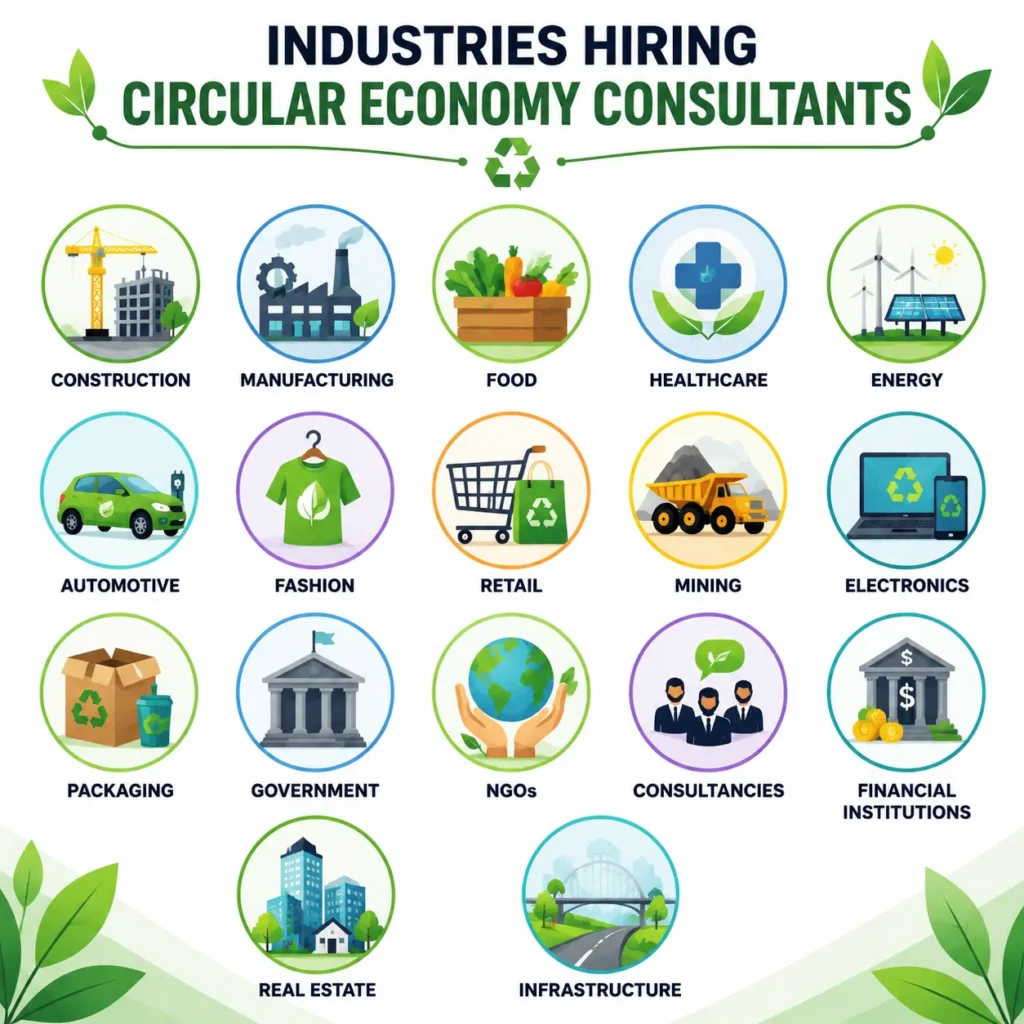
Industries Hiring Circular Economy Consultants
Circular Economy Consultants are needed across many industries to help organizations reduce waste, improve resource use, and develop sustainable solutions.
Industries Hiring Circular Economy Consultants
Circular Economy Consultants are needed across many industries to help organizations reduce waste, improve resource use, and develop sustainable solutions.
Construction
Help companies reuse building materials, reduce construction waste, and design sustainable buildings.
Manufacturing
Support businesses in improving production processes, reducing waste, and creating circular supply chains.
Food and Agriculture
Help reduce food waste, improve resource efficiency, and develop sustainable food systems.
Healthcare
Support hospitals and healthcare organizations in reducing waste and improving sustainable operations.
Energy
Help organizations improve resource efficiency, reduce emissions, and support clean energy solutions.
Automotive
Work on vehicle recycling, remanufacturing, and sustainable material use.
Fashion and Textiles
Support clothing brands in recycling, sustainable design, and reducing textile waste.
Retail
Help businesses improve packaging, product reuse, and sustainable supply chains.
Mining
Develop strategies for responsible resource use, waste reduction, and material recovery.
Electronics
Support e-waste management, recycling programs, and recovery of valuable materials.
Packaging
Help companies design recyclable, reusable, and sustainable packaging solutions.
Government and Public Sector
Assist with circular economy policies, environmental programs, and sustainability initiatives.
NGOs
Support sustainability projects, community programs, and environmental campaigns.
Consulting Firms
Provide circular economy expertise to clients across different industries.
Financial Institutions
Help evaluate sustainable investments and circular business opportunities.
Real Estate
Support sustainable property development, resource efficiency, and green building practices.
Infrastructure
Improve material management, waste reduction, and sustainability in large-scale projects.
Qualifications Required to Become a Circular Economy Consultant
A Circular Economy Consultant can come from different educational and professional backgrounds. A combination of sustainability knowledge, practical experience, and specialized training helps professionals build a successful career in this field.
Degrees
Relevant degree areas include:
- Environmental Science
- Sustainability Management
- Environmental Engineering
- Business Management
- Renewable Energy
- Waste Management
- Sustainable Development
Diplomas
Professional diplomas in areas such as:
- Circular Economy
- Environmental Management
- Sustainability
- Waste Management
- ESG
- Resource Management
can help develop practical industry skills.
Professional Certifications
Useful certifications include:
- Circular Economy certifications
- ISO Environmental Management certifications
- ESG Reporting certifications
- Carbon Accounting certifications
- Life Cycle Assessment training
Short Courses
Short courses help professionals gain focused knowledge in areas such as:
- Circular economy principles
- Sustainable business models
- Waste reduction strategies
- Green technologies
- Sustainability reporting
Online Learning
Online courses provide flexible learning opportunities through:
- Sustainability platforms
- Professional training websites
- University online programs
- Industry-based learning resources
Continuous learning is important because circular economy practices and sustainability standards are constantly evolving.
Certifications for Circular Economy Consultants
Professional certifications help Circular Economy Consultants develop the technical knowledge and practical skills needed to support sustainable business transformation. Important certifications and training areas include:
ISO 14001 – Environmental Management
Provides knowledge of environmental management systems and helps organizations improve their environmental performance.
ISO 50001 – Energy Management
Focuses on improving energy efficiency and reducing energy consumption in organizations.
ISO 59000 – Circular Economy Standards
Develops understanding of circular economy principles, strategies, and implementation methods.
Life Cycle Assessment (LCA)
Teaches how to evaluate the environmental impact of products and processes throughout their lifecycle.
ESG Reporting
Provides skills for measuring and reporting environmental, social, and governance performance.
Carbon Accounting
Helps professionals measure, manage, and reduce greenhouse gas emissions.
Environmental Management
Builds knowledge of pollution control, sustainability practices, and environmental improvement strategies.
Waste Management
Develops skills in waste reduction, recycling, recovery, and sustainable waste solutions.
Resource Efficiency
Focuses on reducing resource consumption and improving the use of materials and energy.
Sustainability Reporting
Provides knowledge of preparing sustainability reports and communicating environmental performance.
These qualifications help professionals build credibility and improve their career opportunities in circular economy consulting.
Circular Economy Consultant Salary Guide (Global)
The salary of a Circular Economy Consultant varies depending on experience, location, industry, and professional expertise. As organizations increasingly focus on sustainability, resource efficiency, and net-zero goals, demand for skilled circular economy professionals is growing worldwide.
| Region / Work Type | Average Salary Range (Approx.) |
|---|---|
| Global Average | $60,000 – $120,000 per year |
| United Kingdom (UK) | £40,000 – £90,000 per year |
| Europe | €45,000 – €100,000 per year |
| Middle East | $50,000 – $120,000 per year |
| Australia | AUD 80,000 – AUD 140,000 per year |
| USA | $70,000 – $130,000 per year |
| Remote Consulting | $50 – $150+ per hour |
| Freelance Consulting | $500 – $5,000+ per project |
Career Path of a Circular Economy Consultant
Flowchart:
🎓 Graduate
↓
📊 Analyst
↓
🌱 Consultant
↓
⭐ Senior Consultant
↓
🏆 Principal Consultant
↓
🏢 Director
↓
🤝 Partner
↓
🌍 Independent Consultant
Tools Used by Circular Economy Consultants
Circular Economy Consultants use different digital and analytical tools to assess environmental impacts, analyze resources, and develop sustainable solutions.
| Tool | Purpose |
|---|---|
| OpenLCA | Analyzes product life cycle environmental impacts |
| SimaPro | Performs Life Cycle Assessment (LCA) studies |
| Power BI | Creates sustainability dashboards and data reports |
| Excel | Supports data analysis and calculations |
| ArcGIS | Maps resources, waste flows, and environmental data |
| AutoCAD | Supports sustainable design and product planning |
| Carbon Accounting Software | Measures and manages carbon emissions |
| Material Flow Analysis Tools | Tracks movement and use of materials |
| ERP Systems | Manages business resources and supply chain data |
| Waste Tracking Software | Monitors waste generation and recycling activities |
| AI Analytics | Uses data insights to improve sustainability decisions |
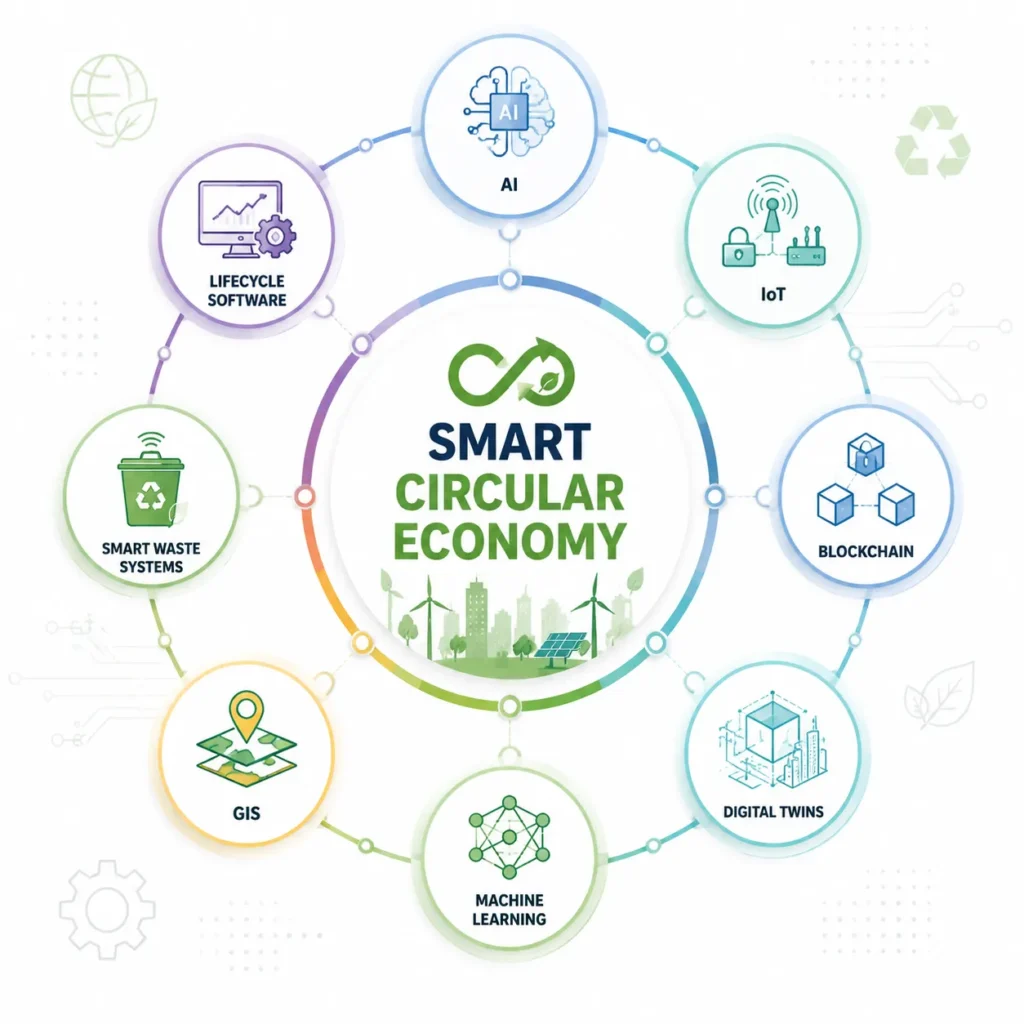
Technologies Used by Circular Economy Consultants
Circular Economy Consultants use modern technologies to analyze resources, improve efficiency, and develop smarter sustainability solutions.
Artificial Intelligence (AI)
AI helps analyze large amounts of sustainability data, identify waste reduction opportunities, and improve decision-making.
Internet of Things (IoT)
IoT devices monitor resources, waste levels, energy use, and material flows in real time.
Blockchain
Blockchain improves transparency by tracking materials, supply chains, and product information securely.
Digital Twins
Digital twins create virtual models of products, buildings, or systems to test improvements and optimize resource use.
Geographic Information Systems (GIS)
GIS helps analyze locations, map resource flows, and support environmental planning.
Machine Learning
Machine learning identifies patterns in data and helps predict resource needs, waste generation, and sustainability improvements.
Smart Waste Systems
Smart waste technologies use sensors and digital platforms to improve waste collection, recycling, and resource recovery.
Life Cycle Software
Life cycle software helps consultants assess the environmental impact of products and processes from production to disposal.
Circular Economy Frameworks and Standards
Circular Economy Consultants use different frameworks, standards, and assessment methods to help organizations design sustainable systems, improve resource use, and measure circularity performance.
Ellen MacArthur Foundation (EMF)
The Ellen MacArthur Foundation provides one of the most widely recognized circular economy frameworks. It promotes the idea of eliminating waste, keeping products and materials in use, and regenerating natural systems.
Key principles include:
- Designing out waste and pollution
- Keeping products and materials in circulation
- Supporting renewable and regenerative solutions
ISO 59004 – Circular Economy Principles and Framework
ISO 59004 provides guidance on circular economy concepts, principles, and implementation. It helps organizations understand how to create circular strategies and improve sustainability performance.
It focuses on:
- Circular economy principles
- Value creation
- Resource optimization
- Sustainable transformation
ISO 59010 – Circular Economy Business Models and Value Networks
ISO 59010 helps organizations develop circular business models and transform their value chains.
It supports businesses in:
- Creating circular strategies
- Redesigning business models
- Improving supply chain circularity
- Increasing resource value
ISO 59020 – Measuring Circularity Performance
ISO 59020 provides guidance on measuring and evaluating circular economy performance.
It helps organizations:
- Select circularity indicators
- Measure progress
- Track resource efficiency
- Improve circular performance
United Nations Sustainable Development Goals (UN SDGs)
The UN Sustainable Development Goals (SDGs) support global sustainability efforts and provide a framework for organizations working toward environmental and social improvement.
Circular economy practices contribute to goals such as:
- SDG 12: Responsible Consumption and Production
- SDG 13: Climate Action
- SDG 9: Industry, Innovation and Infrastructure
- SDG 11: Sustainable Cities and Communities
EU Circular Economy Action Plan
The EU Circular Economy Action Plan provides strategies to reduce waste, promote sustainable products, and improve resource efficiency.
It focuses on:
- Sustainable product design
- Waste prevention
- Recycling improvement
- Sustainable consumption
- Circular industries
Waste Hierarchy
The Waste Hierarchy is a framework that prioritizes methods for managing waste from the most sustainable option to the least preferred.
The order includes:
- Prevention – Avoid creating waste
- Reuse – Use products again
- Recycling – Convert waste into new materials
- Recovery – Recover energy or resources
- Disposal – Last option when other methods are not possible
Material Flow Analysis (MFA)
Material Flow Analysis helps organizations understand how materials move through a system.
It is used to:
- Track resource inputs and outputs
- Identify material losses
- Improve resource efficiency
- Find opportunities for reuse and recovery
Life Cycle Assessment (LCA)
Life Cycle Assessment evaluates the environmental impact of a product or service throughout its entire lifecycle.
It examines:
- Raw material extraction
- Manufacturing
- Transportation
- Product use
- End-of-life management
LCA helps Circular Economy Consultants make informed decisions about sustainable materials, product design, and resource management.
Challenges Faced by Circular Economy Consultants
Circular Economy Consultants may face several challenges when helping organizations adopt sustainable practices.
Stakeholder Resistance
Some businesses and employees may be slow to accept changes in existing processes and business models.
Data Quality
Limited or inaccurate data can make it difficult to measure resource use, waste, and sustainability performance.
Supply Chain Challenges
Changing suppliers and creating circular supply chains can be complex and time-consuming.
Legislation
Different environmental laws and regulations across countries can affect circular economy implementation.
Budget Limitations
Some organizations may find it difficult to invest in new technologies and sustainable solutions.
Technology Barriers
Lack of suitable digital tools or technical knowledge can slow down circular transformation.
Measurement Challenges
Organizations may struggle to measure circularity, resource savings, and environmental improvements.
Future Trends in Circular Economy Consulting
Circular Economy Consulting is expected to grow as organizations focus more on sustainability, technology, and climate goals. Key future trends include:
Artificial Intelligence (AI)
AI will help organizations analyze sustainability data, optimize resources, and make smarter circular economy decisions.
Digital Product Passports
Digital records will provide information about product materials, lifecycle, repair, and recycling options.
Carbon Markets
Businesses will use carbon trading systems to manage emissions and support climate action.
Circular Procurement
Organizations will increasingly choose sustainable, reusable, and recyclable products when purchasing goods and services.
Green Finance
More investments will support sustainable businesses, circular projects, and environmentally responsible solutions.
Net Zero
Circular economy strategies will help organizations reduce emissions and achieve net-zero targets.
Extended Producer Responsibility (EPR)
Manufacturers will take greater responsibility for managing products after use, including recycling and recovery.
ESG Integration
Circular economy practices will become an important part of ESG strategies, sustainability reporting, and business decision-making.
Circular Economy Consultant vs Sustainability Consultant
| Circular Economy Consultant | Sustainability Consultant |
|---|---|
| Focuses on reducing waste and keeping resources in use | Focuses on overall environmental, social, and business sustainability |
| Develops circular business models | Develops broader sustainability strategies |
| Works on reuse, recycling, and resource efficiency | Works on ESG, climate, and sustainability goals |
| Focuses on product lifecycle and materials | Covers wider sustainability areas |
Circular Economy Consultant vs Waste Management Consultant
| Circular Economy Consultant | Waste Management Consultant |
|---|---|
| Focuses on preventing waste and creating circular systems | Focuses on managing and treating waste |
| Works on reuse, repair, and recycling strategies | Works on collection, disposal, and recycling processes |
| Supports business transformation | Supports waste handling improvements |
| Looks at the full product lifecycle | Mainly focuses on waste streams |
Circular Economy Consultant vs ESG Consultant
| Circular Economy Consultant | ESG Consultant |
|---|---|
| Focuses on resource efficiency and circular business models | Focuses on environmental, social, and governance performance |
| Develops strategies for reuse and waste reduction | Supports ESG reporting and compliance |
| Works mainly on materials and product systems | Works across wider business sustainability areas |
| Helps create circular value chains | Helps organizations meet ESG expectations |
Circular Economy Consultant vs Environmental Consultant
| Circular Economy Consultant | Environmental Consultant |
|---|---|
| Focuses on circular systems and resource efficiency | Focuses on environmental protection and compliance |
| Helps redesign business models | Helps manage environmental risks |
| Works on reuse, recycling, and sustainable innovation | Works on pollution control, assessments, and regulations |
| Supports long-term sustainability transformation | Supports environmental management practices |
Conclusion
A Circular Economy Consultant helps organizations reduce waste, improve resource efficiency, and develop sustainable business solutions. As businesses and governments focus more on sustainability, net-zero goals, and responsible resource use, the demand for circular economy expertise continues to grow.
With the right skills, qualifications, and practical experience, professionals can build successful careers in this growing field while helping create a more sustainable and resource-efficient future.